


Why Do Students Forget What They Learn?
50 Essential FAQs on How Students Learn and Remember
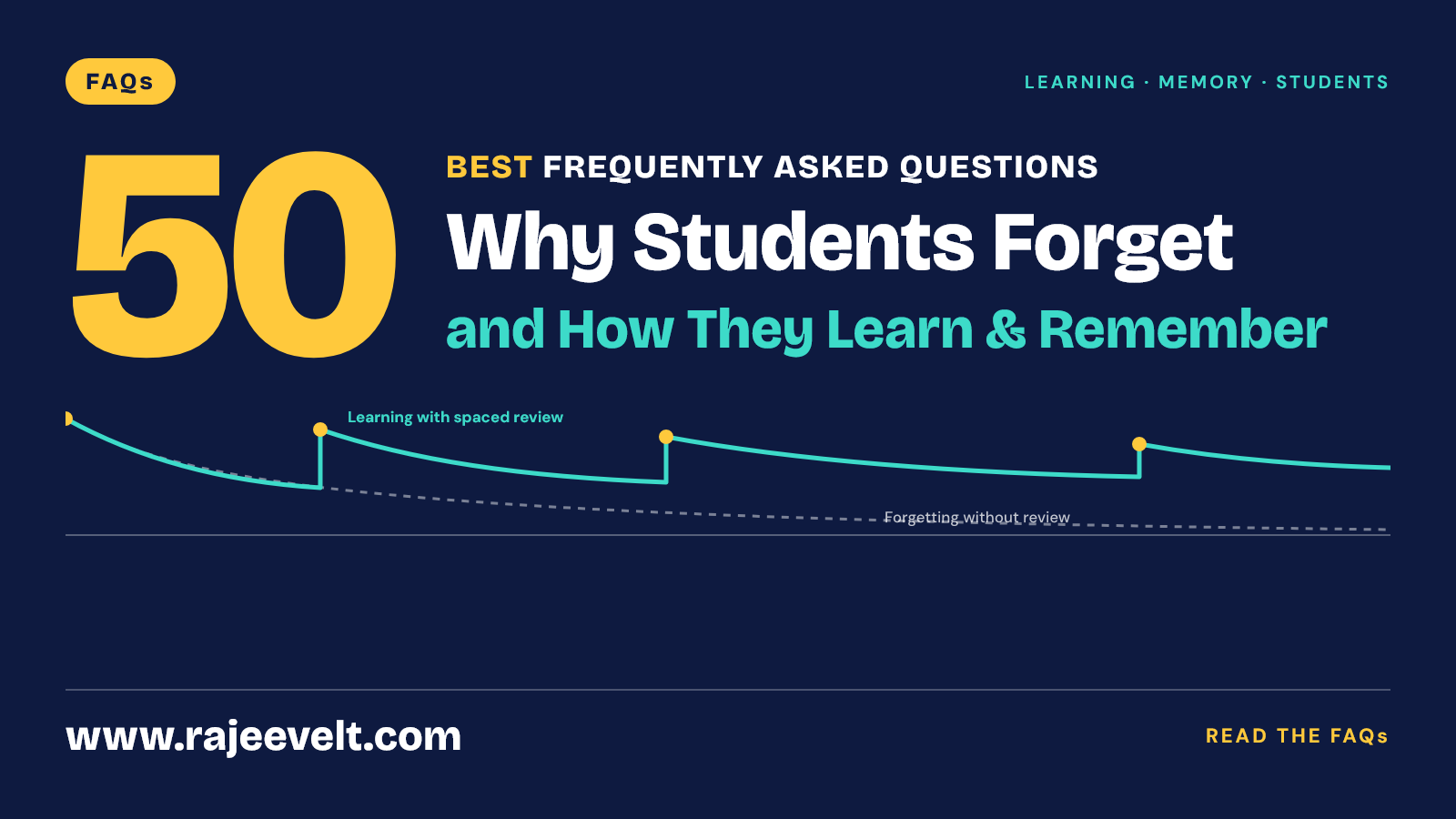
Why Do Students Forget What They Learn?
Students forget because new information fades quickly unless it is revisited, a pattern known as the forgetting curve. The idea dates back to the German psychologist Hermann Ebbinghaus, who studied memory in the 1880s and showed that loss is steepest in the first days after learning. Student forgetting is the gradual loss of newly learned information from memory when it is not attended to, reviewed or used. Is this normal? Yes. It happens to learners everywhere, from CBSE, ICSE and state-board classrooms in India to GCSE and A-level students in the United Kingdom, AP and SAT candidates in the United States, IB students in Singapore and the UAE, and WAEC candidates in Nigeria. Why does it happen? Memory is built in three steps: encoding (taking information in with attention), consolidation (stabilising it, mostly during sleep) and retrieval (pulling it back out). A weakness at any step causes forgetting. Distraction, late-night phone use, stress, long tuition days and passive habits such as re-reading and highlighting all weaken these steps, because they feel productive but build only a fragile memory. Is forgetting always bad? No. The brain clears unimportant details so that frequently used knowledge stands out; the problem is forgetting what matters.
How can parents and teachers help students remember more? Use active recall, meaning testing yourself from memory instead of re-reading, and spaced repetition, meaning reviewing at growing intervals such as 1 day, 3 days, 1 week and 1 month. Is cramming enough? No. Cramming may help for tomorrow’s unit test, but the knowledge usually disappears within days, which hurts in cumulative subjects such as maths and science and in exams like JEE, NEET, board exams, GCSEs and the SAT. Does sleep matter? Yes. The brain consolidates learning overnight, and children aged 6-12 generally need 9-12 hours while teenagers need 8-10. What about screens and stress? Phones nearby split attention, and anxiety can make students blank in exams, so keep devices out of the study space and practise under timed, exam-like conditions. Is it harder to retain lessons taught in English as a second language? Often, because it adds load to working memory, so previewing vocabulary and discussing ideas first in the home language, such as Hindi, Gujarati, Tamil or Arabic, helps. Do the same methods work in every country and grade? Yes, because they rely on how human memory works, not on a syllabus. From Kindergarten to Grade 12, short focused sessions, daily movement, balanced meals, a calm routine and praise for effort make learning last. Parents in Mumbai, Manchester, Melbourne or Mississauga can start tonight with one small habit: ask your child to explain today’s lesson from memory in two minutes. Forgetting is natural, but with the right habits every student, in every country, can remember more.
How to Use This Guide
Students forget because memory is built through attention, effort and repetition, not recorded automatically, so anything learned once and never revisited fades within days. This guide answers 50 questions that parents, teachers and students ask most often about forgetting and learning, in plain language and with a focus on practical action for Grades K-12 in any country.
The questions are grouped into six parts. Read in order for the full picture, or jump to the part that matches your situation.
- Part 1 (Q1-8): The science of forgetting
- Part 2 (Q9-18): How students learn
- Part 3 (Q19-28): Proven strategies that make learning stick
- Part 4 (Q29-36): Body, brain and environment
- Part 5 (Q37-44): Age-by-age guidance and special situations
- Part 6 (Q45-50): The roles of parents, teachers and schools
The five ideas behind every answer:
- Forgetting is normal and even useful; the goal is to slow it, not to eliminate it.
- Memory strengthens when the brain works to retrieve information, not when it simply re-reads it.
- Spacing reviews over days and weeks beats cramming the night before.
- Sleep, movement, nutrition and low stress are part of learning, not extras.
- Parents and teachers help most by coaching strategies and routines, not by supplying answers.
This guide offers general educational information based on widely accepted learning-science research. It is not medical or psychological advice. If you have concerns about your child’s development, consult a teacher, pediatrician or qualified specialist. The answers come from general learning-science knowledge, not live sources, so check any figures (such as sleep hours and session lengths).

Frequently Asked Questions -FAQs
Part 1: The Science of Forgetting (Q1-8)
Q1. Why do students forget what they learn?
Students forget mainly because new information that is not used or revisited is gradually pruned by the brain as unimportant. Memory has to be encoded (taken in with attention), consolidated (stabilised, largely during sleep) and retrieved (pulled back out). A weakness at any stage leads to forgetting. Passive learning such as listening or re-reading, distraction, tiredness, stress and long gaps without review all weaken these stages. Forgetting is therefore rarely a sign of low intelligence; it is usually a sign that the learning conditions did not support lasting memory.
Q2. What is the forgetting curve?
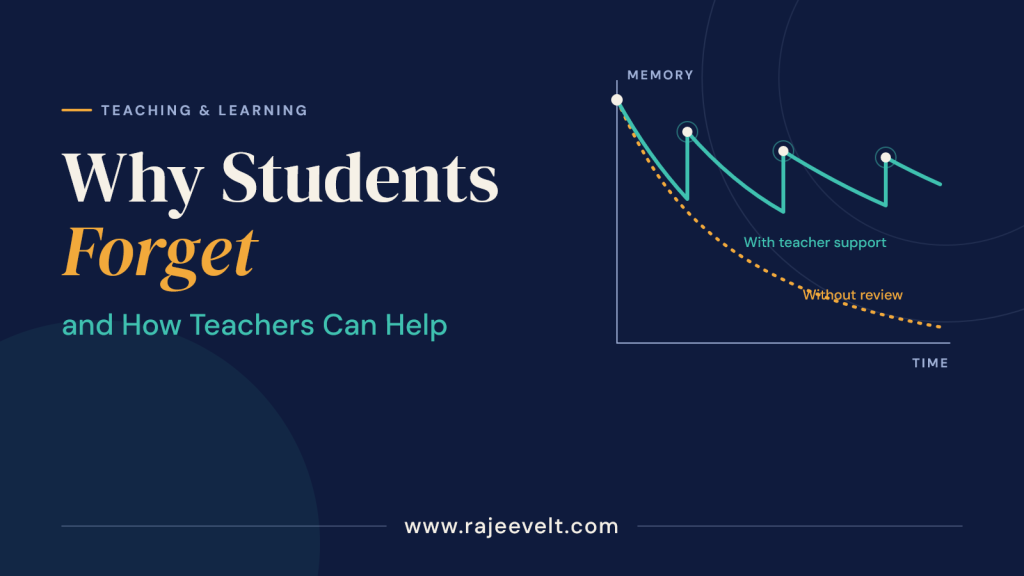
The forgetting curve, first described by psychologist Hermann Ebbinghaus in the 1880s, shows how quickly memory for new material declines over time without review. The loss is steepest in the first hours and days, then levels off. The exact percentages vary with the material, how meaningful it is and how well it was learned, so treat any single figure with caution. The practical lesson is consistent: each timely review flattens the curve, so the memory lasts longer before it needs refreshing.
Q3. Is forgetting normal, or is it a sign of a problem?
Forgetting is normal for every learner, including adults. It becomes worth a conversation with a teacher or professional only when it is severe or sudden, keeps getting worse, appears alongside difficulties with attention, reading, language or daily routines, or follows a head injury or major life disruption. Occasional lost homework, blanked-out facts after a holiday or forgotten vocabulary are ordinary. Noting when and where the forgetting happens (for example, only with certain subjects or only when tired) helps professionals judge whether more support is needed.
Q4. What are the stages of memory?
Memory is commonly described in three stages. Sensory memory holds impressions for a second or two. Working (short-term) memory holds a small amount of information, often around four to seven items, for seconds to minutes while we think with it. Long-term memory stores knowledge and skills for days to a lifetime. Learning means moving information from working memory into long-term memory through attention, meaning, repetition and sleep. Most classroom forgetting happens at this transfer point.
Q5. What is the difference between short-term memory and long-term memory?
Short-term (working) memory is the mental workspace used for tasks such as following instructions or solving a sum; it is small, easily disrupted and temporary. Long-term memory is the vast store of facts, concepts, procedures and experiences that can be recalled later. A student can understand something in the moment (short-term) yet not remember it next week (long-term) because it was never consolidated. Study methods should aim at long-term storage, not just momentary understanding.
Q6. Why can a student understand a lesson in class but forget it by the evening?
Feeling that something makes sense is not the same as having stored it. During a lesson the teacher’s explanation does much of the thinking, so understanding feels easy. Without the student later retrieving and using the idea, the memory trace stays weak. Later activities, new lessons and distractions also compete for attention. A short review the same day, such as explaining the idea aloud from memory in two minutes, greatly improves what remains by evening and by next week.
Q7. What is the difference between forgetting and never learning something in the first place?
Forgetting means information was stored and can no longer be retrieved easily; never learning means it was not properly encoded at all. A common cause of the second is divided attention, such as a phone buzzing or a mind elsewhere during the lesson. A simple test: if a cue, a hint or a multiple-choice option brings the memory back quickly, it was stored but hard to retrieve. If nothing helps, the content likely needs to be re-taught, not just reviewed.
Q8. Is forgetting ever useful?
Yes. Forgetting helps the brain clear out irrelevant details so that important and frequently used knowledge stands out. It also makes room for updating outdated information and for noticing patterns rather than isolated facts. The difficulty arises when students forget what matters because it was not signalled as important by repetition, use and meaning. Effective learning makes the right things hard to forget and lets trivial details fade.
Part 2: How Students Learn (Q9-18)
Q9. How does the brain actually learn something new?
Learning physically changes the brain: when we attend to and repeatedly use information, connections between neurons (synapses) strengthen, forming networks that represent the idea. The brain links new information to what is already known, so learning is a process of building and reorganising, not copying. Connections that are used often become faster and more durable, while unused ones weaken. This is why repetition, meaning and connection to prior knowledge matter so much.
Q10. What role does attention play in learning and forgetting?
Attention is the gateway to memory: information that is not attended to is rarely encoded, so it cannot be remembered later. Students who study with a phone nearby, a television on or a wandering mind may feel they have studied yet retain little. Short, focused sessions with distractions removed are far more effective than long, interrupted ones. Interest, curiosity and a clear purpose for learning all help attention stay on the material.
Q11. What is working memory, and why does it limit learning?
Working memory is the small mental workspace where we hold and manipulate information for a short time. It has a limited capacity, so presenting too much at once overloads it and learning suffers. This is called cognitive overload. Teachers and parents can help by breaking tasks into steps, using clear examples, removing unnecessary detail and letting students master basics before adding complexity. Writing things down frees working memory for thinking.
Q12. How does prior knowledge affect what students remember?
Students remember new material best when it connects to something they already understand. Prior knowledge acts like hooks on which new facts can hang. A child who knows about plants will absorb photosynthesis more easily than one who does not, and a reader familiar with a topic remembers more of a passage about it. Before introducing a new topic, activate what the student already knows by asking questions or recalling a related experience.
Q13. Are there different learning styles, such as visual, auditory and kinesthetic?
People do have preferences, but research has not found that teaching to a preferred “style” improves learning. What matters is matching the method to the content: maps and diagrams for spatial ideas, spoken practice for language, hands-on work for experiments. Using several senses together, such as seeing, saying and doing, usually helps everyone. Labelling a child as only a “visual learner” can limit the strategies they try.
Q14. What is the difference between active and passive learning?
Passive learning means taking information in without much effort: listening, reading, re-reading, highlighting or watching videos. Active learning means doing something with the information: answering questions, solving problems, explaining ideas, drawing diagrams, discussing or teaching. Active methods feel harder but produce stronger, longer-lasting memory. A balanced routine uses passive input to meet material and active practice to lock it in.
Q15. What does “encoding” mean, and how can we improve it?
Encoding is the process of turning an experience or lesson into a memory. Deeper encoding happens when students think about meaning, such as why something is true, how it connects to other ideas or how it applies to their own life, rather than just repeating words. Useful techniques include asking “why” and “how” questions, creating examples, making diagrams, and linking facts into stories or categories. Shallow repetition without understanding encodes weakly.
Q16. Why is understanding different from memorising?
Understanding means grasping how and why ideas fit together; memorising means storing facts as they are. Facts that are understood are easier to remember, apply and rebuild if partly forgotten. Pure rote memorisation can work for items like times tables, spellings or vocabulary but breaks down on complex topics. Strong learners combine both: they understand the concepts and also practise recall of key facts until they are automatic.
Q17. How do emotions affect learning and memory?
Emotions influence attention and memory strongly. Mild positive emotions such as curiosity, interest and enjoyment improve engagement and recall. Moderate challenge feels motivating, while intense anxiety, fear of embarrassment or boredom pull attention away and can block retrieval. A safe classroom or home environment in which mistakes are treated as part of learning helps students focus on the material rather than on worry.
Q18. How do children’s learning needs change as they grow?
Younger children learn best through play, movement, stories, songs and concrete objects, with short activities and plenty of repetition. Older children can handle abstract ideas, longer tasks and more independent study but still need strategies and routines. Teenagers have more developed planning and self-control but are also dealing with changing sleep patterns, social pressure and heavier workloads. Strategies should be adjusted to each stage rather than applying one approach to every age.
Part 3: Proven Strategies That Make Learning Stick (Q19-28)
Q19. What is active recall, and how do students use it?
Active recall means pulling information out of memory without looking at the source, for example by closing the book and writing down everything remembered, answering practice questions or using flashcards. The effort of retrieval strengthens the memory far more than re-reading does. A simple routine: read a section, close the book, write or say the main points, then check what was missed and try again. Even a few minutes of this after each lesson makes a visible difference.
Q20. What is spaced repetition, and why does it work?
Spaced repetition means reviewing material at increasing intervals instead of all at once. Because a little forgetting has occurred by the time of each review, the effort to recall strengthens the memory and extends how long it lasts. A typical pattern is to review after one day, then three days, one week, two weeks and a month. Flashcard apps can automate the schedule, but a simple calendar or notebook works too.
Q21. Is cramming ever effective?
Cramming can help a student pass a test tomorrow, but the knowledge usually disappears within days, which is a problem for cumulative subjects such as maths, languages and sciences. It also increases stress and reduces sleep, both of which harm performance. If time is short, the best compromise is to use active recall on the highest-priority topics, sleep properly and avoid an all-night session. For lasting results, spread study across several days or weeks.
Q22. What is interleaving, and when should it be used?
Interleaving means mixing different topics or problem types within one study session rather than finishing one topic completely before starting another. It feels harder and slower but improves the ability to choose the right method for each problem, which is exactly what exams require. It works especially well in maths and science. Start with blocked practice when first learning a new skill, then move to mixed practice as confidence grows.
Q23. How can students use elaboration and self-explanation?
Elaboration means explaining ideas in your own words and connecting them to other knowledge, asking how and why something works. Students can ask themselves questions such as “Why is this true?”, “How does this connect to what I learned last week?” and “Can I give an example?” Explaining a step aloud while solving a problem reveals gaps that silent reading hides. This deeper processing creates richer memories that are easier to retrieve.
Q24. Does teaching someone else really help students remember?
Yes. Preparing to teach and then explaining a topic forces a student to organise ideas, fill gaps and retrieve information without prompts. Students can teach a parent, a sibling, a friend or even a toy or an imaginary class. If they cannot explain a point simply, that is a useful signal to revisit it. Parents can play the curious learner by asking questions such as “Can you show me how that works?”
Q25. What is the best way to take and use notes?
Notes work best when students write key ideas in their own words rather than copying everything, and then use them for review. Methods such as Cornell notes (a margin of cues and questions beside the main notes), outlines and concept maps support organisation. The most valuable step comes afterwards: cover the notes and quiz yourself from the cue questions. Highlighting and re-reading alone give a false sense of mastery and have limited benefit.
Q26. Are mnemonics, mind maps and memory palaces worth using?
Yes, for the right content. Mnemonics (acronyms, rhymes and stories) help with lists, sequences and vocabulary. Mind maps show how ideas relate and suit topics with many connected parts. The memory palace (placing items along a familiar mental route) can store ordered lists well. These tools help with initial memorisation but do not replace understanding or later retrieval practice, so use them alongside active recall and spacing.
Q27. How long should a study session be, and how many breaks are needed?
Short focused sessions work better than long marathons. As a rough guide, about 10-15 minutes for young children, 20-30 minutes for middle-years students and 30-50 minutes for older students, followed by a break of 5-10 minutes. Breaks should involve movement, water or fresh air rather than a phone. Methods such as the Pomodoro technique (25 minutes of work and 5 minutes of rest) are popular, and each student can adjust the timings to suit their own attention span.
Q28. How can students monitor whether they really know something?
The feeling of familiarity is a poor guide: recognising a page does not mean being able to recall its contents. Better checks include closing the book and writing out the answer, taking practice tests under exam conditions, and asking someone else to quiz them. Students should note what they got wrong and plan extra review there. This habit of checking understanding is called metacognition, and it is one of the strongest predictors of academic success.
Part 4: Body, Brain and Environment (Q29-36)
Q29. How does sleep affect memory and learning?
Sleep is when the brain consolidates the day’s learning, replaying and stabilising new memories and clearing out unneeded information. Too little sleep reduces attention, mood and recall the next day. Common guidance is roughly 9-12 hours for ages 6-12 and 8-10 hours for teenagers, though individual needs vary. Teenagers’ body clocks naturally shift later, so consistent bedtimes, a dark quiet room and no screens before bed help. Trading sleep for extra study time usually backfires.
Q30. Does nutrition affect how well students remember?
The brain uses a large share of the body’s energy, so regular balanced meals support concentration and memory. Skipping breakfast or going long hours without food can reduce attention in some children. A pattern of whole grains, fruit and vegetables, protein, healthy fats and enough water is a sound foundation. There is no single “brain food” that guarantees better memory, and supplements are not a substitute for a good diet. If you suspect a deficiency, such as low iron, consult a doctor.
Q31. How does physical activity help learning?
Regular exercise increases blood flow to the brain, improves mood and attention, and supports the growth of connections involved in learning. Even short bursts of movement before or during study breaks can sharpen focus. Children generally benefit from about an hour of moderate to vigorous activity a day, which can include play, sport, walking or cycling. Sitting for hours without a break works against concentration, so build movement into homework routines.
Q32. How does stress affect memory?
Short bursts of mild stress can sharpen focus, but prolonged or intense stress interferes with both learning and recall. Anxious students may “blank” in exams even when they know the material, because worry occupies working memory. Helpful responses include a predictable routine, adequate sleep, practice under exam-like conditions, slow breathing and a home climate that values effort over perfection. Persistent anxiety that disrupts daily life deserves attention from a school counsellor or health professional.
Q33. Do screens and social media make students forget more?
Screens are not harmful in themselves, but heavy or poorly timed use can reduce sleep, attention and study time. Constant notifications split attention, and information that receives only fragments of attention is poorly stored. Practical steps include keeping phones out of the study area, using app blockers, agreeing on screen-free hours before bed and choosing educational content with active tasks rather than passive scrolling. Parents modelling the same habits makes the rules more credible.
Q34. Can students really multitask while studying?
Mostly no. What feels like multitasking is rapid switching between tasks, and each switch costs time and attention, leading to slower work, more mistakes and weaker memory. Studying with messages, music with lyrics or video in the background typically reduces comprehension, especially for reading and writing tasks. Single-tasking in focused blocks, with a short break afterwards for messages, is more efficient. Some students concentrate better with quiet instrumental or ambient sound, so experiment and check results.
Q35. What does an ideal study environment look like?
A good study space is quiet, well lit, comfortable and reasonably free of clutter, with the needed materials within reach and distractions out of sight. It should be the same place and time most days so that the setting itself becomes a cue to focus. It does not need to be a separate room: a clear corner of a table works. Studying in varied places occasionally can also help memory become less dependent on one setting, but the main routine should stay stable.
Q36. How do hydration, light and temperature affect concentration?
Even mild dehydration can reduce attention and mood, so keeping water nearby is a simple help. Natural daylight supports alertness and sleep timing, while dim or flickering light causes fatigue. A room that is too warm tends to cause drowsiness, and one that is too cold distracts. These effects are small individually, but together they influence how long a student can stay focused comfortably.

Part 5: Age-by-Age Guidance and Special Situations (Q37-44)
Q37. How can parents help young children in Kindergarten to Grade 2 remember what they learn?
Young children learn best through play, songs, stories, movement and hands-on objects. Keep review short (about 10 minutes), joyful and daily. Ask open questions such as “What was the best part of your day?” or “Teach me the new song.” Read together every day, use rhymes and games for letters and numbers, and keep routines for meals and bedtime consistent. Praise effort and curiosity rather than speed.
Q38. What works for children in Grades 3-5?
Children at this stage can begin simple strategies. Introduce flashcards, short quizzes, drawing diagrams and “teach it back” conversations. Help them use a planner or checklist for homework and a regular homework time and place. Keep sessions at about 20-30 minutes with breaks. Link topics to real life, such as measuring while cooking or budgeting pocket money. Begin building the habit of checking their own work.
Q39. What works for middle school students in Grades 6-8?
Workloads grow and subjects multiply, so organisation becomes the main challenge. Teach them to plan the week, break projects into steps and review notes a little each day. Introduce active recall, spaced review and mixed practice. This is also a time of social change and shifting sleep, so protect sleep and limit late-night screens. Parents shift from supervising to coaching: check in, ask questions and let students own the work.
Q40. What works for high school students in Grades 9-12?
Older students face heavy content and high-stakes exams. They benefit most from spaced study schedules made weeks ahead, regular past-paper practice under timed conditions, error logs that record and analyse mistakes, and study groups in which each person explains topics. Time management, sleep and stress management matter as much as study hours. Parents can help by supporting planning, offering a calm home environment and encouraging breaks, while leaving the learning to the student.
Q41. Why do students forget so much over school holidays, and how can this be reduced?
Long breaks mean long gaps without retrieval, so knowledge fades, an effect often called summer slide or holiday learning loss, especially in maths and reading. To reduce it, keep light daily habits: reading for pleasure, short maths games or puzzles, journaling and real-world projects. A brief review of key topics in the last week before school restarts brings knowledge back quickly. Teachers can help by opening the new term with retrieval quizzes on earlier material.
Q42. How does ADHD affect learning and memory, and what can help?
ADHD mainly affects attention, working memory and self-regulation, so students may miss information at the encoding stage rather than lose it later. Helpful supports include short tasks with clear steps, visual schedules and checklists, movement breaks, a distraction-free workspace, immediate feedback and consistent routines. Diagnosis and treatment decisions belong with qualified professionals. If you suspect ADHD, speak to your child’s teacher and doctor, and ask the school about available learning support.
Q43. How can I help a child with dyslexia or other learning differences?
Dyslexia affects reading and spelling accuracy and fluency, not intelligence. Early assessment and structured, multisensory literacy teaching make a significant difference. At home, support with audiobooks, text-to-speech tools, extra time, and praise for effort and strengths. Ask the school about formal support plans or accommodations available in your country, such as extra exam time. Short, frequent practice is usually better than long sessions, and confidence needs protecting as much as skills.
Q44. How can students who learn in a second or additional language remember better?
Learning content in a non-native language places extra load on working memory, so understanding may take longer and forgetting may occur sooner. Helpful steps include previewing key vocabulary before lessons, using visuals and examples, allowing students to discuss and summarise in their home language first, and reviewing vocabulary with spaced flashcards. Strong skills in the home language support learning the new one, so families should keep using and valuing their first language.
Part 6: Parents, Teachers and Schools (Q45-50)
Q45. What is the best role for parents: helper, tutor or coach?
Coach is usually the best role. Parents help by creating routines, a calm study space and enough sleep, by asking questions that prompt recall, and by praising effort and strategy. Doing the work for the child, or hovering over every task, undermines independence and memory. Let children struggle a little before offering hints, because effortful retrieval strengthens learning. Stay in touch with teachers so that problems are noticed early.
Q46. How can parents keep children motivated to learn?
Motivation grows from autonomy (some choice in how and when to study), competence (feeling progress) and connection (feeling supported). Set small, achievable goals, celebrate progress, link topics to the child’s interests and let them see the purpose of what they learn. Avoid relying only on rewards or threats, which can reduce interest over time. Help children recover from setbacks by talking about what to try differently next time.
Q47. What is a growth mindset, and does it help memory?
A growth mindset is the belief that abilities develop through effort, good strategies and feedback. Students who hold it tend to persist after mistakes and to use effective study methods. Parents can encourage it by praising process (“You kept trying different methods”) rather than labels (“You’re so smart”), and by saying “not yet” instead of “can’t.” Mindset alone does not replace good strategies, but it makes students more willing to use them.
Q48. When should parents seek extra help for a forgetful child?
Seek advice if forgetfulness is severe, appears suddenly or is getting worse, or if your child has persistent trouble with attention, reading, writing, maths, speech, sleep or mood. Also act if academic results fall without explanation, if your child avoids school or shows strong anxiety, or after a head injury. Start with the class teacher or school counsellor, and then consider a paediatrician, psychologist or learning specialist. Early support usually leads to better outcomes.
Q49. How can teachers and schools reduce forgetting in the classroom?
Teachers can build in retrieval practice, such as low-stakes quizzes and “do now” questions that revisit earlier lessons, and space topics so they return over the term. Other helpful practices include clear explanations with worked examples, chunking content, mixing practice problems, giving timely feedback and teaching study strategies explicitly. Schools can support sleep-friendly start times where possible, manage homework load sensibly and keep phones from disrupting lessons.
Q50. What are the most important habits for building a lifelong learner?
The habits that matter most are simple and repeatable:
- Focus on one task at a time, without distractions.
- Test yourself from memory rather than only re-reading.
- Review in spaced sessions across days and weeks.
- Explain ideas in your own words and teach others.
- Protect sleep, movement, meals and downtime.
- Treat mistakes as information and keep trying with better strategies.
Learners who build these habits remember more, feel less stress and carry the skills well beyond school.
Quick-Reference Checklist
Use this checklist weekly to turn the guide into habits.
- Study sessions are short, focused and free of phones and notifications
- After each lesson, my child explains it from memory for two minutes
- Reviews are scheduled at 1 day, 3 days, 1 week, 2 weeks and 1 month
- Self-testing (flashcards, practice questions) replaces most re-reading
- Different topics are mixed within practice sessions as skills grow
- Sleep meets the recommended range for my child’s age
- Meals, water and daily physical activity are regular
- Screens are out of the study space and off before bedtime
- Effort and strategy are praised more than scores or labels
- I stay in touch with teachers and act early if concerns persist
Rajeev Ranjan
School Education
“Let knowledge grow from more to more.”
Alfred Tennyson, “In Memoriam”, Prologue, line 25
The sources below are well-known works on learning science, listed from general knowledge without live links. Please verify details and editions before citing them in published material.
- Hermann Ebbinghaus, Memory: A Contribution to Experimental Psychology (1885), the original forgetting-curve research
- Dunlosky, Rawson, Marsh, Nathan and Willingham, “Improving Students’ Learning with Effective Learning Techniques,” Psychological Science in the Public Interest (2013)
- Brown, Roediger and McDaniel, Make It Stick: The Science of Successful Learning (2014)
- Pashler, McDaniel, Rohrer and Bjork, “Learning Styles: Concepts and Evidence,” Psychological Science in the Public Interest (2008)
- The Learning Scientists (learningscientists.org), free guides to retrieval practice, spacing, interleaving and more
Reading References: