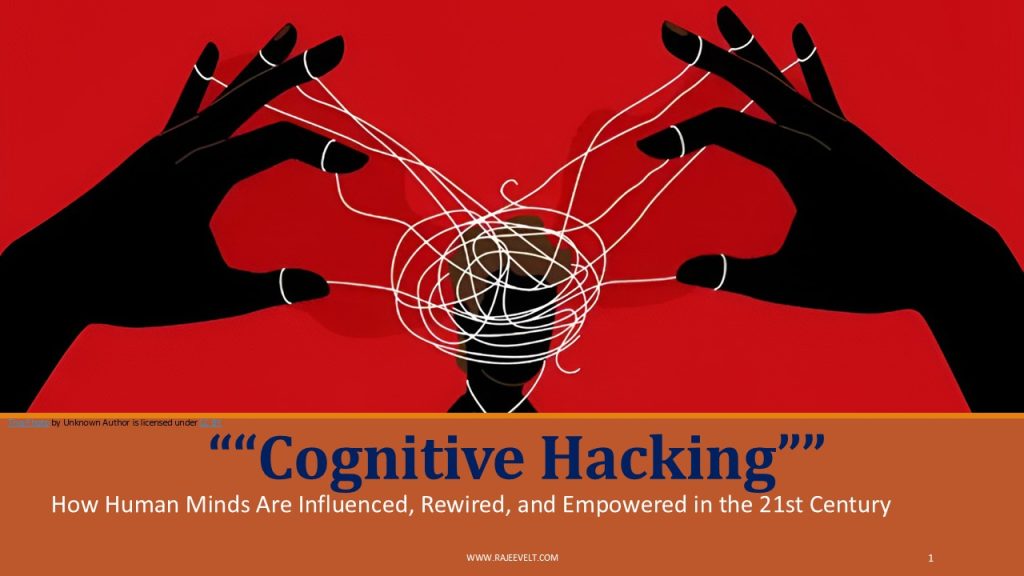
“Cognitive Hacking” How Human Minds Are Influenced, Rewired, and Empowered in the 21st Century
What Is Cognitive Hacking?
Cognitive hacking refers to the deliberate or systematic influence of human perception, thinking, emotions, beliefs, and decision-making by exploiting cognitive biases, psychological vulnerabilities, neural mechanisms, and social conditioning.
Cognitive hacking is the practice of influencing how people interpret reality, often without their explicit awareness.
Cognitive hacking differs from persuasion and brainwashing in both method and intensity. Persuasion is typically transparent—you know someone is trying to convince you i.e. when a leader presents data to justify a new strategy and openly argues why it will benefit the organization; the intent is clear. Brainwashing, on the other hand, relies on coercion, isolation, repetition, and long-term psychological pressure. It removes alternative viewpoints and restricts autonomy. Cognitive hacking sits between these extremes. It does not rely on force or explicit argument; instead, it subtly shapes perception through framing, language patterns, emotional cues, and identity signals embedded in everyday communication.
One simple example is the strategic use of personal pronouns. When a leader says, “You must improve performance,” the message feels evaluative and possibly accusatory. But when the same message becomes, “We are building a culture of excellence,” it activates collective identity. The shift from “you” to “we” changes the psychological experience. “We” reduces defensiveness and increases belonging. Similarly, in digital platforms, phrases like “People like you prefer this option” subtly guide decisions by linking choice to identity. No force is used, yet cognition is nudged through social belonging and self-concept.
Cognitive hacking also appears in relationships and marketing. Saying, “I trust your judgment on this,” primes someone to act consistently with the identity of being trustworthy. The language plants a cognitive frame before the decision is even made. Unlike brainwashing, the individual retains freedom. Unlike overt persuasion, the influence is not always consciously recognized. It operates quietly—through pronouns, framing, narrative tone, and emotional anchoring—shaping how reality is interpreted rather than directly commanding what to think.
Cognitive hacking can be ethical or unethical, intentional or unconscious, and individual or mass-scale. A teacher motivating a class, a leader framing a vision, a partner reframing conflict, and a digital platform optimizing engagement may all be engaging in forms of cognitive hacking. Its moral value depends not on the method itself, but on intent, transparency, and respect for human autonomy.
