



What is Gratitude? The Timeless Art of Thankfulness and 12 Reasons It Transforms Our Health, Happiness, and Relationships
Introduction: The Oldest Wisdom We Keep Forgetting
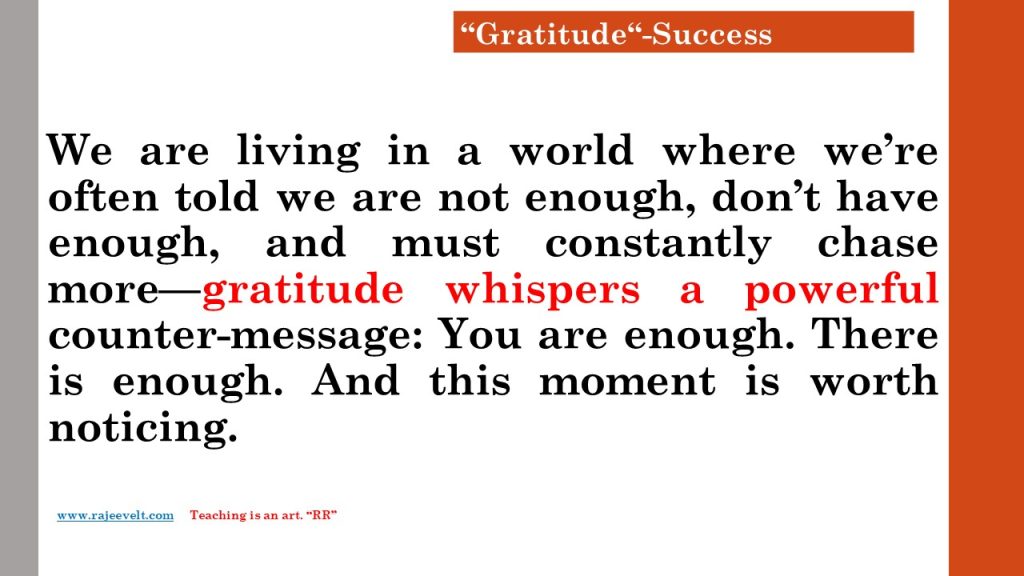
Every morning, before most of us have said a word, a great deal has already been done for us. The sun has risen without being asked. Someone built the road we travel, someone taught us to read, and someone, at some point, stayed awake at night so that we could grow up safe. We rarely stop to notice any of this. We are busy, we are worried, and we are looking ahead to what is missing.
Gratitude is the practice of stopping and noticing. It is among the oldest human values, found in the Vedas, the Bible, the Quran, the Dhammapada, and the sayings of ancient Greek and Roman philosophers. Today, modern science is confirming what saints, poets, and grandmothers have always told us: a grateful life is a healthier, calmer, and richer life.
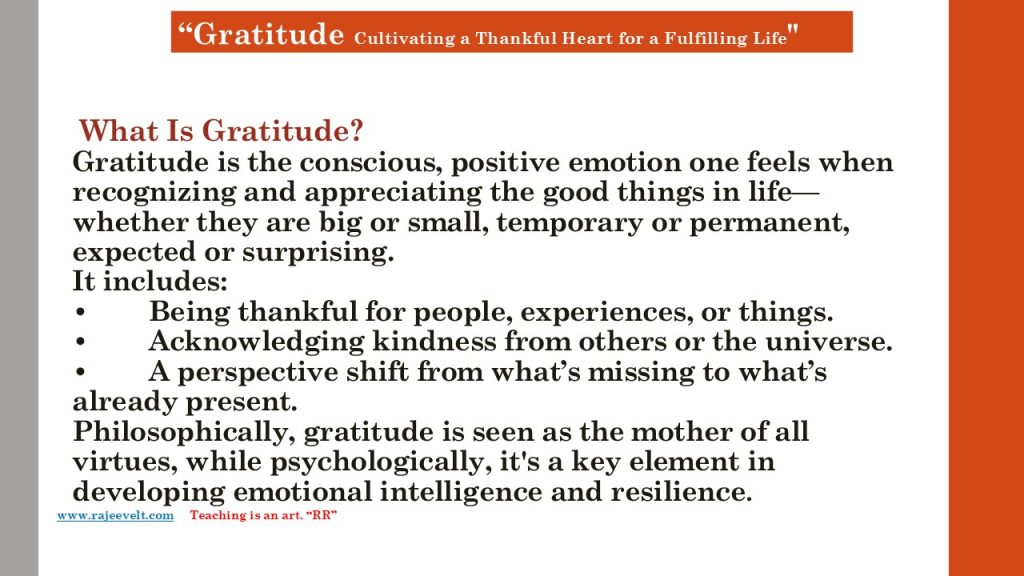
What is Gratitude?
Gratitude is the conscious recognition and appreciation of the good in our lives, and of the people, efforts, and circumstances that make that good possible, followed by a sincere response of thankfulness.
It has three parts:
- Noticing that something good has happened or been given to us.
- Acknowledging that it did not come entirely from our own effort. Others, nature, or fortune played a part.
- Responding with appreciation, through words, actions, or kindness passed on to others.
We live on autopilot without the first step. We become proud and self-absorbed without the second. Gratitude stays a private feeling and never becomes a force in the world without the third.
The Best Definitions of Gratitude Across Time
Robert A. Emmons, one of the world’s leading researchers on gratitude, describes it as a felt sense of wonder, thankfulness, and appreciation for life. He emphasizes two stages: first, we affirm that there is goodness in the world and in our lives. Second, we recognize that the sources of this goodness lie at least partly outside ourselves.
Cicero, the Roman statesman, is often quoted as saying that gratitude is not only the greatest of virtues but the parent of all the others.
Positive psychology treats gratitude as a “character strength,” a quality that helps us build strong relationships and a meaningful life.
Dictionary definitions describe it as the quality of being thankful and being ready to show appreciation and return kindness.
The Sanskrit tradition uses the word kritajnata. It comes from krita (what has been done) and jna (to know), so the grateful person is literally “one who knows what has been done for them.” The opposite, kritaghnata (ingratitude), is treated in Indian literature as among the gravest moral failings.
We say dhanyavad, aabhar, shukriya, or nandri in everyday Indian languages. Each carries the same gentle recognition: I see what you did, and it mattered to me.
State Gratitude and Trait Gratitude
Psychologists distinguish between two forms:
- State gratitude is a temporary feeling. A stranger returns our lost wallet, a friend surprises us with help, and a warm wave of thankfulness washes over us.
- Trait gratitude is a lasting disposition. Some people seem to notice the goodness in ordinary life: the cup of tea, the shade of a tree, the patience of a colleague.
The hopeful truth is that we can move from the first to the second. Gratitude is not reserved for naturally cheerful people. It is a skill, like swimming or playing a musical instrument. The more we practice, the more natural it becomes.
Why Gratitude Matters in Our Lives: 12 Powerful Reasons
1. Gratitude improves our mental well-being
Psychologists Robert Emmons and Michael McCullough asked one group of participants to write weekly about things they were grateful for, another to write about daily irritations, and a third to write about neutral events in a well-known study. The grateful group reported greater optimism and better overall well-being. Other research, including work by Martin Seligman, found that writing and delivering a “gratitude letter” could raise happiness for a period afterward.
Gratitude is also linked with lower levels of envy, resentment, and depressive thinking. It is not a cure for clinical depression or anxiety, and anyone struggling should seek professional help, but it is a meaningful support.
Think of a student who has failed an exam. One path leads to “I am useless.” Other leads to “I am grateful I have a teacher who will explain my mistakes, a family that believes in me, and another chance to try.” The facts have not changed, but the mind’s footing has.
2. Gratitude supports our physical health
People who regularly feel appreciative often report better sleep, fewer aches and complaints, and a greater willingness to exercise and care for themselves. Ending the day by thinking of good things, rather than replaying worries, can ease the mind toward rest. A calmer mind generally means a calmer body.
3. Gratitude strengthens our relationships
When we say a sincere “thank you,” we tell the other person: you are seen, you matter, and your effort was not wasted. This builds trust and warmth in friendships, marriages, families, and workplaces. We can consider a mother who cooks every day for decades. The meals appear so reliably that they become invisible. The day a child says, “Thank you, Maa. I know how much effort this takes,” the kitchen feels different. Nothing about the food has changed, but the relationship has deepened.
4. Gratitude builds emotional resilience
Gratitude does not deny suffering. It helps us hold suffering and goodness together. People who practice it tend to find meaning, support, and small mercies even in painful seasons, which helps them recover more quickly from setbacks.
5. Gratitude reduces comparison and envy
We live in an age of endless scrolling, where we constantly see edited versions of other people’s lives. We see that comparison is the thief of contentment. Gratitude is its antidote, because it turns our attention from “what they have” to “what I have been given.”
6. Gratitude makes us better workers and leaders
Workplaces where appreciation is expressed tend to have higher motivation, stronger teamwork, and lower turnover. A manager who notices effort and says “thank you” often earns more loyalty than one who only gives orders.
7. Gratitude makes us kinder and more generous
Grateful people are more likely to help others. When we recognize how much we have received, we feel moved to give. This creates a virtuous cycle: kindness received becomes kindness shared.
8. Gratitude anchors us in the present
We see that much of our suffering comes from regretting the past or fearing the future. Gratitude brings us back to this moment: the meal in front of us, the friend beside us, the breath in our lungs.
9. Gratitude trains our attention
What we practice noticing, we begin to notice more. A mind trained to scan for threats finds threats everywhere. A mind trained to scan for blessings finds blessings everywhere. Gratitude is attention training.
10. Gratitude guards us against arrogance
When we believe we did everything ourselves, pride grows. When we recognize the teachers, parents, farmers, and strangers behind our success, humility grows. Indian tradition has always stressed this point, as we will see below.
11. Gratitude connects us to something larger than ourselves
Gratitude opens a sense of belonging: to family, community, nature, humanity, or the divine. This sense of connection is among the deepest sources of meaning in human life.
12. Gratitude nurtures a culture of peace
A society that values thankfulness values contribution, cooperation, and respect. Nations and communities built on mutual appreciation are more stable and humane than those driven by entitlement and blame.
Gratitude in Indian Epics and Mythology
India’s storytelling tradition teaches gratitude not through lectures but through unforgettable characters. The stories below are drawn from widely known retellings of the Ramayana, Mahabharata, and Puranas. Details sometimes vary across regional versions, and we note where a story belongs to folk tradition rather than the classical text.
The Ramayana: Rama and the Many Kinds of Thanks
Rama and Hanuman. Rama is overwhelmed after Hanuman crosses the ocean, finds Sita in Lanka, and returns with news of her. He says that nothing he can offer, not even his own life, could repay what Hanuman has done, and he embraces him. Rama does not treat Hanuman’s service as a duty owed to a king. He treats it as a gift. Hanuman, for his part, shows gratitude in the opposite direction: he never claims credit for his feats and attributes everything to Rama’s name and grace. Here we see gratitude flowing both ways, from leader to servant and from servant to leader.
Rama and Jatayu. The vulture king Jatayu fights the mighty Ravana to save Sita and is mortally wounded. When Rama finds him dying, he treats him with the love and honour due to a father and performs his last rites with his own hands. A bird, not a king or a sage, receives the funeral of a revered elder. The lesson is that gratitude honours sacrifice, no matter who makes it.
Rama and Shabari. The elderly forest-dweller Shabari spends years waiting for Rama’s arrival and offers him berries she has tasted to make sure they are sweet. Rama accepts them with deep respect, caring nothing for social convention. He receives the gift for what it is: love expressed in the only form she had.
Rama and the squirrel (folk tradition). A beloved story, found in later retellings rather than Valmiki’s original, tells of a small squirrel that helped the great army build the bridge to Lanka by rolling in sand and shaking it into the gaps between stones. Some of the monkeys scoffed. Rama gently stroked the little creature’s back, and the three stripes on Indian squirrels are said to be the marks of his fingers. The message is lovely: no contribution is too small to deserve thanks.
Ingratitude condemned. The Ramayana also shows what happens when gratitude is absent. Characters who forget the help they have received are criticized sharply, and the epic repeatedly suggests that forgetting a benefactor is a failing that is hard to repair.
The Mahabharata: Gratitude, Loyalty, and Its Shadows
Krishna and Sudama. Sudama is a poor Brahmin and Krishna’s boyhood friend from their days at the gurukul. Pushed by his wife, he travels to Dwarka carrying nothing but a small bundle of flattened rice (poha), too embarrassed to ask for anything. Krishna receives him as an honoured guest, washes his feet, and eagerly eats the humble offering. Sudama returns home without having voiced a single request, only to find his hut transformed into a palace. Krishna’s gratitude for a simple gift and Sudama’s gratitude for simple friendship make a beautiful pairing. Both treat love as the true value of an offering, not its price.
Draupadi and Krishna’s bandaged finger (folk tradition). A popular tradition tells that when Krishna cut his finger, Draupadi tore a strip from her sari and bound the wound. Years later, when she was humiliated in the Kuru assembly, Krishna is said to have repaid that small kindness many times over by protecting her dignity. Whether we read it as history or parable, the message is the same: a small, sincere kindness is never lost.
Karna and Duryodhana: when gratitude becomes complicated. Karna, shunned by society as the son of a charioteer, was publicly honoured by Duryodhana, who made him king of Anga. Karna remained loyal to Duryodhana for life out of gratitude. Even when Krishna revealed that Karna was Kunti’s eldest son and offered him a throne, Karna refused to abandon the friend who had stood by him in his moment of humiliation. His gratitude gives him tremendous nobility, but it also binds him to a cause he knows is unjust. This is a mature lesson: gratitude is a virtue, but it must be paired with wisdom. We can honour our debts without surrendering our conscience.
The Pandavas and Krishna. Krishna guides the Pandavas, yet the Pandavas, particularly Yudhishthira and Arjuna, repeatedly acknowledge that their survival is owed to him. Arjuna’s closing words in the Gita, that his confusion has been dispelled and he is ready to act, reflect a student’s gratitude for clarity received.
The story of the ungrateful man in the Shanti Parva. In a teaching story from the epic’s long discourse on duty, a man who has been generously helped by a kindly crane-king betrays his benefactor. The tale is told as a warning: betraying a friend is among the worst of wrongs.
The Puranas: Gratitude Toward Nature and Teachers
Dattatreya and his twenty-four gurus. In the Bhagavata Purana, the sage Dattatreya explains that he learned from twenty-four teachers, among them the earth (patience), the sky (openness), water (clarity), a bee (gathering without hoarding), and even a child (simplicity). Gratitude here becomes an entire way of seeing: everything around us has something to teach, and every teacher deserves our thanks.
Kunti’s prayer to Krishna. In the Bhagavata Purana, after the war, Queen Kunti offers a famous prayer. She even asks that hardships continue, because in times of difficulty she remembered God more deeply than in times of comfort. It is a profound reflection on how adversity can deepen thankfulness.
Govardhan Puja. In the Puranic story, young Krishna persuades the villagers of Vrindavan to honor Govardhan hill, which fed their cows and sustained their lives, rather than perform the usual offerings to Indra. When Indra, angered, sends terrible storms, Krishna lifts the hill to shelter the village. The festival of Govardhan Puja, observed the day after Diwali, is an annual act of gratitude toward the land, the cattle, and the nourishment they provide.
Gratitude in Indian Scriptures and Philosophy
The Vedas and the Earth
The Atharva Veda’s celebrated Prithvi Sukta (Hymn to the Earth) declares in essence that the Earth is our mother and we are her children. Vedic hymns also praise the dawn (Usha), the sun (Surya), fire (Agni), rivers, and rain. This is a civilization that began by saying thank you to nature.
The Upanishads: Honouring Those Who Raised Us
The Taittiriya Upanishad, in its instruction to students completing their education, says to treat the mother, the father, the teacher, and the guest as divine (Matru Devo Bhava, Pitru Devo Bhava, Acharya Devo Bhava, Atithi Devo Bhava). This teaching has shaped Indian family and cultural life for centuries. It does not ask us to worship people blindly. It asks us to recognize the sacred in those who give to us.
The Isha Upanishad opens by teaching that all of this world is pervaded by the divine and encourages us to enjoy life through a spirit of non-possessiveness. We are guests and stewards, not owners.
The Three Debts (Rina Traya) and the Five Daily Offerings
Vedic and later texts describe the idea that every human being is born carrying three debts:
- Deva-rina: to the divine forces and nature that sustain life.
- Rishi-rina: to the sages and teachers who preserved knowledge.
- Pitri-rina: to our ancestors and parents.
Tradition prescribes the Pancha Maha Yajna to honour these, five daily acts of giving: study and teaching (Brahma yajna), remembrance of ancestors (Pitri yajna), reverence for the divine (Deva yajna), feeding animals and other beings (Bhuta yajna), and hospitality to guests (Manushya yajna). Imagine a way of life in which every day contains a built-in prompt to say thanks to teachers, ancestors, nature, creatures, and strangers.
The Bhagavad Gita: Receiving, Giving, and Contentment
The Gita addresses gratitude from several angles:
- Chapter 3 teaches that life is sustained by a cycle of giving and receiving. One who enjoys the gifts of life without ever giving anything back, the Gita says bluntly, is like a thief. Gratitude is not only a feeling, but also a responsibility to contribute.
- Chapter 9 (verse 26) has Krishna say that he accepts a leaf, a flower, a fruit, or a little water offered with love. What matters is the devotion behind the offering, not its size. This is a profound statement about the spirit of giving and thanking.
- Chapter 12 describes the devotee dear to God as one who is content in all circumstances, free from envy, and steady in both pleasure and pain. Contentment (santosha) is gratitude’s quiet cousin.
- Chapter 4 (verse 24) is the source of the well-known mealtime prayer Brahmarpanam Brahma Havih, in which we see the food, the act of offering, and the one who offers as all part of one sacred whole. Many Indian families recite it before eating, turning each meal into a moment of thanks.
The Yoga Tradition
Patanjali’s Yoga Sutras list santosha, contentment, as one of the niyamas, the personal disciplines. A person established in contentment, the tradition says, experiences deep inner happiness. Gratitude is the daily practice that makes contentment possible.
Tamil Wisdom: The Tirukkural
The ancient Tamil classic Tirukkural by Tiruvalluvar devotes an entire chapter to gratitude (Seynandri Arithal, “Knowing the Help Received”). It says that a help received in time of need, even if small, is greater than the world itself, and that the wise treat even a kindness as small as a millet seed as being as big as a palm tree. It also says that while there may be a way out for those who commit other wrongs, there is none for one who forgets a kindness.
Kabir and the Bhakti Poets
The saint-poet Kabir famously asks, in a short verse, whom he should bow to first when both the guru and God stand before him, and answers that he will bow to the guru, because it was the guru who showed him God. This couplet has become a cornerstone of Indian reverence for teachers, and it is recalled each year on Guru Purnima, a day of gratitude to teachers and to the sage Vyasa.
Gratitude in Other Indian-Born and World Religions
Buddhism
The Buddha spoke often of the value of gratitude (katannuta) and described it as a mark of a good person. Teachings in the Pali canon say that it is difficult to repay one’s parents. The Buddha spent a week gazing at the Bodhi tree without blinking after attaining enlightenment, in thanks for the shelter it had given him during his struggle. A great teacher, in the hour of his greatest awakening, paused to thank a tree.
Jainism
The Jain principle Parasparopagraho Jivanam, “souls render service to one another,” places mutual support at the center of existence. The annual forgiveness ritual Micchami Dukkadam and the practice of Kshamavani complement gratitude by cleansing our hearts of resentment.
Sikhism
Sikh teaching places great emphasis on Shukar (thankfulness to the Creator) and encourages three habits: remembering the divine (Naam Japna), earning an honest living (Kirat Karni), and sharing with others (Vand Chakna). The langar, the community kitchen, serves free meals to everyone regardless of background, and is gratitude turned into a daily act of service.
Islam
Thankfulness (shukr) is a core virtue, and the Quran repeatedly encourages believers to be grateful in Islam. Prayer, the blessing before and after meals, and charity (zakat) all express gratitude to God and to fellow humans.
Christianity and Judaism
Christian scripture encourages giving thanks in all circumstances. Jewish tradition includes numerous daily blessings (berakhot) for ordinary things such as bread, water, and the morning light. The Modeh Ani prayer, said upon waking, thanks God for the gift of another day.
Stoicism and Greek-Roman Thought
Philosophers such as Seneca wrote at length about the art of giving and receiving benefits graciously, and Marcus Aurelius opened his Meditations by thanking each of the people who shaped him.
Gratitude Around the World Today
Modern societies keep gratitude alive through festivals and customs:
- India: Pongal and Makar Sankranti thank the sun and the cattle at harvest time; Onam celebrates abundance; Chhath Puja offers thanks to the sun; Pitru Paksha honors ancestors; Guru Purnima and Teachers’ Day honor those who educated us. The simple namaste gesture is itself a daily act of respect.
- Japan: Arigatō and the pre-meal phrase itadakimasu (“I humbly receive”) express thanks to everyone and everything involved in a meal.
- North America: Thanksgiving gathers families to reflect on blessings.
- Africa: The concept of Ubuntu (“I am because we are”) reflects the idea that none of us exists alone.
Different languages, one human truth.
Gratitude vs. Happiness, Politeness, and Indebtedness
- Happiness is a general feeling of well-being. Gratitude is one of the most reliable ways to cultivate it.
- Politeness is a social habit. Gratitude is a heartfelt recognition that goes deeper than manners.
- Indebtedness is feeling burdened by an obligation. Gratitude is feeling uplifted by a gift.
- Complacency is being satisfied and ceasing to grow. Gratitude says “thank you for what I have,” and still leaves room to work toward better.
Common Myths About Gratitude
Myth 1: “Gratitude means ignoring our problems.”
Not at all. We can acknowledge real pain, injustice, and loss while still recognizing the good that remains. The Indian epics are full of characters who suffer greatly and remain grateful.
Myth 2: “Only happy people feel grateful.”
Often it works the other way around. Practicing gratitude helps create happiness.
Myth 3: “If we are grateful, we should never ask for more.”
Gratitude and ambition can coexist. Being thankful for our education does not stop us from pursuing a higher degree.
Myth 4: “We should feel grateful all the time.”
No one feels thankful every moment. Gratitude is a practice we return to, not a permanent emotional state.
Myth 5: “Gratitude means accepting mistreatment.”
Gratitude is never a reason to stay silent about harm. We can appreciate someone’s past help and still set boundaries. Karna’s story reminds us that gratitude must be balanced with conscience.

How We Can Practice Gratitude Every Day
1. Keep a gratitude journal.
We can write down three to five things each night we appreciated that day. The key is specificity. Instead of “my family,” we might write, “My sister called me even though she was exhausted after work.” Specific details make gratitude vivid.
2. Write and deliver a gratitude letter.
We can choose someone, a teacher, a parent, an old friend, and write a letter describing exactly what they did and how it affected us. If possible, we read it to them in person. Few acts leave both people feeling so warm.
3. Begin and end the day with a moment of thanks.
We might do this the way many Indian families do: a quiet prayer in the morning and a bhojan mantra before meals. Even a silent minute of thankfulness before sleep can shift our mood.
4. Thank the unseen helpers.
We can think of the farmer, the driver, the sweeper, the electrician, and the nurse whose work makes our day possible. Thanking them in our minds, or better, in person, builds humility and connection.
5. Practice the “Pancha Yajna” in a modern form.
We can learn something and teach someone (Brahma yajna), remember our elders (Pitri yajna), pause in reverence for nature or the divine (Deva yajna), feed a stray animal or water a plant (Bhuta yajna), and welcome a guest warmly (Manushya yajna).
6. Say thank you mindfully.
Eye contact, a warm tone, and one specific detail (“Thank you for staying back to help me finish the report”) turn a routine phrase into genuine appreciation.
7. Reframe challenges.
When something goes wrong, we can ask, “What is this teaching me?” or “Who is helping me through this?” Like Kunti’s prayer, we may discover that hardship deepens our understanding.
8. Limit comparison.
We can reduce time on social media, or follow accounts that inspire rather than provoke envy.
9. Turn gratitude into action.
We can volunteer, donate, mentor, or simply help someone in need following the Gita’s idea of giving back. Gratitude that is only felt is good; gratitude that is shared is better.
10. Gratitude walks and nature moments.
We can take a short walk and silently thank the trees, sunlight, and fresh air, echoing the Vedic hymns to nature.
11. Share gratitude at the dinner table.
Families can take turns saying one thing they appreciated that day. Children who grow up with this habit learn that thankfulness is a normal part of life.
12. Practice gratitude in difficult times.
When we are struggling, we can begin small: a roof overhead, a friend who texted, a cup of warm tea. We do not need to force happiness, only to notice what is still good.
Overcoming Common Roadblocks to Gratitude
- “I’m too busy.” We can attach gratitude to existing habits: brushing teeth, commuting, or waiting for the kettle to boil.
- “I feel nothing.” Feelings often follow action. We can begin by writing or saying thanks, even mechanically, and let the emotion catch up.
- “My life is too hard right now.” We can start with the tiniest things and be gentle with ourselves. Gratitude is not a demand to feel positive.
- “I feel indebted or resentful toward someone.” We can separate the person’s help from the complicated feelings in the relationship, and appreciate what was genuinely good.
- “It feels fake.” We can aim for honesty. Thanking people for what is true is never fake.
Frequently Asked Questions
What is gratitude in simple words?
Gratitude is feeling and showing thankfulness for the good things and good people in our lives.
What is the meaning of gratitude in Hinduism?
Gratitude (kritajnata) is a moral and spiritual duty in Hindu tradition. It is expressed through reverence for parents, teachers, guests, ancestors, nature, and the divine, and through practices such as the five daily offerings and festivals of thanksgiving.
Which stories in Indian epics teach gratitude?
Examples include Rama’s honouring of Hanuman and Jatayu, Shabari’s offering of berries, Krishna and Sudama, Karna’s loyalty to Duryodhana, and the folk tale of the squirrel who helped build the bridge to Lanka.
Why is gratitude important?
It supports mental and physical health, strengthens relationships, builds resilience, reduces envy, and gives life a deeper sense of meaning.
Can gratitude be learned?
Yes. With consistent practice such as journaling, thanking others, and reflecting daily, we can strengthen it over time.
How long does it take to see benefits?
Some people notice a lift in mood within a few weeks, but results vary. Consistency matters more than intensity.
Is gratitude a substitute for therapy?
No. It is a valuable habit, but if we are experiencing persistent sadness, anxiety, or hopelessness, we should reach out to a qualified professional.
How can we teach gratitude to children?
By modelling it ourselves, sharing stories such as those from the Ramayana and Mahabharata, encouraging thank-you notes, and asking them each evening, “What made you feel thankful today?”
Gratefulness is a practice for a lifetime
Humanity’s wisest traditions all arrive at the same insight: “Life is a gift, and we are never self-made” from the Vedic hymns to the Gita, from Rama’s embrace of Hanuman to Krishna’s joy at Sudama’s humble rice, from the Buddha’s silent bow to the Bodhi tree to the Sikh langar and the Japanese itadakimasu,. Every skill we have, every meal we eat, and every success we achieve rests on the shoulders of countless others.
We cannot control everything that happens to us. We will face loss, disappointment, and uncertainty. But we can always choose where to direct our attention, and we can always choose to give thanks. Gratitude does not erase hardship, but it changes how we walk through it.
So let us begin today, not with a grand gesture but with one small, sincere “thank you.” Let us thank a teacher, call a parent, bless the meal before us, or simply pause and look at the sky. Like the little squirrel on the bridge to Lanka, our small acts matter. And like every great story we have inherited, the story of a grateful life is written one thankful moment at a time.