


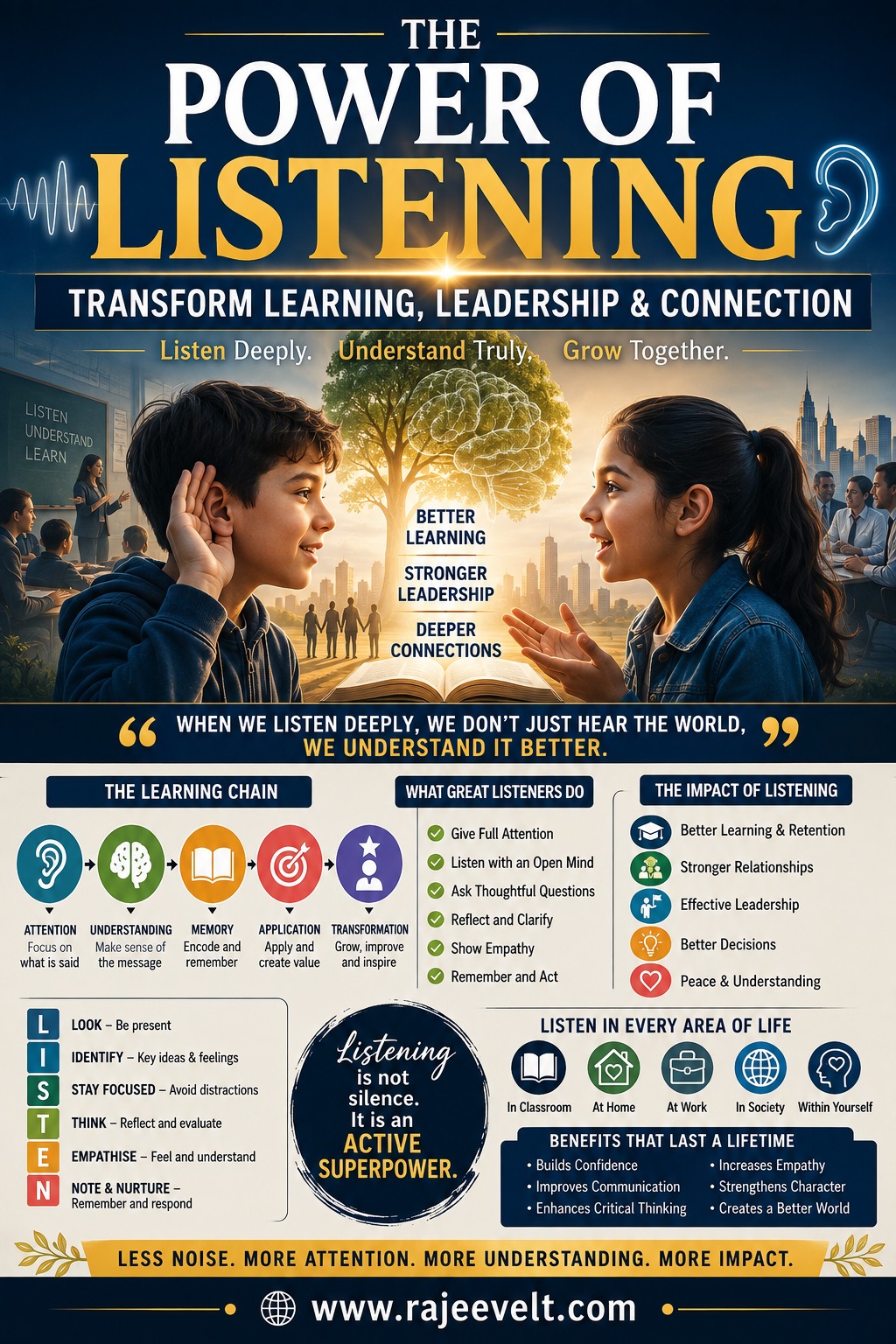
The Power of Listening
The Forgotten Skill That Can Transform Learning, Leadership and Human Connection
By Rajeev Ranjan
Abstract
We live in an age of unprecedented communication. We speak, present, message, post, comment, record and broadcast more than any previous generation. Yet, paradoxically, many of us are becoming poorer listeners.
We often listen while preparing our reply. We listen while checking our phones. We listen selectively, waiting for information that confirms what we already believe. We hear words, but miss meaning; we receive information, but miss emotion; we attend meetings, classes and conversations, yet remain mentally somewhere else.
Listening is not simply the act of hearing sound. It is an intellectual, emotional and social process through which we give attention, construct meaning, evaluate information and respond appropriately. Research increasingly connects perceived listening with relationship quality, trust, performance, well-being and workplace outcomes. A large meta-analysis involving 664 effect sizes and more than 400,000 observations found a positive relationship between perceived listening and work outcomes, with particularly strong associations with relationship quality.
Keywords: listening, active listening, deep listening, empathic listening, learning, memory, attention, leadership, communication, emotional intelligence, psychological safety, critical thinking, student learning, workplace communication, relationships, listening skills.
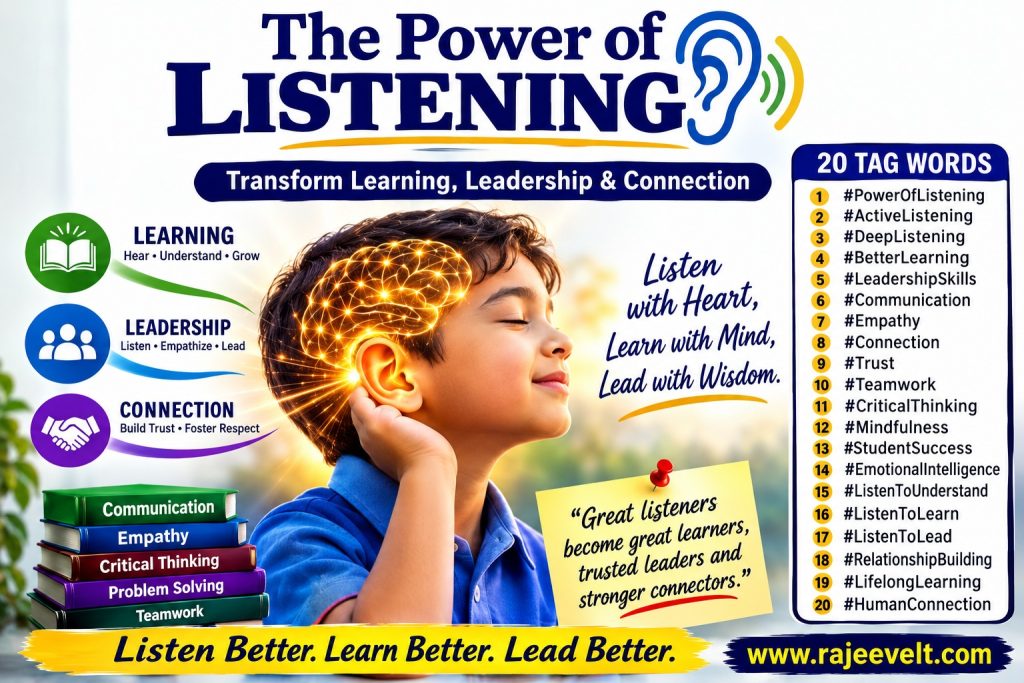
1. We hear more than we listen
Hearing receives sound. Listening receives meaning.
Human beings are continuously surrounded by sound. We hear conversations, classroom instructions, traffic, announcements, music, notifications and countless other sounds throughout the day. Hearing is a natural sensory process through which our auditory system receives sound waves and transmits information to the brain. Listening, however, is a more complex cognitive and psychological process. It requires attention, interpretation, understanding and conscious engagement with the information being received.
This distinction explains why we hear more than we listen. Hearing can occur without intention. We may hear a teacher speaking while our mind is occupied with yesterday’s events. We may hear a colleague explaining a problem while mentally preparing our response. We may hear our parents talking while looking at a mobile screen. We can hear our child talking without discovering what the child is really trying to communicate. The sound reaches our ears in each situation, but meaningful processing may not occur.
This is the paradox of listening: our ears may be open while our minds are closed.
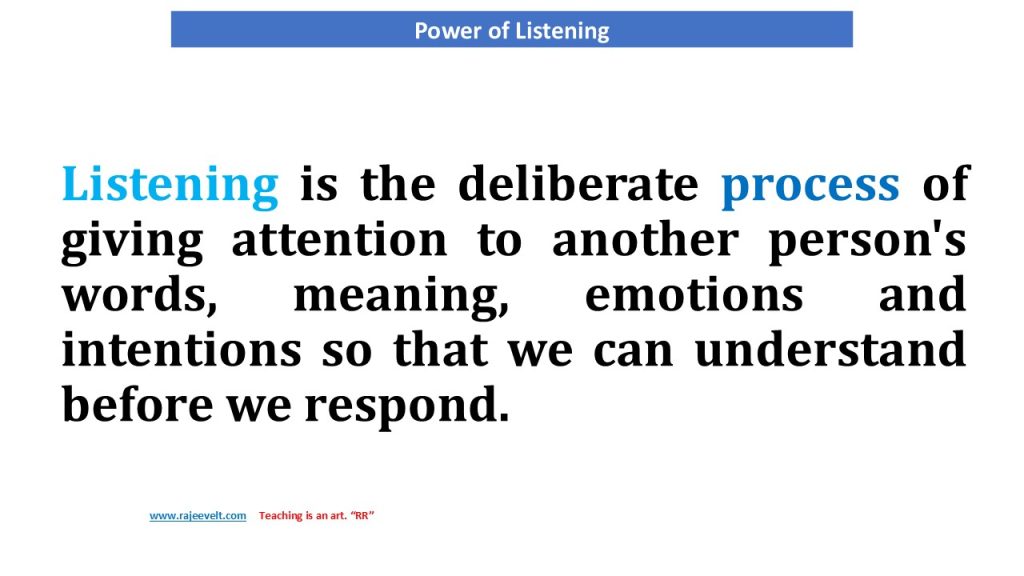
Listening begins when attention is deliberately directed towards the message. It involves selecting relevant information, interpreting meaning, connecting new information with existing knowledge, recognising emotions and evaluating what has been communicated. We often assume that listening is automatic because hearing is automatic. But listening requires intention. We define listening as:
Listening is the deliberate process of giving attention to another person’s words, meaning, emotions and intentions so that we can understand before we respond.
This definition contains four important elements:
Attention → Understanding → Empathy → Response
If attention is absent, understanding becomes weak.
If understanding is absent, empathy becomes superficial.
If empathy is absent, response can become mechanical or inappropriate.
Therefore, listening is not passive behaviour. It is an active form of thinking.
Attention acts as a gateway between sensory information and meaningful processing from a cognitive perspective. When attention is divided, working memory has fewer resources available to process and organise information. Consequently, information may be heard but not understood, understood but not remembered, or remembered without its deeper meaning. Therefore, hearing is primarily reception, whereas listening is purposeful understanding.
We hear because we possess ears; we listen because we choose to engage our minds. The ability to transform hearing into meaningful listening has become one of the most valuable human skills in an increasingly noisy world.
2. Listening is not silence
Listening is often misunderstood as a state of remaining quiet while another person speaks. Although silence can create the space necessary for listening, silence itself does not constitute listening. A person may remain completely silent while mentally distracted, emotionally disconnected, or preparing a response. Therefore, genuine listening is not defined by the absence of speech; it is defined by the presence of attention, comprehension and cognitive engagement.
Listening is an active process from a psychological perspective in which the mind receives, selects, interprets and organises auditory information. While the speaker is communicating, the listener attempts to construct meaning from words, tone, pauses, emphasis and context. This requires sustained attention and working-memory resources. Consequently, effective listening involves considerable mental activity even when the listener is outwardly silent.
Silence can support listening when it communicates patience and gives the speaker sufficient time to complete a thought. A thoughtful pause can also allow the listener to process information before responding. However, passive silence without attention may create only the appearance of listening.
True listening therefore involves active mental participation behind quiet external behaviour. We listen when we seek to understand rather than merely wait for our opportunity to speak. Thus, we may define the principle:
Silence is the absence of words; listening is the presence of understanding.
A powerful listener may speak very little, yet remain intellectually, emotionally and attentively engaged throughout the conversation. A person can remain silent and still be a poor listener.
Imagine a student sitting quietly in a classroom. The teacher explains a mathematical concept for ten minutes. The student does not disturb anyone, does not speak and appears attentive. Yet, when asked to explain the concept, the student cannot do so.
Was the student listening? Perhaps not. Silence is only the external appearance of listening. We can therefore propose another definition:
True listening is silent on the outside but active on the inside.
A good listener is mentally asking:
- What is being said?
- What does it mean?
- Why is it important?
- What evidence supports it?
- How does it connect with what we already know?
- What is not being said?
- What should we remember?
- What should we do with this information?
This is why listening belongs not only to communication but also to learning, reasoning and decision-making.
3. The Listening–Learning Connection
Listening is one of the fundamental processes through which learning begins. Before learners can analyse, remember, question or apply new knowledge, they must first attend to and process information. For this reason, effective listening should not be regarded merely as a communication skill; it is an important cognitive component of learning.
It is believed that listening involves the interaction of attention, perception, working memory, prior knowledge and meaning-making from a theoretical perspective. When a student listens attentively to a teacher, auditory information is received and processed by the brain. Attention helps the learner select relevant information, while working memory temporarily holds and organises that information. The learner then connects the new material with existing knowledge, creating meaningful cognitive associations.
This explains why simply hearing a lesson does not guarantee learning. If attention is divided, information may receive insufficient cognitive processing and may therefore be poorly understood or forgotten. In contrast, active listening encourages learners to identify key ideas, recognise relationships, ask questions, make predictions and mentally explain concepts.
Listening supports deeper learning when learners move beyond receiving information and begin interacting with it. They may paraphrase an explanation, compare ideas, identify causes and effects, or connect a concept with real-life experiences. Thus, we can describe the relationship as:
Attention makes listening possible; listening makes understanding possible; understanding makes learning possible.
When we teach students how to listen strategically, we are not simply improving classroom behaviour. We are strengthening one of the essential pathways through which information becomes knowledge.
Listening may be one of the most underestimated learning skills for students.
A child cannot learn effectively from instruction without first processing what is being communicated. Listening comprehension depends on attention, language knowledge and cognitive resources such as working memory.
Research examining children in Grades 1–3 found that working memory was particularly important for listening comprehension, while behavioural attention also predicted listening performance.
This gives us an important educational equation:
Attention + Listening + Processing + Retrieval = Learning
Consider two students sitting in the same classroom.
Student A hears the teacher explain photosynthesis. The student copies the definition from the board but mentally thinks about the lunch break.
Student B listens actively. The student asks:
“Why does the plant need sunlight?”
“What happens if there is no chlorophyll?”
“How is this different from respiration?”
Both students received the same lesson. But only one transformed information into a mental structure. That is the difference between being present and being cognitively present.
4. Listening and Memory
Listening and memory are closely interconnected cognitive processes. Listening provides the brain with information, while memory enables that information to be retained, organised and retrieved when required. Effective learning therefore depends not simply on hearing information but on processing it sufficiently for meaningful memory formation.
Listening begins with attention and perception. When we listen attentively, relevant auditory information is selected and processed by working memory. Working memory temporarily holds information while the brain interprets it, connects it with prior knowledge and determines its significance. If attention is weak or divided, information may receive insufficient processing and is less likely to become a stable memory.
Meaningful listening strengthens memory because it encourages elaboration and association. When learners connect new information with previous experiences, examples, images, questions or concepts, they create multiple pathways through which the information can later be retrieved. For example, a student who merely hears a historical date may forget it quickly; a student who connects the date with an event, story or visual representation is more likely to remember it.
Memory is also strengthened through retrieval and revision. Listening establishes the initial representation, while subsequent recall reinforces accessibility.
We can therefore describe the relationship as:
Attention captures information; listening processes it; understanding gives it meaning; memory preserves it; retrieval makes it usable.
Thus, powerful listening is not simply about remembering more. It is about transforming information into organised, meaningful and retrievable knowledge.
We sometimes tell students, “Listen carefully; you will remember it. “But listening alone does not guarantee memory. Memory becomes stronger when information receives attention, is connected with prior knowledge, is meaningfully processed and is later retrieved.
This is why effective listening should be followed by:
Listen → Connect → Question → Explain → Retrieve → Revise
A student who hears a lesson and immediately closes the book may forget much of it. A student who listens, creates a mental connection, explains the concept in their own words and later retrieves it is far more likely to build durable learning.
Recent research on language learners also suggests that metacognitive interventions can improve listening performance and awareness of listening strategies, including among learners with lower working-memory capacity.
Therefore, we should teach children not merely how to listen, but how to listen strategically.
5. Our Definition of Deep Listening
Deep listening is a higher-order form of listening in which we engage not only our ears but also our attention, cognition, emotions and awareness. It goes beyond hearing words or understanding their literal meaning. Psychologically, deep listening involves sustained attention to both the explicit message and the subtle elements surrounding it, including emotion, intention, tone, hesitation and context.
We define deep listening as:
“The conscious and sustained process of giving another person our full attention, seeking to understand their words, emotions, intentions and perspective before forming judgement or responding.”
Deep listening requires the temporary regulation of several internal processes. We should manage distractions, suppress the impulse to interrupt, reduce premature judgement and resist the tendency to relate everything we hear to our own experiences. This requires attentional control, emotional regulation, working memory and cognitive flexibility.
Deep listening involves perspective-taking. Rather than asking only, “What does this person mean?”, we begin to ask, “What might this person be experiencing, feeling or trying to communicate?” This creates the foundation for empathy and psychological connection.
Indeed, deep listening does not require agreement. We can understand a person’s perspective while maintaining a different opinion. Its purpose is not immediate acceptance but accurate understanding.
Thus, deep listening transforms communication from hearing → understanding → empathising → reflecting → responding.
Deep listening is therefore not merely a communication technique in a distracted world; it is a disciplined psychological practice of attention, understanding and human connection.
We can distinguish between several levels of listening.
Level 1: Hearing
We receive sound.
Level 2: Selective Listening
We notice only the information that interests us.
Level 3: Attentive Listening
We consciously focus on what is being said.
Level 4: Active Listening
We process, clarify, question and reflect on the message.
Level 5: Empathic Listening
We attempt to understand the speaker’s feelings and perspective.
Level 6: Critical Listening
We evaluate evidence, assumptions, logic and credibility.
Level 7: Transformative Listening
We allow what we hear to challenge our assumptions and change our thinking or behaviour.
We define the highest level this way:
Transformative listening occurs when listening does not merely add information to our mind but changes the way we understand a person, a problem or ourselves.
6. The Psychology of Feeling Heard
To be heard is more than having someone receive our words. Psychologically, feeling heard occurs when we perceive that another person has genuinely attended to us, understood our meaning and recognised our emotional experience. It is therefore an interpersonal experience involving attention, validation, empathy and psychological connection.
When we speak, we are often communicating at two levels: the content of our message and the experience behind that message. A person may say, “I am tired,” while also communicating frustration, disappointment or a need for support. A listener who responds only to the literal words may miss the deeper psychological message.
Feeling heard can contribute to a sense of belonging, respect and psychological safety. When people perceive that their thoughts and emotions are being taken seriously, they may become more willing to communicate openly. Conversely, repeated experiences of interruption, dismissal or premature judgement can discourage communication and create emotional distance.
Effective listening can also support validation from a psychological perspective. Validation does not necessarily mean agreeing with another person’s interpretation. It means acknowledging that their thoughts or feelings are understandable within their experience.
We can therefore define feeling heard as:
“The psychological experience of believing that our message, perspective and emotional reality have been genuinely noticed, understood and respected by another person.”
The power of feeling heard lies in its simplicity. Sometimes people do not immediately need solutions, advice or correction. They first need evidence that someone has truly understood them.
Thus, listening becomes powerful when attention is experienced as respect and understanding is experienced as connection.
There is another dimension of listening that is frequently overlooked. People do not merely want to communicate information. They want to experience being understood. When someone listens carefully to us, we often feel respected, valued and psychologically safer.
A 2025 registered report in the Journal of Experimental Social Psychology found that highly empathic listening could satisfy speakers’ psychological needs and contribute to well-being.
This helps explain why a simple sentence such as:
“I understand why that was difficult for you. Tell me more.”
can sometimes be more powerful than:
“Don’t worry. Everything will be fine.”
The second response attempts to solve the emotion. The first response creates space for the person to express it. That difference matters.
7. Listening and Leadership
Leadership is often associated with speaking, decision-making, vision and influence. Yet, from a theoretical and psychological perspective, effective leadership also depends profoundly on the ability to listen. A leader who listens well gains access to information, perspectives, emotions and concerns that cannot be discovered through speaking alone.
We can define leadership listening as:
“The deliberate process through which a leader gives attention to people, seeks to understand their perspectives, evaluates the information they provide and uses that understanding to make wiser decisions.”
Psychologically, listening influences important interpersonal processes such as trust, psychological safety, belonging and perceived respect. When people believe that their leader genuinely listens, they are more likely to express ideas, concerns and disagreements. This can increase the flow of information within an organisation and reduce the danger of decisions being based solely on assumptions.
Listening also requires cognitive humility. Leaders should recognise that their interpretation of a situation may be incomplete. Instead of immediately asking, “How do I solve this?”, an effective leader first asks, “What am I missing?”
Consider a leader who notices declining team performance. A directive leader may immediately introduce new rules. A listening leader first speaks with team members and discovers that unclear responsibilities, inadequate resources or communication problems may be contributing to the situation.
Thus, listening improves leadership not by making leaders passive, but by making their decisions better informed and more psychologically intelligent.
Great leaders do not merely communicate the vision; they listen carefully enough to understand the reality in which that vision must succeed.
We often imagine leadership as speaking.
The leader gives instructions.
The leader presents the vision.
The leader motivates the team.
The leader makes decisions.
But exceptional leadership also begins with listening.
A leader who speaks constantly may know what the organisation is saying.
A leader who listens deeply may discover what the organisation is not saying.
Research in organisational psychology has increasingly connected listening with job performance, knowledge, attitudes, relationships, trust and well-being. A major review describes listening as a process that can benefit both speakers and listeners and proposes that effective listening can create moments of shared understanding that generate clarity and new ideas.
A meta-analytic review found that perceived listening was positively associated with work outcomes, with a particularly strong relationship between listening and relationship quality.
This leads us to a leadership principle:
The quality of a leader’s listening determines the quality of information available for leadership decisions.
A leader who listens only to senior people may develop a distorted picture. A leader who listens to teachers, students, customers, parents, junior employees and frontline workers receives a much wider map of reality.
8. The Student Who Was “Not Paying Attention” (Case Study 1)
Consider a classroom situation. A teacher notices that a student repeatedly fails to answer questions. The teacher concludes:
“He is careless. He doesn’t listen.”
The student is warned several times.
One day, instead of giving another warning, the teacher asks:
“Tell me what happens when I explain the lesson. What makes it difficult for you to follow?”
The student replies:
“I understand the first part, but when the teacher changes the example, I become confused. Then I stop asking questions because I think everyone else understands.”
Suddenly, the problem looks different. The child was not necessarily unwilling to learn. The child was experiencing a listening and comprehension gap.
The teacher changes the strategy:
- Explain a small concept.
- Ask the student to explain it back.
- Provide a new example.
- Invite questions without embarrassment.
- Connect the new idea to the previous lesson.
- Conduct a short retrieval activity.
The student’s participation improves.
The lesson is important:
Before we judge behaviour, we should listen for the story behind the behaviour.
The case of a student who appears “not to be paying attention” illustrates why observation alone cannot fully explain learning behaviour from a theoretical and psychological perspective. What appears to be inattention may result from cognitive overload, limited working-memory capacity, difficulty processing language, anxiety, lack of prior knowledge, or uncertainty about the task. The Power of Listening begins when a teacher moves beyond judging visible behaviour and seeks to understand the learner’s internal experience. When a teacher asks open questions, listening without immediate judgement, and allowing the student to explain where the difficulty occurs, s/he can identify the actual barrier to learning. Psychologically, such listening communicates attention, respect, validation and psychological safety, making the student more willing to express confusion and ask for help. The teacher therefore shifts from “Why is this child not listening?” to “What is preventing this child from listening and learning effectively?” This shift is significant because listening transforms the teacher’s role from merely correcting behaviour to understanding cognition. In this sense, listening becomes a diagnostic tool: it helps us discover what cannot be seen from the outside. When we listen to the learner before judging the learner, we create the possibility of understanding the problem—and therefore the possibility of changing the learning outcome.
9. The Leader Who Almost Solved the Wrong Problem (Case Study 2)
Imagine a school or organisation where staff morale appears low. A leader assumes the problem is workload. A meeting is organised. The leader proposes reducing meetings. But after listening individually to staff members, a different issue emerges.
People are not primarily complaining about the number of meetings. They are frustrated because decisions affecting their work are sometimes made without consulting them.
The solution is therefore not simply “fewer meetings.”
The deeper solution is:
better participation + clearer communication + genuine consultation.
The leader’s first interpretation was based on observation. The second interpretation emerged through listening.
This is why we can define leadership listening as: Leadership listening is the disciplined practice of seeking reality before prescribing solutions.
“The Leader Who Almost Solved the Wrong Problem” demonstrates how assumptions and cognitive biases can influence leadership decisions when listening is inadequate from a theoretical and psychological perspective. Leaders naturally interpret situations through their existing experiences, expectations and mental models, but these interpretations may represent only a partial view of reality. In the case of declining staff morale, a leader might assume that workload is the central problem and immediately introduce a solution, while the actual issue may involve lack of recognition, poor communication, exclusion from decision-making or insufficient psychological safety. The Power of Listening helps interrupt this assumption-driven process. When the leader listens actively to employees, asking open-ended questions and seeking perspectives from different levels of the organisation, leaders obtain richer information before making decisions. Psychologically, genuine listening also communicates respect and inclusion, encouraging people to share concerns that they might otherwise suppress. This creates a feedback environment in which hidden problems become visible. Listening, therefore, is not merely a communication skill for leaders; it is a cognitive discipline and decision-making mechanism. It encourages leaders to replace “I already know the problem” with “Let me understand the problem first.” Ultimately, the quality of a leader’s solution depends greatly on the quality of the listening that precedes it.
10. A Conversation Between a Parent and a Child (Case Study 3)
A teenager says:
“I don’t want to go to school tomorrow.”
An adult may immediately respond:
“You have to go. Everyone has problems. Don’t make excuses.”
The conversation ends.
Now consider another response:
“Something seems to be bothering you. Tell me what happened.”
The child speaks. Perhaps the issue is an argument with a friend. Perhaps there was embarrassment in class. Perhaps the child failed an assessment and fears being judged. The adult still may eventually say, “You need to go to school.” But the decision is now based on understanding rather than assumption.
Listening does not mean agreeing.
This distinction is essential.
We can listen deeply without agreeing completely.
Listening says:
“Your experience matters enough for me to understand it.”
Agreement says:
“I believe your conclusion is correct.”
They are not the same.
“A Conversation Between a Parent and a Child” demonstrates how listening can influence emotional development, trust and the quality of parent–child relationships from a theoretical and psychological perspective. When a child says, “I don’t want to go to school tomorrow,” an adult may immediately interpret the statement as laziness, avoidance or disobedience and respond with advice or criticism. However, the statement may represent a deeper emotional experience such as fear of failure, peer conflict, embarrassment, anxiety or a feeling of not belonging. The Power of Listening encourages the parent to pause judgement and explore the meaning behind the child’s words. Through attentive listening, open-ended questions, appropriate silence and emotional validation, the parent creates psychological safety, allowing the child to communicate more honestly. Importantly, listening does not mean agreeing with everything the child says; rather, it communicates, “Your experience matters, and I am willing to understand it.” We believe that repeated experiences of being heard can strengthen trust and encourage healthier emotional expression from an attachment and emotional-development perspective. The parent therefore moves from controlling the conversation to understanding the child. This case illustrates a fundamental principle of listening: when we listen to the words, we hear the message; when we listen beneath the words, we may discover the emotion, need or fear that the child is unable to express directly.