


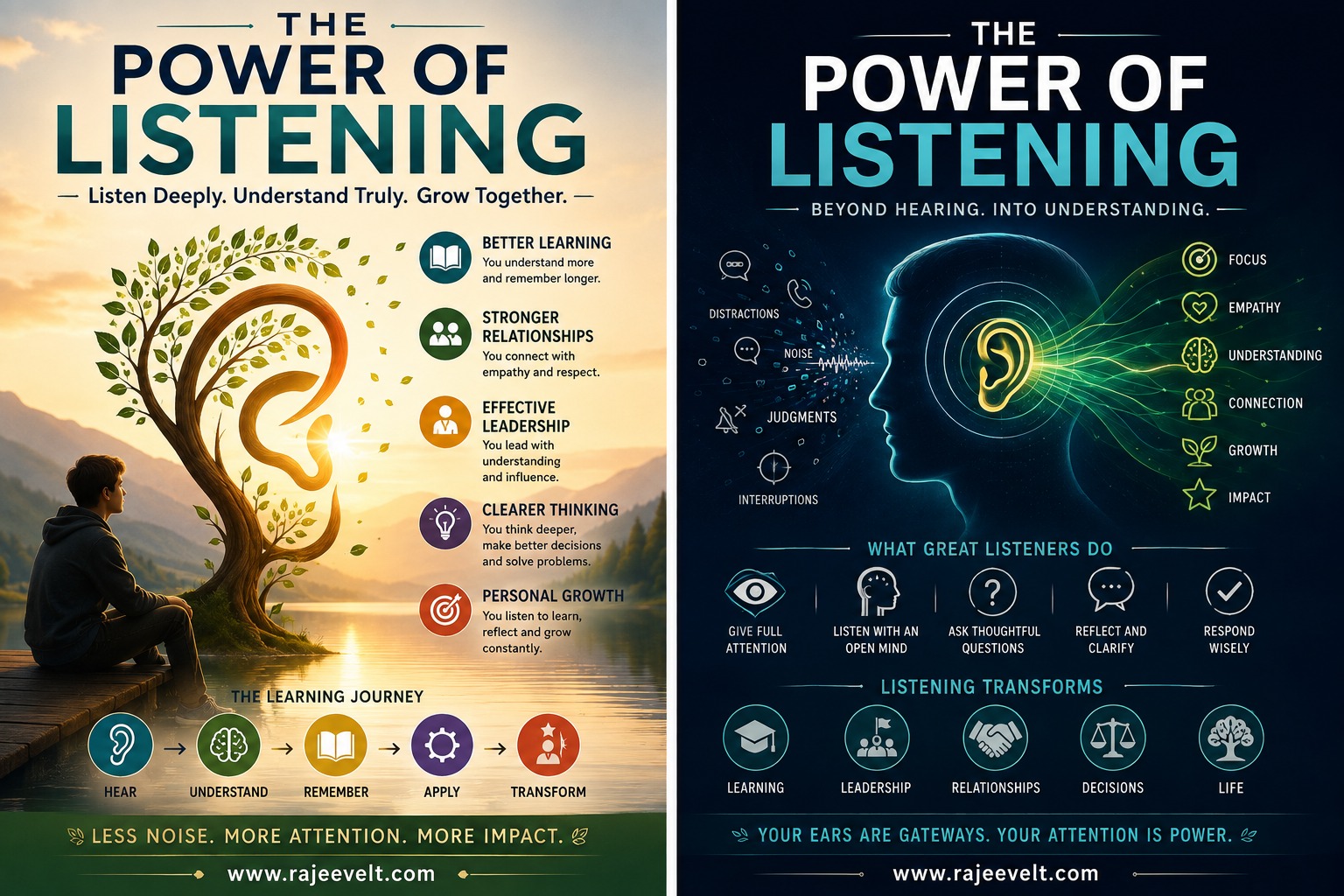
The Power of Listening
The Forgotten Skill That Can Transform Learning, Leadership and Human Connection-Part 2
By Rajeev Ranjan
Abstract
We live in an age of unprecedented communication. We speak, present, message, post, comment, record and broadcast more than any previous generation. Yet, paradoxically, many of us are becoming poorer listeners.
We often listen while preparing our reply. We listen while checking our phones. We listen selectively, waiting for information that confirms what we already believe. We hear words, but miss meaning; we receive information, but miss emotion; we attend meetings, classes and conversations, yet remain mentally somewhere else.
Listening is not simply the act of hearing sound. It is an intellectual, emotional and social process through which we give attention, construct meaning, evaluate information and respond appropriately. Research increasingly connects perceived listening with relationship quality, trust, performance, well-being and workplace outcomes. A large meta-analysis involving 664 effect sizes and more than 400,000 observations found a positive relationship between perceived listening and work outcomes, with particularly strong associations with relationship quality.
Keywords: listening, active listening, deep listening, empathic listening, learning, memory, attention, leadership, communication, emotional intelligence, psychological safety, critical thinking, student learning, workplace communication, relationships, listening skills.
11. The Biggest Enemy of Listening: Our Own Mind
We often assume that the greatest barriers to listening are external distractions—noise, mobile phones, interruptions or an uncomfortable environment. Yet, from a theoretical and psychological perspective, one of the most powerful barriers exists inside our own mind. While another person is speaking, our attention may be occupied by thoughts, memories, emotions, assumptions and plans for what we will say next. We may appear attentive while mentally preparing a response, evaluating the speaker, comparing the message with our own experiences or silently constructing a counterargument.
Psychologically, listening requires selective attention and cognitive control. Because our cognitive resources are limited, competing thoughts can reduce the mental capacity available for processing another person’s message. Confirmation bias may also influence listening: we tend to notice information that supports our existing beliefs while overlooking information that challenges them. Emotional reactions can create another barrier. When we feel criticised, threatened or defensive, we may listen primarily to protect ourselves rather than to understand the speaker.
This is why deep listening requires self-regulation. We must temporarily suspend judgement, resist the urge to interrupt and become aware of our internal reactions.
We can express this principle simply:
“Sometimes we do not fail to listen because the other person speaks poorly; we fail because our own thoughts are speaking too loudly.”
The first step toward powerful listening is therefore not controlling the speaker—it is learning to quiet our own mind. Many people think distraction is the biggest problem in listening.
It is not always the smartphone. Sometimes we are the distraction.
While another person speaks, our mind may be:
- preparing a reply,
- comparing the story with our own experience,
- judging the speaker,
- planning what we will say next,
- looking for mistakes,
- defending ourselves,
- thinking about another task,
- deciding whether we agree,
- or waiting for an opportunity to interrupt.
Therefore:
The greatest barrier to listening is often not noise around us, but noise within us.
Deep listening requires temporary suspension of the need to respond. We do not have to abandon our opinions. We simply postpone them long enough to understand.
12. The “WAIT” Principle
The WAIT Principle is a simple self-regulation strategy designed to help us become more conscious listeners. WAIT stands for “Why Am I Talking?” It encourages us to pause before interrupting, giving advice, changing the subject or immediately responding. The principle is based on a simple psychological idea: effective listening requires us to manage our impulse to speak while another person is still communicating.
When we ask ourselves, “Why am I talking?”, we examine our intention. Are we genuinely adding value, or are we simply uncomfortable with silence? Are we responding to what the person actually said, or are we preparing to prove our point? Are we trying to understand, or merely trying to be understood?
WAIT creates a brief mental pause between listening and responding. This pause allows attention, emotional regulation and thoughtful judgement to operate before speech begins.
We can use WAIT in classrooms, meetings, family conversations and leadership situations.
WAIT does not mean that we should speak less; it means that we should speak with greater purpose.
Sometimes the most intelligent response is not another sentence in the practice of powerful listening —it is another moment of attention.
A practical strategy is the WAIT principle:
W — Why Am I Talking?
Before interrupting, ask ourselves whether our contribution is necessary.
A — Am I Attending?
Are we actually listening, or merely waiting for our turn?
I — Is the speaker finished?
Do we know the complete thought?
T — To what am I responding?
Are we responding to what was actually said, or to what we assumed was meant? This small mental pause can transform conversations.
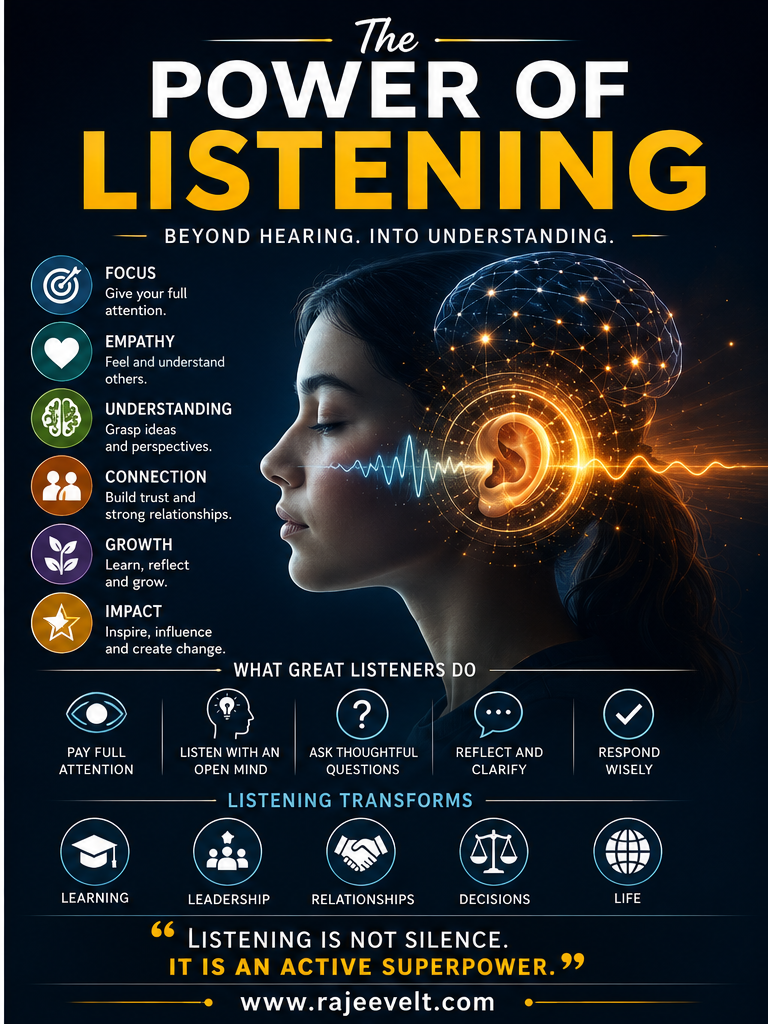
13. Five Behaviours of Powerful Listeners
Powerful listening is not simply the ability to remain quiet while another person speaks. It is a deliberate cognitive, emotional and behavioural process through which we seek to understand information, meaning and perspective. Five observable behaviours distinguish powerful listeners from passive listeners.
1. They Give Full Attention.
They consciously focus on the speaker and minimise distractions. Attention is the foundation of listening because information cannot be meaningfully processed when our cognitive resources are divided.
2. They Suspend Premature Judgement.
They avoid immediately deciding whether the speaker is right or wrong. This creates space for complete understanding and reduces the influence of assumptions and biases. Instead of assuming, we ask: “Do you mean that…?”
3. They Clarify.
They ask thoughtful questions such as, “Could you explain what you mean?” Clarification prevents misunderstanding and demonstrates genuine interest. Instead of assuming, we ask: “Do you mean that…?”
4. They Reflect and Paraphrase.
They restate the central idea in their own words: “So, what I understand is…” This allows both people to identify misunderstandings and creates greater conversational accuracy. We can say: “So what I am hearing is…”Reflection allows the speaker to correct misunderstandings.
5. They Respond Rather Than React.
They consider the message before answering. Instead of responding impulsively from emotion, they choose a response appropriate to the situation.
These behaviours are important because effective listening strengthens understanding, trust, learning, relationships and decision-making. In education, it improves comprehension; in leadership, it improves information flow; in relationships, it strengthens connection.
Powerful listeners do not listen merely to reply. They listen to understand, learn, connect and respond wisely.
Listening creates the space between stimulus and response. That space is where judgement, empathy and wisdom can operate.
14. The Power of the Pause
A pause is a brief period of silence between receiving information and responding to it. Although it may appear insignificant, a deliberate pause can play an important role in effective listening, communication and psychological self-regulation. In a culture that often rewards speed, we frequently respond before we have fully understood what has been said. The pause creates a small but valuable space between stimulus and response.
Why is this important? When we pause, we allow our mind to process information rather than reacting automatically. The pause gives us time to identify the speaker’s main message, consider emotional context, organise our thoughts and choose an appropriate response. It can also reduce impulsive reactions, particularly when conversations involve disagreement, criticism or strong emotions.
The pause is equally valuable for the speaker. When we do not immediately fill silence, the speaker may have an opportunity to continue, clarify an idea or express something deeper. In this sense, silence can become an invitation rather than an interruption.
A teacher’s pause after asking a question in classrooms can encourage students to think before answering. A pause can prevent premature decisions in leadership conversations. It can prevent words spoken in anger from causing unnecessary damage in personal relationships.
Thus, the power of the pause lies not in silence itself but in what happens cognitively and emotionally during that silence.
Pause before reacting. Listen before answering. Understand before judging.
A thoughtful pause can turn an immediate reaction into an intelligent response. Silence has been undervalued in modern communication. We often fear silence. Someone finishes speaking and, within a fraction of a second, we reply.
But a thoughtful pause can communicate: “I am considering what you said.”
It can also give the speaker permission to continue. Recent research on empathic communication and conversational pacing has highlighted the importance of context-sensitive pauses and forms of silence in supporting perceived listening and engagement. Therefore, we should not always rush to fill silence. Sometimes:
Silence is not absence of communication.
Silence is part of listening.
15. Listening in the Age of Artificial Intelligence
Artificial intelligence has transformed the way we access, process and communicate information. We can now obtain answers, summaries, translations and ideas within seconds. Yet, as machines become increasingly capable of processing information, the human capacity to listen deeply becomes even more important. AI can analyse words and patterns, but human communication often contains emotions, intentions, context, values and unspoken meaning that require interpersonal understanding.
What is listening in the AI age?
It is the deliberate ability to give sustained attention to another person, interpret both the message and its context, question assumptions, and respond with empathy and judgement rather than simply processing information.
Why is it important?
Because technological efficiency does not automatically create human understanding. We may communicate faster through digital platforms while becoming less attentive to the people around us. Students, teachers, leaders, parents and professionals still need to recognise emotions, understand different perspectives, resolve disagreements and build trust.
How can we develop it?
We can create technology-free moments during important conversations, maintain focused attention, ask clarifying questions, practise paraphrasing, allow pauses, and distinguish between information processing and human understanding. We should also teach young people to critically evaluate AI-generated information while developing the human skills that technology cannot replace easily—empathy, perspective-taking, judgement and meaningful dialogue.
The central principle is simple:
The more powerful our technology becomes at generating answers, the more valuable our human ability to listen becomes for understanding people.
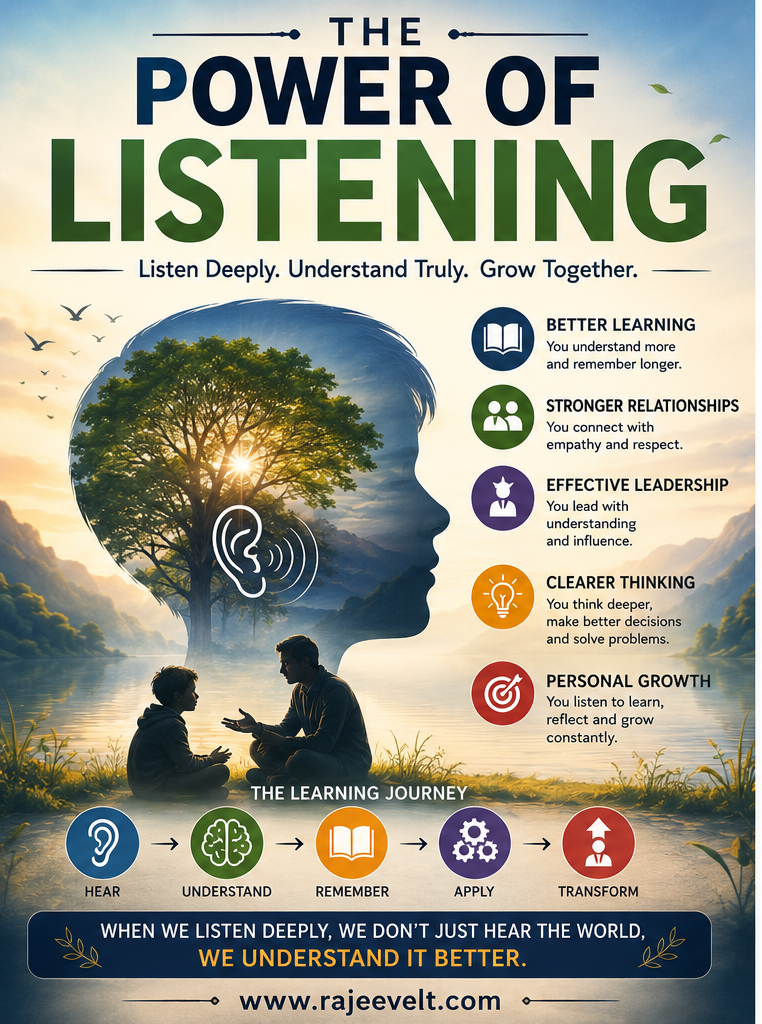
Listening is not an outdated skill in the AI age. It is a human advantage. AI has changed how we communicate. We can now obtain answers instantly. We can summarise books, generate reports, translate languages and produce ideas within seconds. But faster information does not automatically produce deeper understanding. In fact, as technology becomes better at generating answers, human listening may become more valuable.
The future therefore requires both: AI literacy and human listening literacy.
We should teach young people to ask: “What did the AI say?” But also: “What does another human being mean?” The second question cannot be reduced to information retrieval.
16. Listening and Psychological Safety
Psychological safety refers to an environment in which individuals feel sufficiently safe to express their thoughts, questions, concerns, mistakes, and disagreements without fear of humiliation, rejection, or punishment. Listening is one of the primary behaviours through which psychological safety is created.
Theoretically, effective listening communicates acceptance, respect, attention, and interpersonal value. When a student feels genuinely heard, the perceived social risk of speaking decreases. This encourages students to ask questions, admit confusion, seek clarification, share alternative ideas, and acknowledge mistakes. In contrast, dismissive listening, interruption, ridicule, or premature judgement can create a defensive psychological climate in which students remain silent.
The psychological safety is particularly important because learning requires intellectual risk-taking. Students must sometimes say, “I don’t understand,” “I disagree,” or “I made a mistake.” A safe listening environment makes such behaviour more likely.
Listening also strengthens belonging and trust. When teachers and peers listen attentively, students experience greater interpersonal connection and are more willing to participate.
Therefore:
Listening creates safety → safety encourages participation → participation enables questioning → questioning deepens learning.
Powerful listening is therefore not merely a communication skill for students; it is a social and psychological foundation for confident learning, healthy relationships, and personal growth.
A person who expects ridicule, dismissal or punishment may stop speaking.
This happens in classrooms.
It happens in families.
It happens in workplaces.
It happens in leadership teams.
Listening can therefore influence whether people feel safe enough to contribute.
Research involving school teachers found that listening training over an academic year was associated with increases in perceived listening, relational climate, autonomy satisfaction, psychological safety and relational energy.
The implication is powerful:
When people believe they will be heard, they are more willing to speak. When they are more willing to speak, organisations gain access to more information.
We feel that sometimes the information we most need is held by the person who speaks the least.
17. Listening is also critical thinking
Listening is not merely the reception of spoken information; it is an active cognitive process involving attention, interpretation, analysis, evaluation, and response. Effective listening requires the learner to examine what is being communicated rather than accepting every statement automatically.
When students listen critically, they identify the main idea, supporting evidence, assumptions, reasoning, and conclusions within a message. They distinguish between fact and opinion, recognise possible bias, compare new information with existing knowledge, and consider alternative explanations. Thus, listening becomes a process of constructing and evaluating meaning.
Cognitive psychology suggests that meaningful learning occurs when learners actively connect new information with prior knowledge. Critical listening strengthens this process by encouraging students to ask:
- What is being said?
- Why is it being said?
- What evidence supports it?
- Is the reasoning logical?
- What assumptions are present?
- Could there be another perspective?
This transforms students from passive receivers into active thinkers in the classroom. A student who listens critically does not merely remember a teacher’s explanation; the student analyses it, questions it, connects it with previous knowledge, and applies it to new situations. Therefore:
Good listening receives information; critical listening examines information.
LISTEN → QUESTION → ANALYSE → EVALUATE → CONCLUDE → APPLY
Thus, developing listening skills simultaneously develops reasoning, judgement, intellectual curiosity, and independent thinking.
Listening should not mean believing everything we hear. A good listener is both open-minded and intellectually disciplined.
Critical listening asks:
- What is the evidence?
- What assumptions are being made?
- Is the argument logically consistent?
- What information is missing?
- Is this fact, interpretation or opinion?
- What alternative explanation exists?
- Who benefits from this claim?
- What would change our mind?
| We need two listening muscles: | |
| Empathic listening: “Help me understand your experience.” | Critical listening: “Help me evaluate your argument.” |
| Great thinkers need both. | |
Great thinkers need both.
18. A Simple Listening Framework: L.I.S.T.E.N.
The L.I.S.T.E.N. framework provides students with a simple structure for converting ordinary hearing into purposeful, active and meaningful listening. It emphasises that effective listening requires both attention and cognitive engagement.
L — Look
Give the speaker your visual and mental attention. Appropriate eye contact and attentive body language communicate respect and help maintain focus.
I — Identify
Identify the main idea, purpose and important information. Ask yourself: “What is the speaker really trying to communicate?”
S — Stay Focused
Resist distractions, interruptions and premature judgements. When attention wanders, consciously bring it back to the speaker.
T — Think
Process what you hear. Connect new information with prior knowledge, experiences and concepts. Ask questions and evaluate the reasoning rather than simply accepting information.
E — Empathise
Try to understand not only the speaker’s words but also their feelings, perspective and intention. Empathic listening strengthens relationships and psychological safety.
N — Note & Navigate
Capture key ideas mentally or through brief notes, then decide how to respond or apply what you have learned.
The framework can therefore be represented as:
LOOK → IDENTIFY → STAY FOCUSED → THINK → EMPATHISE → NOTE & NAVIGATE
L.I.S.T.E.N. transforms listening from a passive sensory activity into an active learning behaviour.
“Listen with your ears, process with your brain, understand with your mind, and respond with purpose.”
19. How We Can Train Ourselves to Listen Better
Listening is not simply an inborn ability; it is a trainable cognitive and behavioural skill that improves through deliberate practice. Better listening develops when individuals learn to regulate attention, reduce distractions, process information actively, and monitor their own understanding.
The first requirement is attention control. Students can deliberately focus on the speaker, reduce environmental distractions, and consciously return their attention whenever it wanders. This strengthens attentional regulation.
Second, listeners should practise active processing rather than merely receiving words. They can identify the main idea, recognise key information, connect new knowledge with prior knowledge, and mentally summarise what they hear. Such elaborative processing supports deeper understanding and memory.
Third, metacognitive monitoring is essential. Students should periodically ask themselves: “Do I understand this?” “What is the main point?” “What am I missing?” This makes listening a self-regulated learning process.
Fourth, students should develop response discipline—avoiding unnecessary interruptions, delaying judgement, and using a brief pause before responding. This improves comprehension and reduces impulsive reactions.
Finally, listening improves through deliberate practice and feedback. Activities such as summarising conversations, recalling spoken information, asking clarifying questions, and reflecting on listening mistakes gradually build competence. Thus:
Better Listening = Attention + Active Processing + Self-Monitoring + Practice + Feedback
The ultimate goal is not simply to hear more, but to understand more deeply, remember more effectively, and respond more thoughtfully. Listening improves through deliberate practice.
The 60-Second Challenge
| Choose one conversation every day. | Simply listen. Then ask: “What is the most important thing this person wanted me to understand?” |
| For sixty seconds, make a commitment: Do not interrupt. Do not check your phone. Do not prepare your reply. Do not redirect the conversation to yourself. | The Paraphrase Practice After someone explains something, say: “If I have understood you correctly, you are saying…” Then allow the person to correct you. |
| The Paraphrase Practice After someone explains something, say: “If I have understood you correctly, you are saying…” Then allow the person to correct you. | The Paraphrase Practice After someone explains something, say: “If I have understood you correctly, you are saying…” Then allow the person to correct you. |
| The Question Practice Replace advice with one additional question. Instead of: “You should do this.” Try: “What do you think would help?” | The Emotion Practice Listen for emotion behind information. Someone may say: “The project is delayed.” But the underlying message might be: “I am worried that people will blame me.” Strong listeners hear both. |
| The Emotion Practice Listen for emotion behind information. Someone may say: “The project is delayed.” But the underlying message might be: “I am worried that people will blame me.” Strong listeners hear both. | The Reflection Practice At the end of the day, ask: Whom did I listen to today? When did I interrupt? When did I assume? What did I learn because I listened? Whom do I need to listen to more carefully tomorrow? |
20. Listening in Education: From Classroom Skill to Life Skill
Listening is often treated as a classroom behaviour, but theoretically it is a foundational cognitive, social, and lifelong competency. In education, listening enables students to receive instructions, understand concepts, process explanations, ask meaningful questions, and connect new information with prior knowledge. It therefore contributes directly to comprehension, learning, memory, and academic performance.
Effective listening requires attention, working-memory engagement, interpretation, and integration of information. A student who listens actively is not merely receiving words but constructing meaning. This makes listening an important component of critical thinking and self-regulated learning.
Its significance extends beyond academics. Listening supports communication, empathy, emotional intelligence, conflict resolution, collaboration, and relationship building. The ability to listen helps individuals understand different perspectives and respond appropriately rather than reacting impulsively in family and social environments.
Listening becomes equally important for teamwork, leadership, problem-solving, negotiation, customer interaction, and decision-making in professional life. Leaders who listen effectively can gather information, understand people, identify problems, and make more informed decisions.
Thus, education should not teach listening merely as “sit quietly and hear the teacher.” It should develop listening as an intentional habit of attention, understanding, questioning, reflection, and response. The progression can be expressed as:
Listen to Learn → Listen to Understand → Listen to Connect → Listen to Think → Listen to Lead
Therefore, listening begins as a classroom skill but develops into a lifelong capability that influences how effectively a person learns, communicates, collaborates, and leads.
Schools traditionally teach students to read, write and speak. We should give listening equal status.
A student who listens well can:
- understand instructions,
- follow complex explanations,
- ask better questions,
- remember important information,
- identify contradictions,
- learn from peers,
- participate in discussion,
- resolve disagreements,
- develop empathy,
- and make better decisions.
We should therefore stop treating listening as merely a classroom behaviour.
Listening is a learning skill, a thinking skill, a relationship skill and a leadership skill.
When we teach children to listen, we are not simply making classrooms quieter. We are developing minds that can receive, examine, connect and transform information.
21. What great listeners do differently
Great listeners differ from ordinary listeners not because they hear more, but because they process information more intentionally. Theoretically, effective listening involves attention, interpretation, emotional awareness, memory, and purposeful response. Great listeners therefore treat listening as an active cognitive and interpersonal process.
First, they give focused attention. They minimise distractions and consciously remain present rather than preparing their response while the other person is speaking. Second, they listen for meaning rather than merely words. They identify the central idea, supporting information, emotions, intentions, and context.
Third, great listeners delay judgement. They do not immediately label information as right or wrong; instead, they seek clarification and consider alternative perspectives. This behaviour supports critical thinking and reduces assumptions and confirmation bias.
Fourth, they use active listening behaviours such as appropriate eye contact, purposeful questions, paraphrasing, summarising, and relevant responses. These behaviours demonstrate understanding and allow misunderstandings to be corrected.
Fifth, great listeners practise empathic listening. They attempt to understand another person’s perspective without necessarily agreeing with it. This builds trust, psychological safety, and stronger relationships.
Finally, they remember and act upon important information. Their listening produces behavioural consequences rather than ending when the conversation finishes.
The difference can therefore be summarised:
Ordinary listeners hear.
Good listeners understand.
Great listeners understand, connect, remember, and respond wisely.
| Great listening is characterised by presence, curiosity, patience, empathy, critical thinking, and purposeful action. |
| Great listeners do not necessarily speak less all the time. They speak with greater purpose. They know when to ask. They know when to pause. They know when to challenge. They know when to encourage. They know when silence is better than advice. They do not listen merely to reply. They listen to discover. This gives us perhaps the simplest definition of all: Poor listening asks, “When can I speak?” Good listening asks, “What can I understand?” Great listening asks, “What can I learn?” |
22. The Listening Challenge for the Modern World
The modern world presents an unprecedented challenge to our ability to listen. Although technology has increased access to information and communication, it has also created an environment of constant stimulation, distraction, rapid information exchange, and shortened attention cycles. Notifications, social media, multitasking, short-form content, and continuous digital interaction compete for limited cognitive attention.
Effective listening requires sustained attention, working-memory capacity, cognitive processing, and inhibition of irrelevant stimuli. When attention is repeatedly interrupted, the brain must continually redirect its focus, potentially reducing the depth with which information is processed and understood. Consequently, people may hear more information while understanding and remembering less.
Another important challenge is information overload. Individuals encounter enormous quantities of information but have limited capacity to evaluate it critically. This makes selective and critical listening increasingly important. Confirmation bias and algorithmically personalised information can also encourage people to listen primarily to views that reinforce existing beliefs.
The modern listening challenge is therefore not simply “How can we hear more?” but:
“How can we protect our attention and listen deeply in a world designed to capture it?”
For students, this requires deliberate habits: reducing unnecessary distractions, practising focused attention, listening before responding, questioning information, and engaging in reflective recall.
| In an age of information abundance, attention becomes a valuable resource—and deep listening becomes a competitive advantage. Our world does not suffer from a shortage of voices. It suffers from a shortage of attention. Everyone wants to be heard. Few people are willing to listen. Everyone wants to explain. Few people want to understand. Everyone wants to win arguments. Few people want to discover truth. If we can reverse this pattern, the consequences could be profound. A teacher who listens can discover a learner. A parent who listens can discover a child. A leader who listens can discover an organisation. A colleague who listens can discover an idea. A friend who listens can discover a hidden struggle. And a person who listens to themselves can sometimes discover a life that needs to change. |
Perhaps We Do Not Need More Voices
Modern society often celebrates the ability to speak, express opinions, share ideas, and be heard. However, communication theory suggests that effective communication is not created by increasing the number of voices alone. It depends equally upon the quality of listening, understanding, interpretation, and response.
When everyone seeks to speak but few are willing to listen, communication can become a competition for attention rather than an exchange of meaning. In classrooms, meetings, families, and digital spaces, this can produce misunderstanding, polarisation, repetition, and superficial interaction. More information does not automatically produce greater understanding.
Listening provides the cognitive space necessary to process another person’s perspective before responding. It allows individuals to recognise evidence, question assumptions, understand emotions, and consider viewpoints different from their own. In this sense, listening is not silence or passivity; it is an active contribution to communication.
Psychologically, being genuinely heard also communicates respect and interpersonal value. It can strengthen trust, empathy, belonging, and psychological safety. In education, a culture of listening encourages students to ask questions, express uncertainty, and engage in intellectual risk-taking. Therefore, the challenge of modern communication may not simply be to create more opportunities to speak, but to develop the capacity to listen deeply.
| Perhaps we do not need more voices. Perhaps we need more people willing to listen, understand, think, and respond wisely. |
| Less noise. More attention. More understanding. We have more communication tools than ever. What we need is not necessarily more communication. We need better attention. We need the courage to pause. We need the humility to admit that our first interpretation may be incomplete. We need the patience to hear the whole story. We need the intellectual discipline to evaluate what we hear. And we need the humanity to recognise that behind every voice is a person who wants to matter. Research gives us compelling reasons to take listening seriously: it is associated with stronger relationships, workplace outcomes, psychological safety, well-being and learning. |
| But perhaps the deepest reason is simpler. When we truly listen, we give another human being something that cannot be measured easily: our attention. Attention is one of the purest forms of respect. So let us teach our children to listen. Let us train our teachers to listen. Let us expect our leaders to listen. Let us listen to people with whom we disagree. Let us listen before judging. Let us listen before advising. Let us listen before solving. And, occasionally, let us listen simply because another human being needs to be heard. Because in a noisy world, the person who has mastered the art of listening possesses a rare form of power. Listening does not make us smaller. It makes our understanding larger. |
Conclusion: The Power of Listening
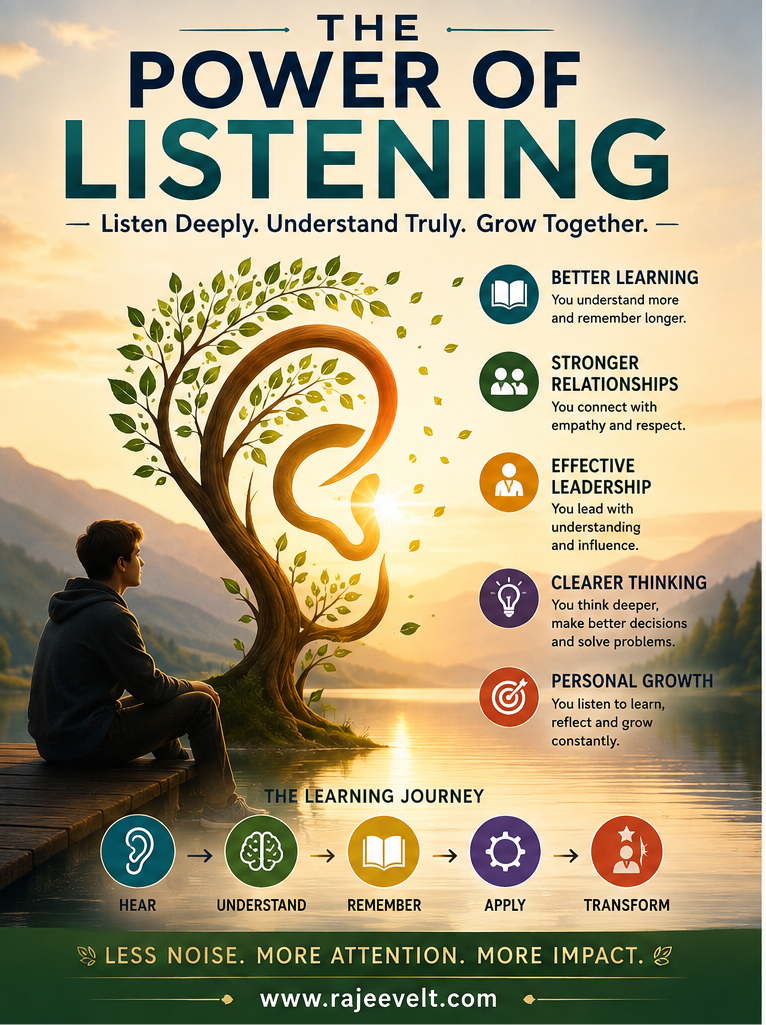
Listening is far more than the ability to hear spoken words; it is a cognitive, emotional, social, and intellectual discipline that shapes how we learn, remember, think, communicate, and grow. In education, listening is the first gateway to learning. Attention enables understanding; understanding supports encoding; encoding contributes to memory; retrieval strengthens learning; and application transforms knowledge into competence.
Neuroscience reminds us that listening requires active brain engagement, while psychology shows that focused listening strengthens empathy, trust, psychological safety, and meaningful relationships. Critical listening develops the ability to question assumptions, evaluate evidence, distinguish fact from opinion, and form independent judgements. Thus, listening is simultaneously a learning skill and a thinking skill.
The implications extend far beyond the classroom for students. Listening carefully to teachers improves comprehension; listening to oneself supports reflection; listening to parents and peers strengthens relationships; and listening during disagreement develops emotional maturity. In leadership, listening creates understanding before action.
In a world crowded with notifications, opinions, distractions, and endless voices, deep listening has become increasingly valuable. We may not need more voices; we need more people capable of paying attention and understanding deeply.
Listen to learn.
Listen to understand.
Listen to connect.
Listen to think.
Listen to grow.
When we learn to listen deeply, we do not merely hear the world—we understand it better, and in understanding it, we become better learners and better human beings.
“The Power of Listening” is informed by research across cognitive psychology, neuroscience, educational psychology, communication, memory science, emotional intelligence, critical thinking, psychological safety, and leadership.
Grow Together Glow Together
Regards
Rajeev Ranjan
School Education
“Let knowledge grow from more to more.”
Alfred Tennyson, “In Memoriam”, Prologue, line 25
Selected Research
- Gordoni, G., Zyberaj, J., Bakaç, C., et al. — A Meta-analytic Systematic Review and Theory of the Effects of Perceived Listening on Work Outcomes. The review synthesised 664 effect sizes and approximately 400,020 observations and found meaningful positive associations between perceived listening and work outcomes, especially relationship quality.
- Kluger, A. N., & Itzchakov, G. — The Power of Listening at Work. Annual Review of Organizational Psychology and Organizational Behavior. The review examines listening as a process associated with performance, relationships, trust, knowledge, attitudes and well-being.
- Itzchakov, G., et al. — Longitudinal research on listening training among teachers found positive changes in perceived listening, relational climate, autonomy, psychological safety and relational energy.
- Jiang, H., & Farquharson, K. — Research examining Grades 1–3 found important relationships between working memory, behavioural attention and listening comprehension.
- Weinstein, N., & Itzchakov, G. — A registered report published in the Journal of Experimental Social Psychology examined empathic listening and found evidence that highly empathic listening can satisfy speakers’ psychological needs and support well-being.
Neuroscience, Learning & Memory
- Baddeley, A. D. (2000). The episodic buffer: A new component of working memory? Trends in Cognitive Sciences, 4(11), 417–423.
- Baddeley, A. D. (2003). Working memory: Looking back and looking forward. Nature Reviews Neuroscience, 4, 829–839.
- Bjork, R. A. (1994). Memory and metamemory considerations in the training of human beings. In J. Metcalfe & A. Shimamura (Eds.), Metacognition: Knowing about knowing. MIT Press.
- Craik, F. I. M., & Lockhart, R. S. (1972). Levels of processing: A framework for memory research. Journal of Verbal Learning and Verbal Behavior, 11(6), 671–684.
- Karpicke, J. D., & Roediger, H. L. (2008). The critical importance of retrieval for learning. Science, 319(5865), 966–968.
- Mayer, R. E. (2009). Multimedia Learning (2nd ed.). Cambridge University Press.
- Sweller, J. (1988). Cognitive load during problem solving: Effects on learning. Cognitive Science, 12(2), 257–285.
Attention & Cognitive Psychology
- Kahneman, D. (1973). Attention and Effort. Prentice-Hall.
- Posner, M. I., & Petersen, S. E. (1990). The attention system of the human brain. Annual Review of Neuroscience, 13, 25–42.
- Gazzaley, A., & Rosen, L. D. (2012). The Distracted Mind: Ancient Brains in a High-Tech World. MIT Press.
- Chun, M. M., Golomb, J. D., & Turk-Browne, N. B. (2011). A taxonomy of external and internal attention. Annual Review of Psychology, 62, 73–101.
Listening & Communication
- Brownell, J. (2012). Listening: Attitudes, Principles, and Skills (5th ed.). Pearson.
- Wolvin, A. D., & Coakley, C. G. (1996). Listening (5th ed.). McGraw-Hill.
- Adler, R. B., Rosenfeld, L. B., & Proctor, R. F. Interplay: The Process of Interpersonal Communication. Oxford University Press.
- Rogers, C. R., & Farson, R. E. (1987). Active Listening. In R. G. Newman et al. (Eds.), Communicating in Business Today. Heath.
Empathy, Psychological Safety & Relationships
- Rogers, C. R. (1951). Client-Centered Therapy. Houghton Mifflin.
- Edmondson, A. C. (1999). Psychological safety and learning behavior in work teams. Administrative Science Quarterly, 44(2), 350–383.
- Deci, E. L., & Ryan, R. M. (2000). The “what” and “why” of goal pursuits: Human needs and the self-determination of behavior. Psychological Inquiry, 11(4), 227–268.
Critical Thinking & Education
- Facione, P. A. (1990). Critical Thinking: A Statement of Expert Consensus for Purposes of Educational Assessment and Instruction. The Delphi Report.
- Dewey, J. (1933). How We Think. D. C. Heath.
- Hattie, J. (2009). Visible Learning: A Synthesis of Over 800 Meta-Analyses Relating to Achievement. Routledge.
- Zimmerman, B. J. (2002). Becoming a self-regulated learner: An overview. Theory Into Practice, 41(2), 64–70.
Leadership & Listening
- Greenleaf, R. K. (1977). Servant Leadership: A Journey into the Nature of Legitimate Power and Greatness. Paulist Press.
- Goleman, D. (1995). Emotional Intelligence. Bantam Books.
- Goleman, D., Boyatzis, R., & McKee, A. (2002). Primal Leadership: Realizing the Power of Emotional Intelligence. Harvard Business School Press.
Digital Distraction & Modern Attention
- Rosen, L. D., Carrier, L. M., & Cheever, N. A. (2013). Facebook and texting made me do it: Media-induced task-switching while studying. Computers in Human Behavior, 29(3), 948–958.
- Ophir, E., Nass, C., & Wagner, A. D. (2009). Cognitive control in media multitaskers. Proceedings of the National Academy of Sciences, 106(37), 15583–15587.