


What Should a School Teach Beyond the Textbook? Lessons in Thinking, Judgment and Lifelong Learning in the Age of AI Search
Introduction: A Question that will not go away
We keep returning to one question after more than two decades in education. We have asked it in staffrooms, in parent meetings, in examination halls and in quiet corridors after the last bell has rung as teachers, as teacher educators, as school leaders and as Principal.
What should a school teach beyond the textbook?
Even after twenty years the question it important. Today it is urgent. A child can now type a question into a search box, or speak it to an AI assistant, and receive a fluent, confident, well-structured answer in under three seconds. The textbook no longer holds a monopoly on information. Neither does the teacher. Neither, for that matter, does the school.
So, what is left for a school to do?
We believe a great deal is left. In fact, the most important work of education begins exactly where the answer ends. A school that only transmits information is competing with a machine that never tires, never forgets and never charges a fee. A school that develops human beings is doing something no machine can do on its behalf.
Why This Question Matters More in the Age of AI Search
Let us begin with a definition.
AI search is the use of artificial-intelligence systems, such as large language models and answer engines, to interpret a question in natural language and generate a direct, synthesised response, rather than simply returning a ranked list of web pages. The search engine worked like a library index for the decades. It pointed us to sources, and we did the reading, comparing and judging. The new generation of tools works differently. They read on our behalf, summarise on our behalf, and increasingly decide on our behalf which sources deserve to be mentioned at all.
This shift has a quiet but profound consequence for education. When the finding of information becomes effortless, the human skills that matter move upstream and downstream. In fact, upstream, we need the ability to ask a good question. Downstream, we need the ability to judge whether the answer is true, complete, fair and useful.
Consider two students given the same assignment. The first copies the question into an AI tool and submits what comes back. The second asks, “What exactly am I trying to understand? What would a wrong answer look like? Which claims here need checking?” Both used the same technology. Only one of them was educated by it.
The difference between them is not technical. It is intellectual and moral. And that difference is precisely what a school should teach beyond the textbook.
There is a second reason these matters. The world of search is itself changing shape. Website owners once optimised pages to rank on a results page, a practice known as search engine optimisation. Now they increasingly optimise to be cited inside AI-generated answers.
Search Engine Optimisation (SEO) is the practice of structuring content so that search engines can find, understand and rank it.
Generative Engine Optimisation (GEO) is the practice of structuring content so that AI systems can accurately extract, trust and cite it in their generated answers.
Why should an educator care? Because these systems reward content that is clear, well-organised, factually careful and written by people with demonstrable experience. In other words, they reward precisely the habits a good education builds: clarity, structure, honesty and depth. A child who learns to write clearly and reason carefully is not merely doing well in school. That child is learning to be findable, credible and useful in the information ecosystem of the future.
What Do We Mean by “Beyond the Textbook”?
We should be careful here. We are not arguing against textbooks. A well-written textbook is a gift: it organises knowledge, builds sequence and gives every child a common foundation. Knowledge matters. Without it, thinking has nothing to work on.
Let us define our terms.
Textbook learning is the structured acquisition of established knowledge, such as facts, concepts, formulas and procedures, within a defined curriculum.
Beyond-the-textbook learning is the development of the capacities that allow a person to use, question, extend and apply that knowledge in situations the textbook never anticipated.
The two are partners, not rivals. A student who has no knowledge cannot think critically, because there is nothing to be critical about. But a student who has only knowledge is like a person with a full toolbox and no idea what to build.
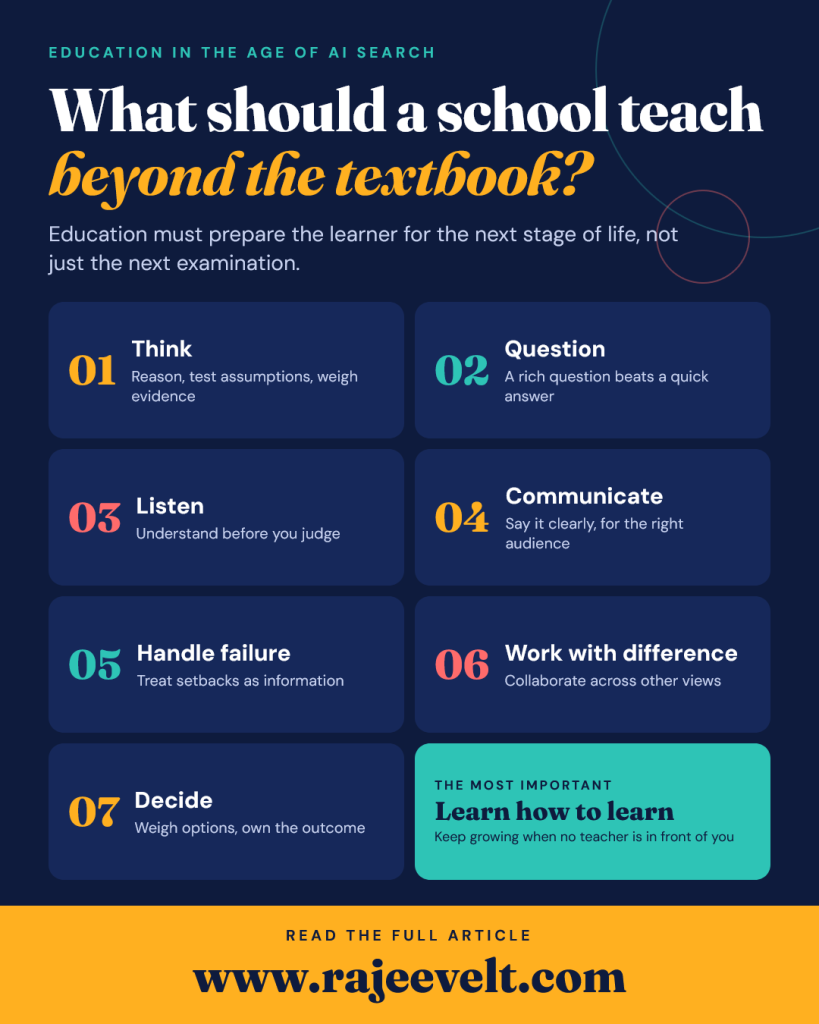
I personally believe that “the purpose of education is not to prepare a child for the next examination. It is to prepare the learner for the next stage of life.”
That sentence looks simply, yet it changes everything. It changes how we teach. It changes how we assess. It changes what we expect from teachers and it changes what we should call a successful school.
The Seven Capacities a School Should Build
Over the years, we have come to see seven capacities that a school should deliberately develop. None of them appears as a chapter in a standard textbook. All of them appear, sooner or later, in every life.
1. How to Think
Critical thinking is the disciplined process of analysing information, testing assumptions, weighing evidence and reaching reasoned conclusions. Most students are asked to remember. Far fewer are asked to reason. Yet reasoning is the skill that survives when facts become outdated, and facts always become outdated.
How do we teach it? Not through a single lesson, but through a classroom culture. We ask, “Why do you think so?” We ask, “What would change your mind?” We ask, “Who benefits if this claim is believed?” Over time, these questions stop being the teacher’s and become the student’s own.
This capacity has a very practical edge in the era of AI search. AI systems can produce answers that sound authoritative and are still wrong. A student should learn to treat every fluent paragraph as a claim to be examined, not a fact to be accepted. Confidence of tone is not evidence of truth. Isn’t that a lesson worth learning at fourteen rather than at forty?
2. How to Question
Questions are the engine of learning. Yet in many classrooms, we quietly train children to stop asking them. The student who asks too much is “disruptive.” The student who asks something unexpected is “off-topic.” After a few years, the curiosity that every child is born with has been politely sanded away.
Inquiry is a learning process driven by the learner’s own questions, in which understanding is built through investigation rather than received through instruction.
We should reverse this. A good school treats a thoughtful question as more valuable than a correct answer. It teaches children the difference between a lazy question (“What is the answer?”) and a rich one (“What would have to be true for this answer to be wrong?”).
This matters enormously now. The quality of an AI response depends heavily on the quality of the question put to it. The student who can frame a precise, layered, well-contextualised question will get far more from any tool than the student who cannot. Questioning, in short, has become a form of literacy.
3. How to Listen
Listening is the most neglected skill in education. We teach children to speak, to present and to debate. We rarely teach them to listen.
Active listening is the practice of giving full attention to another person, understanding their meaning, and responding thoughtfully rather than merely waiting for a turn to speak. Think about the arguments in your own life. How many of them arose because someone was not heard? How many workplaces fail not through lack of intelligence but through lack of attention to one another?
A school can teach listening in ordinary ways. Ask a student to restate a classmate’s argument fairly before disagreeing with it. Require a group to summarise what the previous speaker said before adding a new point. These small rituals build a large capacity: the ability to understand before judging.
4. How to Communicate
A brilliant idea that cannot be explained is, in practice, a lost idea. Communication is therefore not a soft skill. It is the channel through which every other skill reaches the world.
Communication is the ability to express ideas clearly, honestly and appropriately, in speech, writing and other media, for a specific audience and purpose.
Notice the final clause: for a specific audience and purpose. Writing a message to a friend, a report for a manager and a letter to a stranger are three different tasks. Students should learn to shift between them.
Writing deserves special mention. Clear writing is clear thinking made visible. When a student struggles to write a paragraph, the problem is rarely grammar. It is usually that the thought itself is not yet clear. When we are insisting on good writing, we are really insisting on good thinking.
The AI age raises the stakes. A machine can generate text instantly, so the human advantage lies in having something worth saying, in having a point of view, a voice and the integrity to stand behind one’s words. A school should teach students to use technology to sharpen their expression, never to replace it.
5. How to Handle Failure
No honest account of education can skip this one. Our examination systems, however well-intentioned, often teach children that failure is a verdict. A low mark becomes a label, and the label becomes an identity: “I am weak at maths.” “I am not a good student.” Few lessons are more damaging, and few are more common.
Resilience is the capacity to recover from setbacks, adapt to difficulty and continue making progress toward meaningful goals.
Growth mindset is the belief that abilities can be developed through effort, good strategies and feedback, rather than being fixed traits.
We should show children, by example and by design, that failure is information. It tells us what to adjust. The scientist whose experiment fails has learned something. The writer whose draft is rejected has learned something. A school that makes it safe to fail early, in small and recoverable ways, produces adults who are not paralysed by failure later, when the stakes are real.
How can we do this practically? Allow revision and resubmission. Reward improvement, not just the final score. Let teachers speak openly about their own mistakes. When a principal can say, “I got that decision wrong, and here is what I learned,” an entire school community learns that mistakes are survivable.
6. How to Work with People Who Think Differently
The real world does not sort people by opinion, background or temperament. Every workplace, every community and every family contains people who see things differently from us. The ability to work productively across that difference is arguably the defining skill of the coming decades.
Collaboration is the process of working jointly with others toward a shared goal, drawing on diverse perspectives and distributing responsibility fairly.
Intellectual humility is the willingness to recognise the limits of one’s own knowledge and to remain open to being corrected.
Group projects are the usual tool, and they are often done poorly: one student works, three coast, and everyone shares the grade. A better design assigns clear roles, requires students to document how disagreements were resolved, and assesses the process of collaboration as well as the product. There is an additional reason this skill matters now. AI systems increasingly personalise what each of us sees, which means we can drift into comfortable bubbles without noticing. A student who has practised listening to, and learning from, people who disagree with them is far better protected against that drift.
7. How to Make Decisions
We ask children to make very few real decisions. Timetables are set. Subjects are assigned. Choices are made for them, with the best of intentions. Then, at the age of seventeen or eighteen, we suddenly expect them to choose a stream, a course, a career and a city.
Decision-making is the process of identifying options, weighing evidence and consequences, and choosing a course of action while accepting responsibility for the outcome.
Good decision-making can be taught. We can ask students to define the problem, list their options, identify what they do not know, consider the worst realistic outcome, and decide how they will review the choice later. We can let them make real decisions within the school, about a project, a budget or a club, and live with the consequences.
Judgment, unlike knowledge, grows only through practice. A school that gives children no opportunity to exercise it cannot expect them to possess it.
The Most Important Thing: Learning How to Learn
The question we were asked is direct. What, in your view, is the most important thing a school should teach beyond the textbook?
We have thought about it for a long time, and our answer is this: a school should teach students how to continue learning when no teacher is standing in front of them.
Every capacity we have described, thinking, questioning, listening, communicating, resilience, collaboration and judgment, serves this single purpose. They are the components of one larger ability.
Self-directed learning is the capacity to identify what one needs to learn, find and evaluate resources, apply effective strategies, monitor one’s own progress, and persist without external supervision.
Metacognition is the awareness and regulation of one’s own thinking, which means knowing what you know, what you do not know, and how you learn best.
Why do we place this above all else? Because the future is uncertain in a way no curriculum can fully anticipate. The careers our students will hold may not exist yet. The tools they will use have not been invented. The problems they will solve have not yet been named. The World Economic Forum’s Future of Jobs reports have repeatedly placed analytical thinking, resilience, flexibility and a commitment to lifelong learning among the skills employers’ value most. The OECD’s Learning Compass 2030 describes a similar vision, built around agency and the ability to navigate change. India’s National Education Policy 2020 also calls for a shift from rote learning toward critical thinking and holistic development. Many different institutions, in many different countries, have reached the same conclusion.
So, the argument is not merely ours. It is a growing global consensus. The student who has learned how to learn will adapt to whatever comes. The student who has only memorised what was taught may not.
A simple test follows. Suppose a graduate walks out of school today and meets a problem nobody has prepared them for. What do they do? Do they freeze and wait for instructions? Or do they ask a good question, find reliable information, test their understanding, ask for help when needed, and keep going? The second graduate has been educated. The first has only been schooled.
How This Changes Teaching, Assessment and School Leadership
If we accept that education should prepare learners for life, then several practical consequences follow.
It changes how we teach.
The teacher moves from being the sole source of information to being a designer of learning experiences. Instead of asking, “Did I cover the syllabus?”, we begin to ask, “What did students become able to do?” Lessons include more questions, more problems with no single answer, more discussion and more reflection.
It changes how we assess.
Examinations that reward recall alone will produce students who are good at recall alone. We need a broader range of evidence: projects, portfolios, presentations, oral discussions, reflective journals and open-ended problems. We also need to assess how a student reached an answer, not only whether the answer was correct.
This shift becomes essential in the AI era. If a tool can complete a standard homework task in seconds, then the task itself was measuring the wrong thing. Better to design assessments that ask students to explain their reasoning, defend their choices aloud, apply ideas to unfamiliar situations, and show how they verified what a tool told them.
It changes what we expect from teachers.
We cannot demand this of teachers without supporting them. Teachers need time, training and trust. They need professional development that treats them as thinkers, not as deliverers of a script. A teacher who has never been invited to question cannot easily teach children to question.
This is why teacher education sits at the heart of reform. The quality of an education system, as is often said, cannot exceed the quality of its teachers. We would add that it cannot exceed the learning culture its teachers inhabit.
It changes what we call a successful school.
A school is not successful merely because its toppers score well. It is successful when its average student leaves more curious, more capable and more confident than when they arrived. It is successful when its graduates are good colleagues, good citizens and good learners. Parents, too, are partners in this redefinition. When families value understanding over marks alone, children feel free to take intellectual risks.
A Practical Framework: Teaching AI Literacy Without Losing the Child
Many schools are asking how to respond to AI tools. Banning them is unrealistic; surrendering to them is unwise. We suggest a middle path built on one principle: the tool may assist the thinking, but it may never replace it.
A School Can:
- Teach verification. Require students to cross-check any AI-generated claim against at least two independent, reliable sources.
- Teach prompting as questioning. Show that a better question yields a better answer, and that a good question requires understanding the topic first.
- Teach transparency. Ask students to state when and how they used a tool, just as they would cite any other source.
- Teach the limits. Discuss openly that AI systems can be wrong, biased or out of date, and that they have no accountability for their errors. The student does.
- Protect the struggle. Keep some tasks tool-free, because the effort of working through a hard problem is itself how understanding forms.
Is this difficult? Yes. Is it necessary? We believe so. A generation that can use AI wisely will have an enormous advantage over one that either fears it or obeys it blindly.
What Parents Can Do
Schools cannot do this alone, and we would be failing the reader if we left parents out.
We should ask our child, “What good question did you ask today?” rather than only, “What marks did you get?” Let them struggle with a problem for a while before stepping in. Admit your own mistakes in front of them. Read together. Disagree respectfully in their presence. Children learn how to think, listen and recover largely by watching the adults around them do these things.
Frequently Asked Questions
What should schools teach beyond the textbook?
Schools should teach critical thinking, questioning, listening, communication, resilience, collaboration and decision-making, all anchored in the ability to keep learning independently throughout life.
Why is critical thinking important in the age of AI?
AI tools produce fluent answers that may be incomplete, biased or incorrect. Critical thinking allows students to evaluate those answers instead of accepting them blindly.
Does teaching beyond the textbook mean ignoring the syllabus?
No. Knowledge remains essential. Beyond-the-textbook learning builds on the syllabus by teaching students to apply, question and extend what they know.
How can teachers assess skills like communication or resilience?
Through portfolios, projects, presentations, oral explanations, peer-feedback records and reflective journals, using clear rubrics that describe observable behaviours.
What is the difference between SEO and GEO?
SEO helps content rank in traditional search results. GEO helps content be understood and cited by AI-generated answers. Both reward clear, credible, well-structured writing.
What is the single most important skill a school can teach?
In our view, learning how to learn: the ability to direct one’s own education when no teacher is present.
Preparing for the Next Stage of Life
Let us return to where we began. A school should certainly teach knowledge. Nothing in this article argues otherwise. But knowledge alone is not enough, and it never was. The child sitting in our classroom today will one day face decisions, disagreements, disappointments and discoveries that no textbook describes. What will carry that child through is not a memorised page. It is a mind that can think, a voice that can speak, an ear that can listen, a spirit that can recover, and a habit of learning that never switches off.
The machines are getting faster. The answers are getting cheaper. What remains scarce, and therefore precious, is human judgment, human character and human curiosity. These are what a school exists to grow.
Therefore, we put the question back to you. What do you believe a school should teach beyond the textbook as a teacher, a parent, a school leader or a student? Our answer is to teach children how to learn without us. Tell us yours.
Resources and Learning Resources Web-links
https://www.rajeevelt.com/gratitude-in-leadership-and-management/rajeev-ranjan/ https://www.rajeevelt.com/teachers-role-and-responsibility-in-promoting-gratitude-in-school/rajeev-ranjan/