


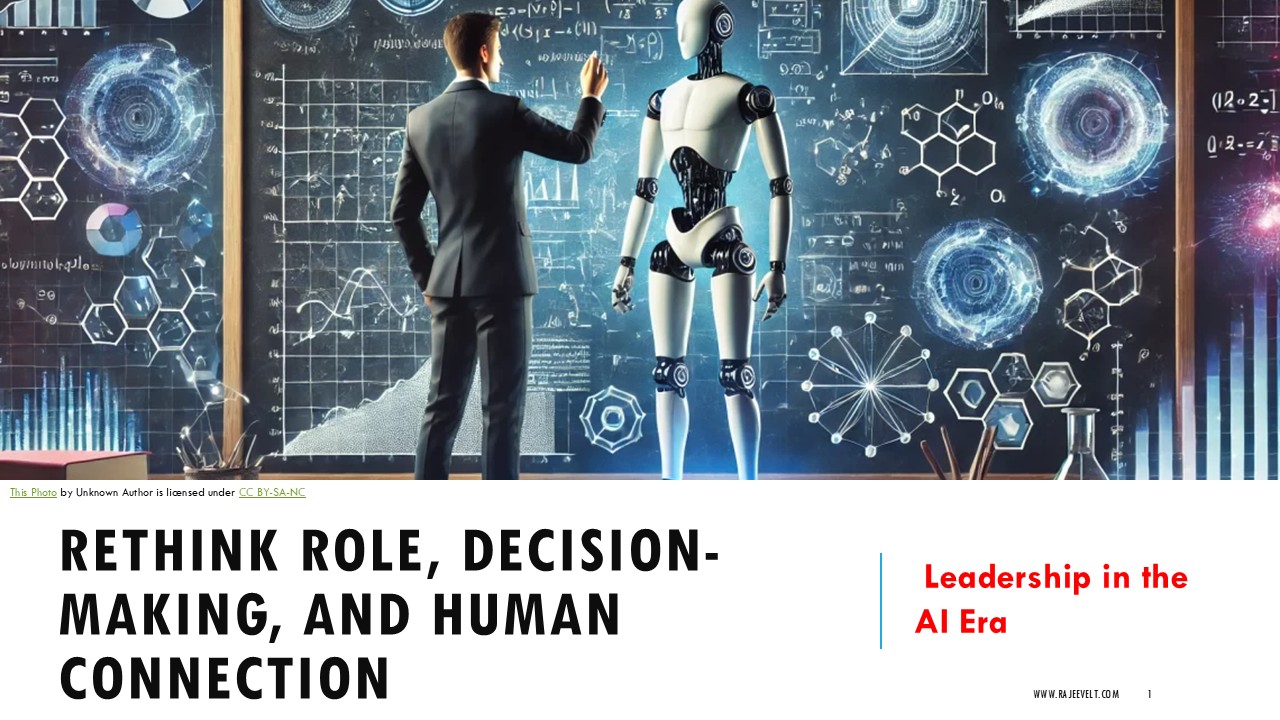
Leadership in the AI Era: How Global Leaders Should Rethink Role, Decision-Making, and Human Connection
Leadership in the AI era demands a new playbook — from decision-making and ethics to emotional intelligence and human handling. Discover what it takes to lead in the age of artificial intelligence.
Keywords: leadership in AI era, AI leadership skills, future of leadership, decision-making with AI, human-centered leadership, digital transformation leadership, leading in the age of artificial intelligence
Introduction: A Defining Moment for Leadership
We are living through the most significant leadership transition in a generation. Artificial intelligence has moved out of research labs and into boardrooms, factory floors, hospitals, classrooms, and government offices. It is no longer a “technology topic” — it is a leadership topic.
Leadership was built on a simple premise for decades: the person at the top knew more than anyone else in the room. They had the widest view, the deepest experience, and the most complete picture of the business. AI has quietly dismantled that premise. A machine can now analyse more data in ten seconds than a leader could review in ten years. It can spot patterns invisible to the human eye, forecast demand, detect fraud, write code, draft contracts, and simulate a thousand possible futures before lunch.
So, what, then, is left for the leader to do?
The answer is not “less.” It is “different — and more important than ever.” Leadership is shifting away from possessing information and toward exercising judgment in the AI era. The leaders who succeed won’t be the ones who use the most AI tools. They will be the ones who know when to trust the machine, when to override it, and how to keep their people human in a workplace increasingly run by algorithms.
“AI can tell you what is likely. Only a leader can decide what is right.”
1. The Changing Role of the Leader
From Information Gatekeeper to Meaning-Maker
The leaders spent enormous energy simply gathering and controlling information — quarterly reports, market research, competitor analysis in the pre-AI world. That labour has been largely automated. AI dashboards now deliver real-time insight at the click of a button.
This changes the leader’s core job. The modern leader is no longer the person who knows the most; they are the person who can make sense of the most. Their role has shifted from data collector to interpreter-in-chief — someone who takes a flood of machine-generated insight and turns it into direction, priorities, and meaning for their organization.
From Order-Giver to Context-Setter
Command-and-control leadership assumed the leader had superior visibility. When AI systems and frontline employees often have more real-time visibility than the executive suite, rigid top-down instruction becomes a liability. Today the leaders succeed by setting context — vision, values, guardrails, and desired outcomes — and then trusting empowered teams (and their AI tools) to find the best path there.
From Technical Expert to Systems Thinker
Leaders no longer need to be the most technical person in the room, but they do need to understand how AI systems behave: their strengths, their blind spots, their biases, and their failure modes. A leader who blindly trusts an algorithm is just as dangerous as one who dismisses it entirely. The new leadership literacy is not “knowing how to code” — it’s “knowing how to question a model’s output.”
“The leader of the future doesn’t need to be the smartest person in the room. They need to be the wisest person in a room full of smart machines.”
From Authority Figure to Trust Architect
Perhaps the most enduring role of a leader in the AI era is building and protecting trust — trust between humans and machines, and trust among humans navigating a world reshaped by automation. Employees look to leaders to answer the questions AI cannot: Is my job safe? Is this fair? Can I believe what this system is telling me? Leadership itself becomes an act of translation between technological capability and human confidence.
2. Decision-Making in the Age of AI
The Paradox of Abundant Intelligence
AI has created a strange paradox: the more predictive power leaders have access to, the harder some decisions become. Data can tell you what happened and what is statistically likely to happen next — but it cannot tell you what your organization should value, what risks are worth taking for a bigger purpose, or how a decision will be felt by the people it affects.
This is the space where human judgment becomes irreplaceable.
A New Decision-Making Framework
Leaders navigating AI-augmented decisions increasingly need to separate three types of decisions:
- Machine-led decisions — high-volume, low-stakes, pattern-based calls (fraud flags, inventory reordering, basic scheduling) where AI outperforms humans and should be trusted with minimal oversight.
- Human-led, AI-informed decisions — high-stakes, ambiguous, or values-laden calls (restructuring, market entry, layoffs, culture decisions) where AI provides input but a human must own the outcome and its consequences.
- Human-only decisions — decisions rooted in empathy, ethics, identity, and long-term trust, where outsourcing judgment to a model would itself be a leadership failure — no matter how accurate the prediction.
Knowing which bucket a decision fall into is, in itself, a critical leadership skill.
Guarding Against Algorithmic Overconfidence
AI models are often precise but not always correct — and precision can be mistaken for truth. A model trained on historical data will confidently replicate historical bias. A forecasting tool will confidently miss a black-swan event it has never seen before. Great leaders build in structured skepticism: red-teaming AI recommendations, asking “what is this model not seeing,” and preserving space for dissenting human voices before decisions are finalized.
“Data will always tell you the safest story. Leadership is often about choosing the story data can’t yet see.”
Speed Without Recklessness
AI accelerates the pace of decisions — but speed without wisdom is just faster mistakes. The best leaders use AI to compress the analysis phase of decision-making, freeing up more time — not less — for reflection, stakeholder consultation, and stress-testing implications before committing.
3. Human Handling: The Skill AI Cannot Replace
Leading People, Not Just Managing Outputs
Automation can optimize a workflow, but it cannot manage a grieving employee, mediate a conflict between two department heads, or restore morale after a layoff. The leader’s calendar increasingly fills with the messiest, most human parts of the job as routine tasks get automated, — the parts that were always hardest to scale, and the parts AI is least equipped to handle.
This makes emotional intelligence not a “soft skill” but a core leadership competency in the AI era.
Managing AI Anxiety
Nearly every workforce today carries some level of anxiety about AI — fear of job loss, fear of irrelevance, fear of being watched or scored by algorithms. Ignoring this anxiety doesn’t make it disappear; it makes it fester into disengagement or quiet resistance to change. Leaders should proactively name the fear, communicate honestly about what is and isn’t changing, and involve employees in shaping how AI is adopted rather than having it imposed on them.
“People don’t resist AI. They resist feeling replaceable. Leadership’s job is to make sure they never feel that way.”
Reskilling as an Act of Leadership, Not HR Policy
Sending employees to an occasional AI training webinar is not reskilling — it’s a checkbox. Real reskilling requires leaders to treat human capability as seriously as they treat capital investment: mapping which roles will change, creating real pathways for employees to grow into higher-value work, and measuring success not by “AI adoption rate” but by how many people were carried forward, not left behind.
Preserving Psychological Safety in an Automated Workplace
When algorithms start influencing performance reviews, promotions, or workload distribution, employees can quickly feel reduced to a data point. Leaders should actively protect the human dimension of the workplace — ensuring people still feel seen, heard, and evaluated with context and compassion, not just scored by a system.
The Return of “High-Touch” Leadership
Ironically, in a hyper-digital workplace, the leaders who stand out are the ones who show up in deeply human ways — walking the floor, having unscripted one-on-ones, remembering personal details, celebrating small wins. As efficiency gets automated, presence becomes a competitive advantage in leadership.
4. Ethics, Trust, and Responsible AI Leadership
Leaders are now accountable not just for business outcomes but for how those outcomes are achieved — including the fairness, transparency, and social impact of the AI systems they deploy.
Key responsibilities include:
- Bias oversight — ensuring AI systems are regularly audited for discriminatory outcomes in hiring, lending, promotion, or customer treatment.
- Transparency — being honest with employees and customers about where and how AI is used, especially when it affects people’s opportunities or livelihoods.
- Accountability — accepting that “the algorithm did it” is never an acceptable excuse; the leader remains responsible for decisions made with AI’s assistance.
- Sustainability — weighing the environmental and social costs of AI infrastructure alongside its business benefits.
“You cannot outsource accountability to an algorithm. Leaders don’t get to blame the machine — they own the outcome.”
5. Core Leadership Skills for the AI Era
Bringing it all together, the leaders who will thrive over the next decade tend to share a consistent skill set:
- Judgment over information — the ability to make sound calls even when — especially when — the data is incomplete or contradictory.
- Adaptive learning — comfort with constant reskilling, unlearning old models, and staying curious rather than defensive.
- Emotional intelligence — the capacity to read a room, sense unspoken concerns, and lead people through uncertainty with empathy.
- Ethical grounding — a clear, non-negotiable values compass that guides how AI is used, not just whether it is used.
- Systems thinking — understanding how a decision in one part of an AI-augmented organization ripples through the rest.
- Communication clarity — the ability to translate complex technological change into a simple, honest, human story that teams can rally around.
- Courage — the willingness to slow down a popular AI initiative when it conflicts with ethics, culture, or long-term trust.
Conclusion: Leadership, Redefined — Not Replaced
Artificial intelligence is not making leadership obsolete. It is stripping away the parts of leadership that were never really about leading in the first place — data-crunching, routine coordination, repetitive analysis — and leaving behind the parts that always mattered most: judgment, empathy, ethics, and the ability to bring people together around a shared purpose.
The organizations that will win the next decade won’t simply be the ones with the best algorithms. They will be the ones led by people who know how to combine machine intelligence with human wisdom — leaders who use AI to see further, but still rely on their own conscience to decide where to go.
“The future will not be led by artificial intelligence. It will be led by leaders intelligent enough to know exactly where AI ends and humanity must begin.”
- Drucker, P. F. (2006). The Effective Executive. HarperBusiness.
- Bennis, W. (2009). On Becoming a Leader. Basic Books.
- Kahneman, D. (2011). Thinking, Fast and Slow. Farrar, Straus and Giroux.
- Harvard Business Review — “AI Won’t Replace Leaders, But It Will Change What Leadership Means” (ongoing HBR AI & Leadership coverage, hbr.org).
- McKinsey & Company — “The State of AI” annual global survey reports, mckinsey.com.
- World Economic Forum — “Future of Jobs Report,” weforum.org.
- MIT Sloan Management Review — “Artificial Intelligence and Business Strategy” research series, sloanreview.mit.edu.
- Deloitte Insights — “Human Capital Trends” and “State of AI in the Enterprise” reports, deloitte.com.
- Edelman Trust Barometer — annual global trust and technology survey, edelman.com.
- Ranjan, R. — Rajeevelt.com, leadership and educational thought-leadership essays (rajeevelt.com).