


“Hebb’s Law”
“The Neuroscience of Learning, Habits, and Success”
Hebb’s Law-“How Repeated Experience Rewires the Brain and Shapes Human Potential”
The philosophers, educators, and scientists have sought to answer one enduring question for centuries: How do we become who we are? Why does one child develop extraordinary musical talent while another excels in mathematics? Why do repeated habits become almost effortless over time? Why does a traumatic memory remain vivid for decades, whereas a forgotten lesson disappears within days? And perhaps most importantly, can we intentionally reshape our minds by changing what we repeatedly think, feel, and do?
Modern neuroscience suggests that the answers to these questions lie not in a fixed brain but in a dynamic organ that continually remodels itself throughout life. Every conversation we have, every skill we practise, every emotion we repeatedly experience, and every decision we make leaves a biological trace within the intricate network of billions of neurons that constitute the human brain. The brain behaves more like a living ecosystem, continuously adapting to experience rather than being a rigid machine programmed at birth. Hebb’s Law stands one of the most influential principles in neuroscience— at the centre of this remarkable adaptability.
The famous phrase, “Neurons that fire together wire together,” has become one of the most widely quoted statements in neuroscience. Although the wording itself was coined later by researchers interpreting Donald Hebb’s ideas, it elegantly captures the essence of his revolutionary theory. Hebb proposed that when two neurons are repeatedly activated together, the connection between them becomes stronger, making future communication more efficient. Over time, repeated activation transforms temporary neural activity into lasting neural architecture.
This deceptively simple principle has profoundly influenced neuroscience, psychology, education, artificial intelligence, rehabilitation medicine, leadership studies, sports science, and behavioural economics. It explains why repeated practice strengthens expertise, why unhealthy habits become difficult to break, why emotional experiences can permanently influence behaviour, and why lifelong learning remains possible even in old age.
Today, nearly every major discovery concerning learning, memory, neuroplasticity, and skill acquisition reflects Hebb’s original insight. Advances in brain imaging, molecular neuroscience, and computational modelling have refined and expanded his ideas, yet the fundamental message remains remarkably consistent: the brain changes according to how it is used.
Hebb’s Law is not merely an academic exercise. It provides a scientific framework for understanding personal growth, education, leadership, mental health, and human potential. It reminds us that every repeated thought, every repeated action, and every repeated emotional response contributes, however subtly, to reshaping the biological structure of the brain itself.
Donald Hebb: The Scientist Who Changed Neuroscience
Donald Olding Hebb was born in Chester, Nova Scotia, Canada, in 1904. Hebb’s journey was unusually diverse unlike many celebrated scientists who followed a direct academic path. He worked as a schoolteacher before becoming one of the twentieth century’s most influential psychologists, an experience that profoundly shaped his interest in learning and human development. Observing children in classrooms convinced him that intelligence could not be explained solely by inherited ability. Experience appeared to matter enormously, yet psychology at the time lacked a convincing biological explanation for how experience altered behaviour.
Hebb pursued graduate studies at McGill University under the distinguished psychologist Boris Babkin before working alongside pioneering neurosurgeon Wilder Penfield, whose surgical studies of epilepsy offered unprecedented insights into brain function. Later, Hebb collaborated with Karl Lashley, whose investigations into learning and memory challenged simplistic theories that assigned complex cognitive functions to isolated regions of the brain. These experiences exposed Hebb to both experimental psychology and clinical neuroscience, encouraging him to integrate behavioural observations with biological mechanisms.
Hebb published a book “The Organization of Behavior” (1949), that fundamentally altered the trajectory of neuroscience. At a time when little was known about synaptic communication or neuroplasticity, Hebb proposed that learning resulted from changes in the strength of connections between neurons. His theory suggested that repeated co-activation gradually modified the efficiency of synaptic transmission, creating what he called cell assemblies—networks of neurons capable of representing memories, ideas, perceptions, and behaviours.
This proposal was extraordinarily visionary. Decades later, discoveries concerning synaptic plasticity, long-term potentiation, and neural network dynamics would provide compelling biological evidence supporting many aspects of Hebb’s theory. While modern neuroscience has refined and expanded his ideas, Hebb’s conceptual framework remains deeply embedded within contemporary research.
Hebb’s Law
We should first understand that the human brain contains approximately eighty-six billion neurons, each capable of forming thousands of connections with neighbouring cells. These connections, known as synapses, enable neurons to communicate through complex patterns of electrical impulses and chemical neurotransmitters.
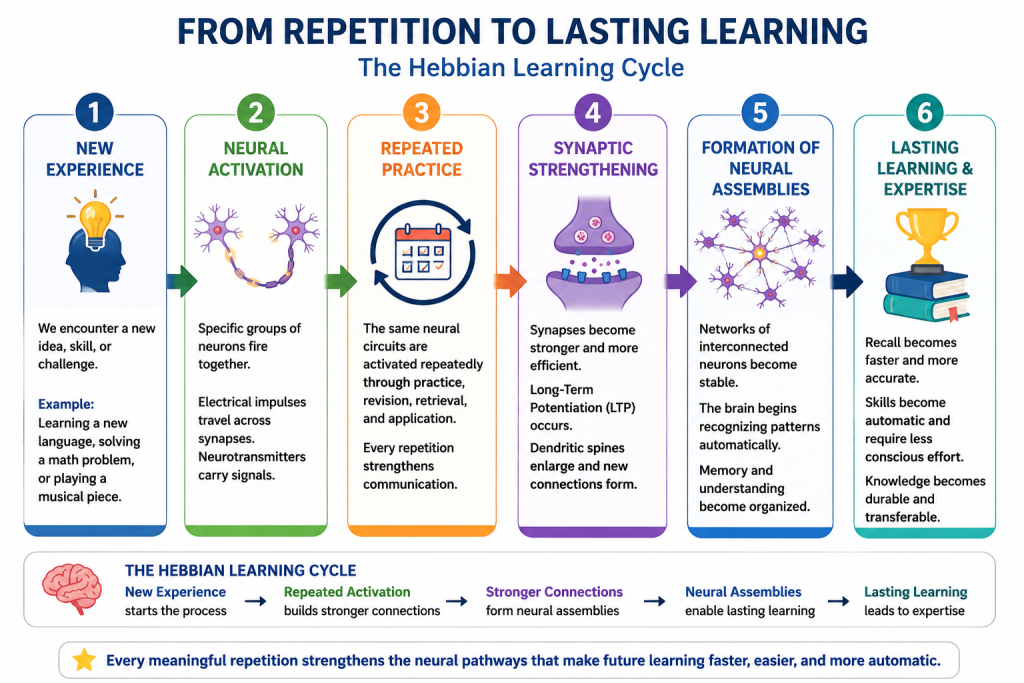
Contrary to popular belief, learning does not occur because new neurons suddenly appear whenever we study something new. Instead, learning primarily results from changes in the strength and efficiency of existing neural connections. Every experience activates specific neural circuits. If the same circuits are repeatedly activated together, communication between them gradually becomes faster, stronger, and more reliable.
Imagine walking through a dense forest where no visible trail exists. The first journey requires considerable effort because vegetation blocks every step. If we continue walking along exactly the same route every day, the plants gradually flatten, the ground becomes firmer, and the path eventually transforms into a well-defined trail. Future journeys become easier not because the destination changed, but because repetition reshaped the pathway itself.
Hebb believed the brain operates in a remarkably similar manner. Repeated neural activity strengthens synaptic pathways until information flows with increasing efficiency. Eventually, behaviours that initially demanded conscious effort become automatic. Reading, driving, speaking a language, playing the piano, solving mathematical problems, and riding a bicycle all reflect neural pathways strengthened through repeated activation.
Modern neuroscience confirms that repeated activation triggers molecular events inside neurons. Calcium ions enter the synapse, specialised proteins become activated, neurotransmitter receptors increase in number, dendritic spines enlarge, and entirely new synaptic connections may emerge. These microscopic structural changes gradually transform temporary neural activity into relatively stable biological architecture.
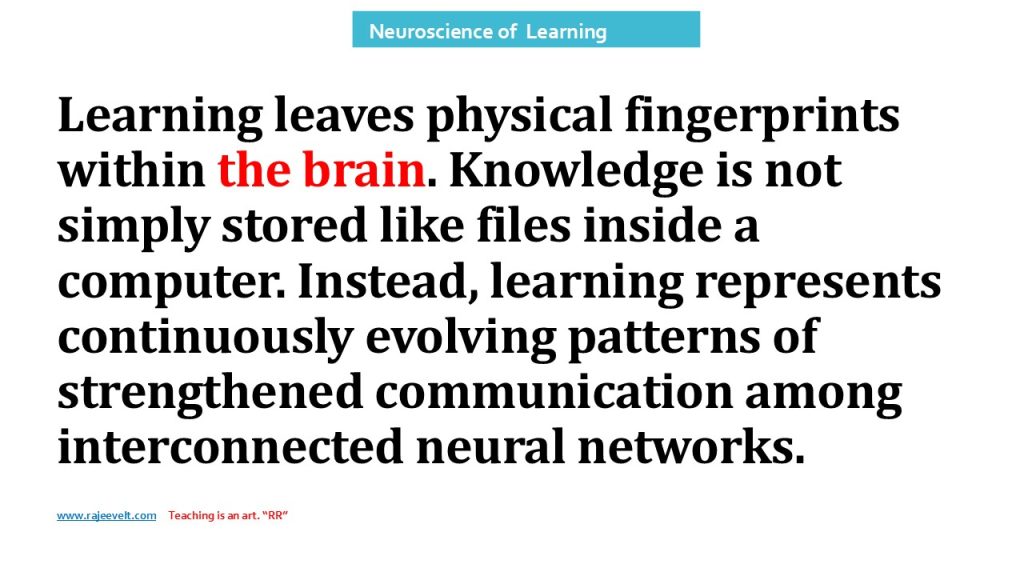
Learning therefore leaves physical fingerprints within the brain. Knowledge is not simply stored like files inside a computer. Instead, learning represents continuously evolving patterns of strengthened communication among interconnected neural networks.
The Cellular Basis of Learning
Communication between neurons depends upon specialised junctions called synapses. When an electrical impulse reaches the end of one neuron, neurotransmitters are released into the tiny synaptic gap separating neighbouring cells. These chemical messengers bind to receptors on the receiving neuron, increasing or decreasing the likelihood that it will generate its own electrical signal.
Among these neurotransmitters, glutamate plays a particularly important role in learning because it activates NMDA and AMPA receptors, which regulate synaptic plasticity. Repeated stimulation allows greater calcium entry into neurons, initiating biochemical cascades that strengthen synaptic transmission. Over time, these strengthened synapses require less stimulation to activate, making future communication increasingly efficient.
This process, known as long-term potentiation (LTP), represents one of the strongest biological mechanisms supporting Hebb’s theory. First demonstrated experimentally in the hippocampus during the early 1970s, LTP showed that repeated stimulation could produce long-lasting increases in synaptic strength. Since then, countless studies have demonstrated similar mechanisms throughout multiple regions of the brain.
However, neuroscience also recognises an equally important complementary process called long-term depression (LTD). Just as frequently used neural connections strengthen, rarely used connections gradually weaken. This balance prevents excessive neural excitation while allowing the brain to adapt continuously to changing environments.
Hebb’s Law therefore does not simply describe strengthening. It reflects the dynamic balance between reinforcement and pruning. Neural pathways that contribute to successful adaptation are preserved and enhanced, whereas inefficient pathways may gradually diminish through disuse. This continual process allows the brain to remain both stable and flexible throughout life.
Neuroplasticity: The Brain That Never Stops Changing
Perhaps the greatest implication of Hebb’s Law is that the brain remains capable of change far beyond childhood. For much of the twentieth century, scientists believed that brain development largely ceased after adolescence. Adult brains were viewed as relatively fixed structures with limited capacity for adaptation.
Research over the past several decades has fundamentally overturned this assumption. Brain imaging studies consistently demonstrate that learning new skills, acquiring additional languages, practising meditation, engaging in physical exercise, recovering from neurological injury, and even changing daily habits can produce measurable alterations in brain structure and function across the lifespan.
Professional musicians often exhibit enlarged motor and auditory cortical regions associated with years of deliberate practice. London taxi drivers, required to memorise thousands of streets, have demonstrated structural changes within portions of the hippocampus associated with spatial navigation. Stroke survivors frequently recover lost abilities because neighbouring neural networks reorganise themselves to compensate for damaged tissue. These remarkable examples illustrate the extraordinary adaptability of the human brain.
Hebb’s Law provides the theoretical foundation for understanding these observations. Repeated experience shapes neural organisation, and neural organisation subsequently influences behaviour. In this continuous reciprocal relationship, experience becomes biology, and biology shapes future experience.
Hebb’s Law and the Architecture of Memory
If Hebb’s Law explains how neural connections become stronger through repeated activation, it also offers one of the most compelling explanations for how memories are formed and preserved. Every memory, whether it is the face of a loved one, the sound of a familiar melody, or the sequence of movements required to ride a bicycle, begins as a transient pattern of neural activity. When that pattern is repeated or emotionally reinforced, the connections among the participating neurons become progressively stronger, increasing the likelihood that the same pattern can be reactivated in the future.
The hippocampus plays a central role in this process. It acts as a temporary hub where new experiences are encoded before they are gradually integrated into distributed networks across the cerebral cortex. Repeated retrieval of information strengthens these networks through synaptic plasticity, making memories more stable and accessible. This is why students who regularly review and recall information remember it far better than those who rely on a single session of intensive study. Memory is not strengthened merely by exposure; it is strengthened by repeated, meaningful activation of neural circuits.
Emotion further amplifies this process. Experiences accompanied by joy, fear, excitement, or sadness activate the amygdala, which modulates hippocampal activity and increases the probability that emotionally significant events will be remembered. From an evolutionary perspective, remembering emotionally charged experiences enhanced survival by enabling our ancestors to avoid dangers and repeat beneficial behaviours. Hebb’s Law therefore helps explain why emotionally meaningful learning often leaves a deeper and more enduring imprint on the brain than emotionally neutral experiences.
Habit Formation: The Biology of Repetition
Habits illustrate Hebb’s Law in everyday life more vividly than perhaps any other phenomenon. Every habit begins as a conscious action requiring attention and deliberate effort. With repetition, however, the neural pathways involved become increasingly efficient, gradually transferring behavioural control from conscious decision-making in the prefrontal cortex to more automatic processing within the basal ganglia.
Learning to drive provides an excellent example. Initially, every movement demands conscious attention. We think deliberately about steering, accelerating, braking, and monitoring traffic. After months of consistent practice, these actions become largely automatic. The brain has not become “smarter” in a general sense; rather, repeated activation has strengthened the specific neural circuits responsible for driving, allowing them to operate with remarkable efficiency.
The same principle explains why both constructive and destructive habits become deeply ingrained. Regular exercise, disciplined study, mindful reflection, and effective communication gradually become easier because the underlying neural pathways are reinforced through repeated use. Conversely, chronic procrastination, excessive digital distraction, persistent negative thinking, or addictive behaviours also become more automatic when repeatedly practised. The brain does not inherently distinguish between beneficial and harmful repetition; it simply strengthens the pathways that are most frequently activated.
This insight carries profound implications. Every repeated choice contributes, however subtly, to shaping the architecture of our future behaviour. Our daily routines are therefore not merely reflections of who we are; they are active participants in determining who we become.
Hebb’s Law in Education: Transforming How We Learn
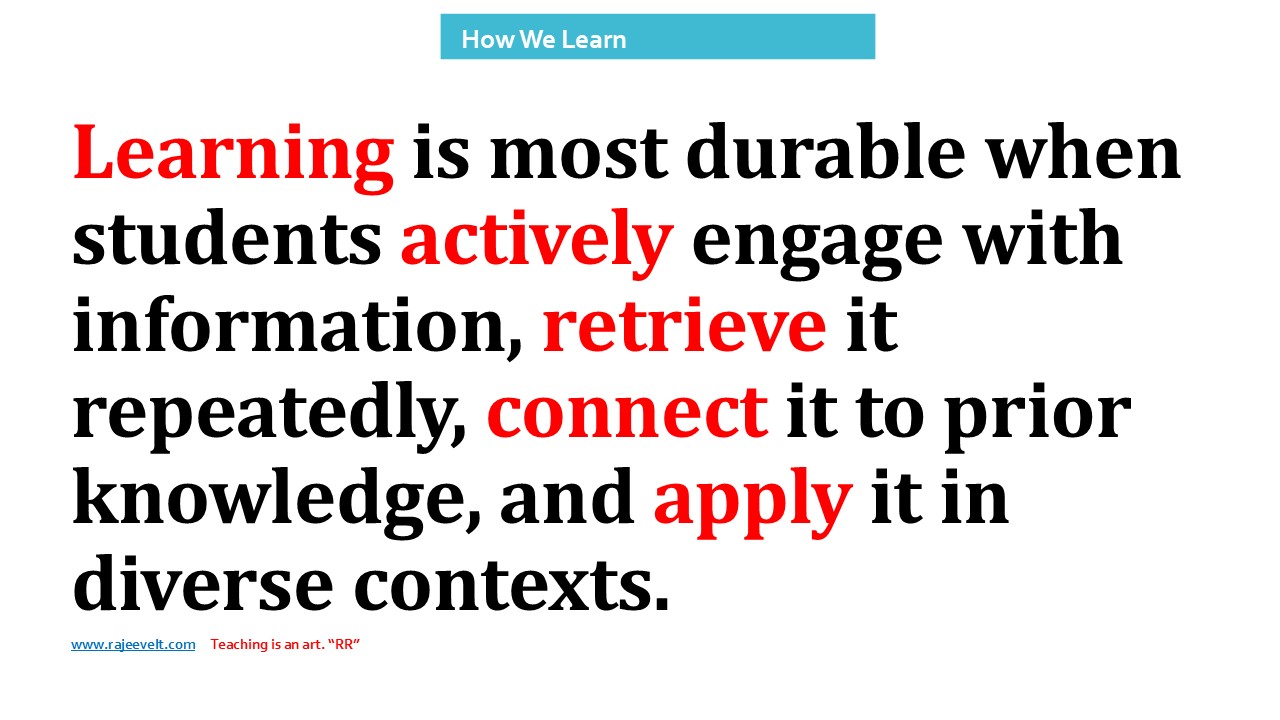
Education has long recognised the importance of practice, yet Hebb’s Law provides a biological explanation for why effective teaching strategies work. Learning is most durable when students actively engage with information, retrieve it repeatedly, connect it to prior knowledge, and apply it in diverse contexts. Passive exposure rarely produces lasting neural change because it generates insufficient activation of the relevant neural networks.
Modern educational research strongly supports practices such as spaced repetition, retrieval practice, elaborative questioning, interleaving, and timely feedback. These strategies repeatedly activate and refine neural circuits rather than allowing them to remain dormant between learning sessions. Each successful retrieval strengthens the underlying synaptic connections, making subsequent recall easier and more reliable.
Teachers therefore become architects of neural development. Every thoughtfully designed lesson, meaningful classroom discussion, collaborative activity, and constructive feedback session contributes to shaping students’ brains. Effective education is not simply the transmission of information; it is the careful orchestration of repeated experiences that strengthen neural networks associated with understanding, creativity, problem-solving, and critical thinking.
Parents likewise influence neural development through everyday interactions. Reading stories aloud, encouraging curiosity, engaging in meaningful conversations, and providing emotionally supportive environments repeatedly stimulate neural pathways involved in language, emotional regulation, and social cognition. Early childhood experiences are particularly influential because developing brains exhibit exceptionally high levels of plasticity, although meaningful change remains possible throughout life.
Leadership, Organisations, and Collective Learning
Hebb’s Law extends beyond individual learning into the functioning of organizations and societies. Organizational culture emerges through repeated patterns of communication, decision-making, and behavior. Every meeting, feedback conversation, recognition ceremony, and leadership action reinforces certain behavioural norms while discouraging others.
Leaders often assume that organizational transformation requires dramatic structural reforms. Neuroscience suggests a more gradual but powerful mechanism. Sustainable cultural change arises through consistent repetition of desired behaviors until they become embedded within collective organizational routines. Repeated demonstrations of trust foster psychological safety. Frequent collaboration strengthens cooperative habits. Continuous learning encourages innovation. Over time, these repeated interactions reshape not only organizational practices but also the neural habits of the individuals who participate within them.
This perspective explains why successful organizations emphasize consistent values rather than isolated motivational events. Lasting change depends less upon occasional inspiration than upon repeated reinforcement of constructive behaviors.
Artificial Intelligence and the Legacy of Hebb’s Law
Hebb’s ideas have profoundly influenced the development of artificial intelligence. Artificial neural networks, although vastly simpler than biological brains, were inspired by the concept that learning occurs through changes in the strength of connections between interconnected processing units.
In biological systems, synaptic strength changes through complex biochemical mechanisms involving neurotransmitters, receptor dynamics, and structural plasticity. Artificial neural networks approximate this process mathematically by adjusting connection weights during training. Although modern deep learning primarily relies on algorithms such as back propagation rather than classical Hebbian learning alone, Hebb’s fundamental insight—that learning emerges from modifications in network connectivity—remains central to computational neuroscience and machine learning.
The comparison also highlights the extraordinary sophistication of the human brain. Biological neural networks operate with remarkable energy efficiency, adapt continuously to changing environments, integrate emotion with cognition, and reorganize themselves following injury. Despite extraordinary advances in artificial intelligence, no existing machine fully replicates the adaptive richness of biological neuroplasticity.
Mental Health Through the Lens of Hebb’s Law
Mental health offers another powerful illustration of Hebb’s principle. Repeated patterns of thought and emotion gradually strengthen corresponding neural pathways. Persistent worry repeatedly activates networks associated with anxiety. Chronic self-criticism reinforces negative self-evaluative circuits. Recurrent traumatic memories repeatedly strengthen fear-related pathways involving the amygdala and associated brain regions.
Fortunately, the same principle underlies psychological recovery. Cognitive Behavioural Therapy (CBT), mindfulness-based interventions, behavioral activation, and exposure therapy all rely, directly or indirectly, upon creating new patterns of neural activation. By repeatedly practicing healthier cognitive and behavioral responses, individuals gradually strengthen adaptive neural circuits while reducing the dominance of maladaptive ones.
Neuroplasticity therefore provides a hopeful message. Although past experiences shape the brain, they do not permanently determine its future. Through sustained practice, supportive relationships, purposeful learning, and appropriate therapeutic interventions, the brain retains a remarkable capacity for positive change across the lifespan.
Sports, Excellence, and Deliberate Practice
Elite athletic performance further demonstrates Hebb’s Law in action. Champions are rarely distinguished solely by innate talent. Instead, years of deliberate practice strengthen neural circuits governing motor coordination, timing, anticipation, and decision-making. Repeated practice improves communication among the motor cortex, cerebellum, basal ganglia, and sensory systems, enabling movements that appear effortless despite requiring extraordinary neural precision.
The same principle applies to musicians, surgeons, pilots, artists, chess grandmasters, and scientists. Expertise reflects the gradual refinement of specialised neural networks through thousands of hours of purposeful, feedback-driven practice. Excellence is therefore not merely a psychological achievement but a biological transformation.
Limitations and Scientific Refinements
Although Hebb’s Law remains foundational, contemporary neuroscience recognises that it does not explain every aspect of learning. Synaptic plasticity is influenced by numerous additional mechanisms, including spike-timing-dependent plasticity, homeostatic plasticity, inhibitory neural networks, neuromodulatory systems, genetic factors, hormonal influences, sleep-dependent memory consolidation, nutrition, and environmental context.
Moreover, not every repeated experience strengthens neural connections equally. Attention, emotional significance, motivation, novelty, and reward substantially influence whether learning occurs. Sleep also plays a crucial role by consolidating newly strengthened synapses and selectively weakening less important ones. Hebb’s original theory therefore represents a foundational principle within a much broader and increasingly sophisticated understanding of brain plasticity.
Scientific progress has refined rather than replaced Hebb’s ideas. His central insight continues to guide research while being integrated into more comprehensive models of neural adaptation.
Conclusion
More than seven decades after the publication of The Organization of Behavior, Donald Hebb’s vision continues to shape neuroscience, psychology, education, artificial intelligence, rehabilitation, leadership, and behavioural science. His profound insight—that repeated neural activity strengthens neural connections—has become one of the organising principles of modern brain science.
Hebb’s Law reminds us that the brain is neither fixed nor passive. It is a living, dynamic organ that continuously responds to experience. Every conversation we have, every book we read, every skill we practice, every emotion we repeatedly cultivate, and every habit we reinforce contributes to the ongoing reconstruction of our neural architecture. Our experiences do not simply influence the brain; they become part of its biological structure.
This understanding carries both responsibility and hope. Responsibility, because repeated negative thoughts and behaviours can gradually shape maladaptive neural pathways. Hope, because repeated positive actions, meaningful learning, compassionate relationships, disciplined practice, and intentional reflection can strengthen healthier, more adaptive networks throughout life.
Hebb’s Law teaches us that human potential is not defined solely by genetics or circumstance. It is continuously sculpted by experience. The pathways we strengthen today become the foundation for the thoughts we think tomorrow, the habits we practice next year, and the person we ultimately become. In recognizing that “neurons that fire together wire together,” we recognize that every meaningful repetition is an opportunity to participate consciously in the lifelong construction of our own minds.
References
Bear, M. F., Connors, B. W., & Paradiso, M. A. (2020). Neuroscience: Exploring the Brain (4th ed.). Jones & Bartlett Learning.
Bliss, T. V. P., & Collingridge, G. L. (1993). A synaptic model of memory: Long-term potentiation in the hippocampus. Nature, 361(6407), 31–39. https://doi.org/10.1038/361031a0
Brown, R. E., & Milner, P. M. (2003). The legacy of Donald O. Hebb. Nature Reviews Neuroscience, 4(12), 1013–1019. https://doi.org/10.1038/nrn1257
Doidge, N. (2007). The Brain That Changes Itself. Viking.
Draganski, B., et al. (2004). Neuroplasticity: Changes in grey matter induced by training. Nature, 427, 311–312. https://doi.org/10.1038/427311a
Fields, R. D. (2020). The Brain Learns in Unexpected Ways. MIT Press.
Hebb, D. O. (1949). The Organization of Behavior: A Neuropsychological Theory. Wiley.
Kandel, E. R., Koester, J. D., Mack, S. H., & Siegelbaum, S. A. (2021). Principles of Neural Science (6th ed.). McGraw-Hill.
Kolb, B., & Gibb, R. (2014). Searching for the principles of brain plasticity and behaviour. Cortex, 58, 251–260. https://doi.org/10.1016/j.cortex.2013.11.012
Malenka, R. C., & Bear, M. F. (2004). LTP and LTD: An embarrassment of riches. Neuron, 44(1), 5–21. https://doi.org/10.1016/j.neuron.2004.09.012
Squire, L. R., et al. (2021). Fundamental Neuroscience (5th ed.). Academic Press.
Takeuchi, H., et al. (2011). Working memory training using mental calculation impacts structural connectivity. Journal of Neuroscience, 31(49), 17773–17781. https://doi.org/10.1523/JNEUROSCI.4893-11.2011
Zatorre, R. J., Fields, R. D., & Johansen-Berg, H. (2012). Plasticity in gray and white matter during learning. Nature Neuroscience, 15(4), 528–536. https://doi.org/10.1038/nn.3045