


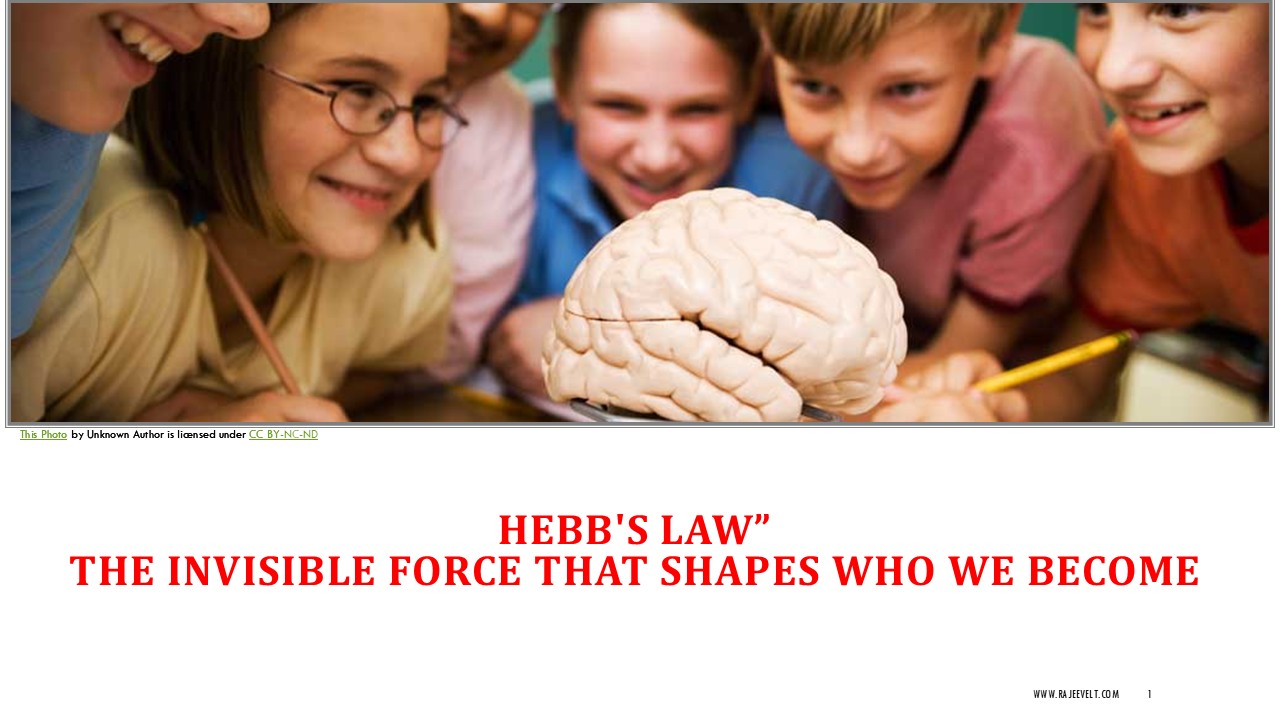
“Hebb’s Law”
The Invisible Force That Shapes Who We Become
It is interesting to imagine a young child sitting in front of a piano for the very first time. Every movement appears awkward. The fingers hesitate over unfamiliar keys, the rhythm constantly breaks, and every note demands conscious effort. Frustration arrives quickly because nothing feels natural. Yet something extraordinary is happening beneath the surface. Although the child cannot see it, millions of neurons within the brain are beginning to communicate in entirely new ways. Tiny electrical impulses travel across intricate neural networks, chemical messengers leap from one synapse to another, and microscopic changes begin to reshape the brain itself. The child’s fingers move with greater confidence weeks later. The familiar melodies emerge almost effortlessly months later. Years later, the same individual performs complex compositions with remarkable precision while carrying on a conversation or expressing deep emotion through music. What once required immense concentration has become almost automatic. The transformation did not occur because the piano changed or because the child’s hands became fundamentally different. It occurred because the brain changed.
This remarkable phenomenon extends far beyond music. Every language we learn, every mathematical equation we solve, every sport we master, every professional skill we develop, and every habit we cultivate reflects the brain’s extraordinary capacity to reorganise itself through experience. Whether we are learning to ride a bicycle, speak a second language, write computer code, lead an organisation, or comfort a distressed friend, repeated experiences gradually reshape the neural architecture that supports those behaviours. Human development is therefore not simply a story of acquiring knowledge; it is a story of continuously reconstructing the biological pathways through which knowledge is expressed.
The philosophers and educators believed for centuries that learning was primarily a psychological process. Ancient scholars emphasised repetition because they observed its effectiveness, even though they could not explain why it worked. Teachers encouraged students to practise repeatedly. Musicians rehearsed scales every day. Athletes performed the same movements thousands of times. Craftsmen spent decades perfecting their techniques. Leaders developed routines that strengthened discipline and judgement. Across cultures and civilisations, one principle quietly emerged: repetition changes performance. Yet no one fully understood the biological mechanism behind this universal observation.
Modern neuroscience has transformed that understanding. Today we know that learning is not merely the accumulation of information; it is the physical modification of the brain itself. Every meaningful experience leaves traces within the nervous system. Every repeated action strengthens particular neural pathways while allowing others to weaken. Every deliberate practice session changes the probability that specific neurons will communicate efficiently in the future. Learning, therefore, is not simply something the brain does—it is something that changes what the brain becomes.
This understanding has profound implications for every aspect of human life. It explains why some habits become automatic while others remain difficult to establish. It helps us understand why repeated thoughts gradually become deeply held beliefs, why emotional experiences often shape behaviour more powerfully than facts, why destructive habits become increasingly difficult to abandon, and why expertise emerges through years of disciplined practice rather than isolated moments of inspiration. It also provides scientific hope by demonstrating that change remains possible throughout much of life because the brain retains an extraordinary capacity for adaptation.
One of the most influential principles explaining this lifelong adaptability is known as Hebb’s Law. Although often summarised by the famous expression, “Neurons that fire together wire together,” the idea represents far more than an elegant scientific slogan. It fundamentally changed how we understand learning, memory, intelligence, habit formation, rehabilitation, leadership, education, artificial intelligence, and human potential. Few scientific principles have exerted such broad influence across so many disciplines while remaining remarkably simple in their central message.
At first glance, the statement appears almost deceptively straightforward. When groups of neurons repeatedly become active together, the connections between them gradually strengthen. As those connections strengthen, future communication becomes faster, more efficient, and more reliable. Eventually, behaviours that once demanded enormous cognitive effort become increasingly automatic. Memories become easier to retrieve. Skills become more refined. Decisions become more intuitive. In essence, repeated experience reshapes the brain’s internal wiring.
Although this principle now seems intuitive, it represented a revolutionary departure from prevailing scientific thinking during the middle of the twentieth century. At that time, the brain was often regarded as a relatively static organ whose fundamental structure changed little after childhood. Intelligence was frequently viewed as largely fixed, and learning was commonly interpreted as the simple storage of information within an unchanging biological system. Hebb challenged these assumptions by proposing that experience itself could alter the strength of neural connections, thereby transforming the physical organisation of the brain. His theory suggested that the brain was not merely a passive container of memories but an active, continually evolving network shaped by every meaningful interaction with the environment.
Subsequent decades of neuroscience have repeatedly confirmed the remarkable insight behind Hebb’s proposal. Advances in molecular biology, electrophysiology, functional magnetic resonance imaging, diffusion tensor imaging, computational neuroscience, and neuropsychology have revealed that learning genuinely alters synaptic communication. New proteins are synthesised, dendritic spines expand, receptor densities change, myelin adapts, and neural networks reorganise in response to repeated experience. What Hebb proposed theoretically has been observed experimentally across multiple species and countless research studies.
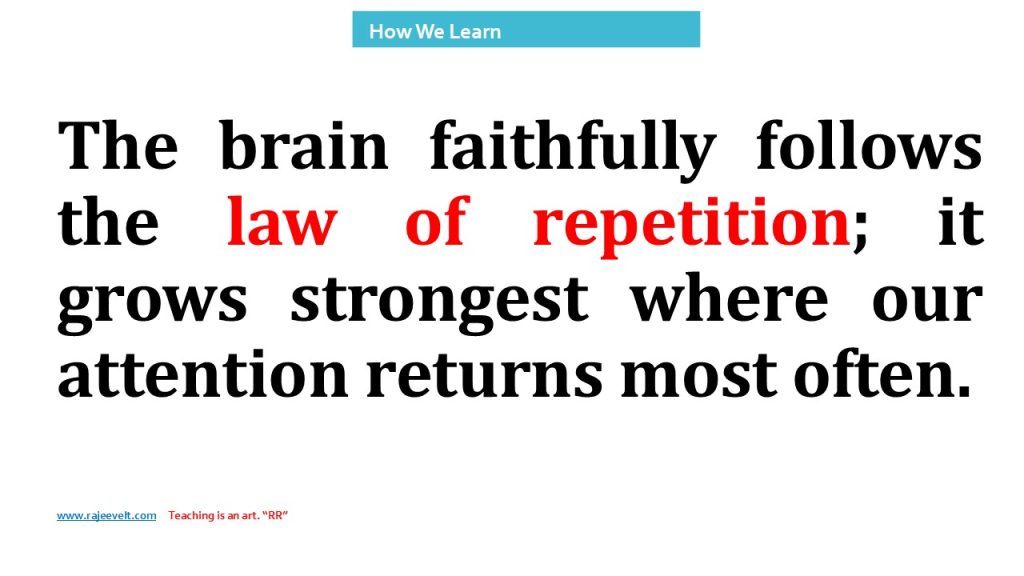
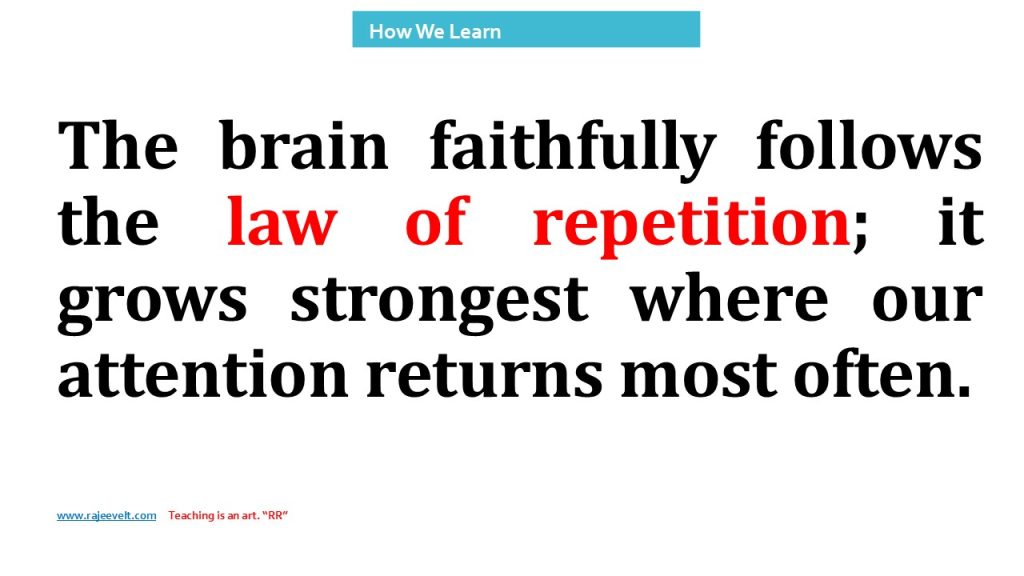
Perhaps the greatest significance of Hebb’s Law lies not only in its scientific accuracy but also in its profound implications for everyday life. Every morning routine we establish, every conversation we repeatedly have, every emotional response we reinforce, every skill we practise, and every belief we repeatedly revisit contributes, in subtle yet measurable ways, to reshaping the neural networks that govern our future thoughts and behaviours. The brain is constantly listening to repetition. It does not merely record what happens occasionally; it responds most powerfully to what happens consistently.
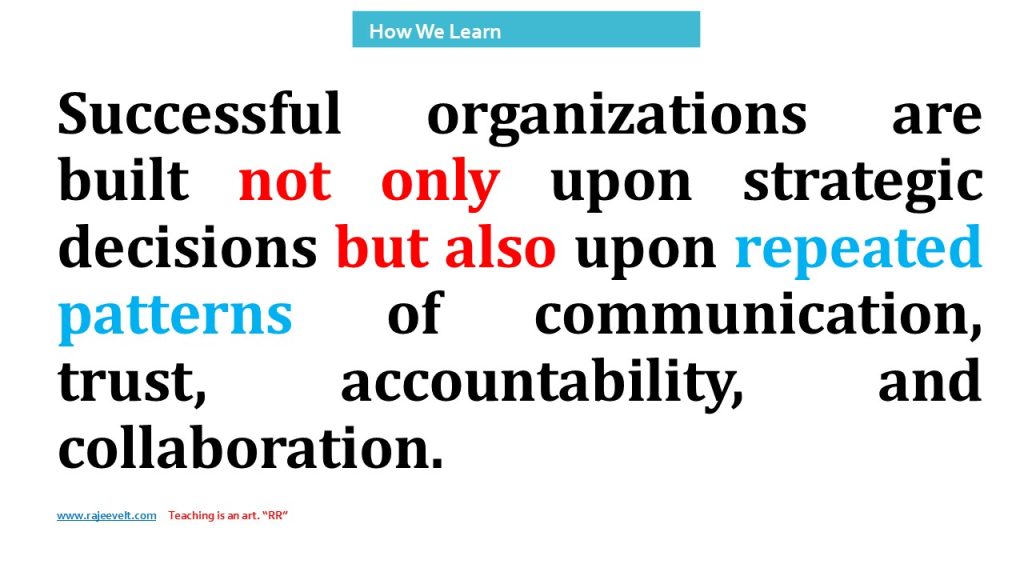
This observation explains one of the greatest paradoxes of human behaviour. We often expect dramatic change through isolated acts of motivation while underestimating the extraordinary influence of ordinary repetition. A single day of exercise rarely transforms physical fitness, yet months of consistent movement gradually reshape muscles, metabolism, and cardiovascular health. Similarly, one evening of study seldom creates expertise, but years of disciplined learning reorganise neural networks supporting knowledge, reasoning, and creativity. The brain rewards persistence more reliably than intensity because repeated activation strengthens biological connections over time.
The same principle also explains why undesirable habits become surprisingly resistant to change. Every repeated behaviour reinforces the neural pathways responsible for producing it. Initially, an unhealthy behaviour may require conscious choice, but repeated performance gradually transfers control to increasingly automatic neural systems, particularly those involving the basal ganglia. Eventually, behaviours occur with minimal conscious awareness because the brain has optimized the corresponding neural circuits through repetition. This optimisation serves an important evolutionary purpose by conserving cognitive resources, yet it also means that harmful habits can become deeply embedded when repeatedly practiced.
Our thoughts follow a similar pattern. Contrary to common assumptions, thoughts are not fleeting psychological events without biological consequences. Every recurring pattern of thinking repeatedly activates particular neural networks. Persistent optimism strengthens one set of pathways, while chronic rumination, fear, resentment, or self-criticism repeatedly reinforces others. Over months and years, these repeated patterns influence how we perceive ourselves, interpret challenges, and respond to uncertainty. Beliefs therefore emerge not simply because they are intellectually convincing but because repeated neural activation gradually stabilises specific patterns of cognition.
This insight carries profound implications for education. Every lesson taught in a classroom is more than an exchange of information; it represents an opportunity to influence the developing architecture of the learner’s brain. Effective teachers instinctively understand that meaningful learning requires repeated engagement rather than passive exposure. Retrieval practice, spaced repetition, collaborative discussion, problem-solving, reflection, and feedback all repeatedly activate neural circuits, making future learning progressively easier. Education, viewed through the lens of Hebb’s Law, becomes an act of carefully guiding the construction of neural networks rather than merely delivering content.
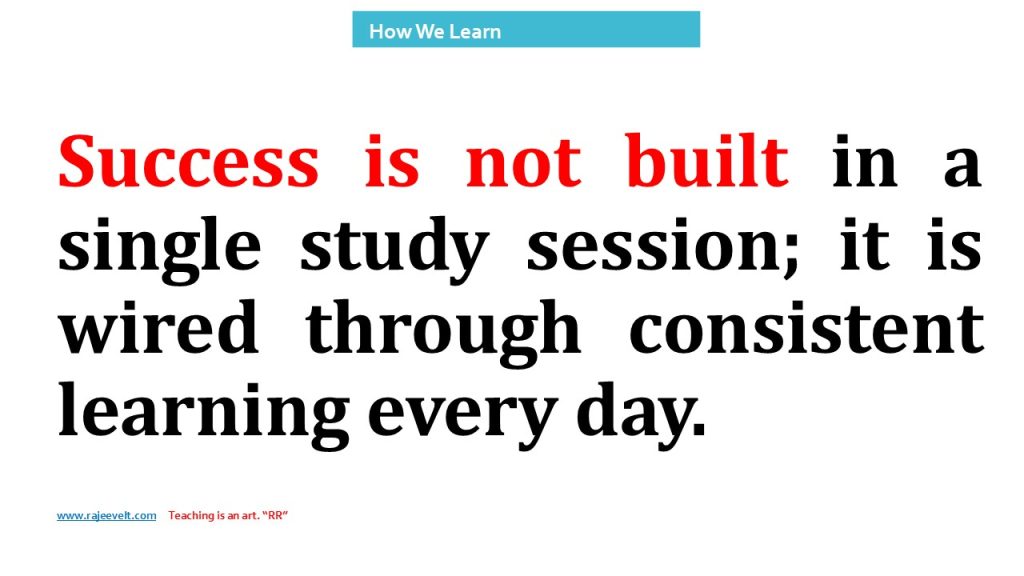
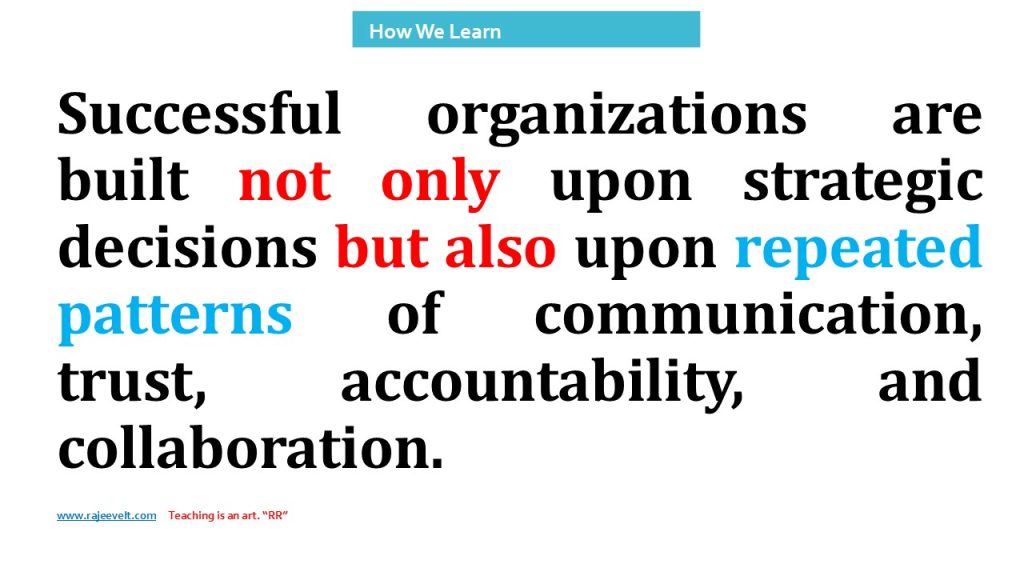
The implications extend equally into leadership and organisational behaviour. Successful organisations are built not only upon strategic decisions but also upon repeated patterns of communication, trust, accountability, and collaboration. Every meeting reinforces cultural expectations. Every recognition programme strengthens certain behaviours. Every leadership decision repeatedly activates organisational habits that eventually define institutional identity. Culture itself can be understood as a collection of repeatedly reinforced behavioural pathways distributed across individuals working toward shared goals.
The same biological principle explains in sports science why elite performers appear effortless despite years of invisible labour. Behind every graceful tennis serve, every precise surgical procedure, every elegant musical performance, and every confident public speech lies countless hours of repeated neural activation. Excellence rarely emerges suddenly. Instead, it develops gradually as repeated practice transforms fragile neural connections into highly efficient biological systems capable of extraordinary precision.
Hebb’s Law—The Invisible Force That Shapes Who We Become
The gradual transformation of effort into ease is one of the most remarkable characteristics of the human brain. Every student has experienced this phenomenon. A mathematical formula appears confusing, unfamiliar vocabulary feels impossible to remember, and solving complex problems demands complete concentration at the beginning of a new academic year. Yet after weeks or months of consistent study, the same concepts become increasingly familiar. Questions that once required prolonged reasoning are answered almost instinctively. This transformation is often described as gaining confidence or acquiring knowledge, but neuroscience reveals a deeper reality. The learner has not merely accumulated information; the brain itself has been reorganised through repeated activation of specific neural networks.
This progressive increase in efficiency reflects one of the defining characteristics of the nervous system. The brain is fundamentally an adaptive organ. Unlike a machine assembled once and expected to function without structural change, the brain continuously remodels itself in response to experience. Every meaningful repetition alters the probability that certain neurons will communicate with one another in the future. Connections that are repeatedly used become stronger and more efficient, whereas those that are seldom activated gradually weaken or are eliminated through processes of synaptic pruning. In this way, the brain constantly reallocates its resources toward the experiences and behaviours that occur most frequently.
This remarkable adaptability provided an enormous survival advantage from an evolutionary perspective. Early humans lived in environments filled with uncertainty, where the ability to learn from experience often determined survival. Remembering the location of reliable water sources, recognising dangerous predators, identifying edible plants, navigating unfamiliar landscapes, and cooperating effectively within social groups all required a nervous system capable of retaining useful experiences. Rather than encoding every event with equal importance, evolution favoured brains that strengthened the neural circuits associated with repeated and meaningful experiences. Consequently, learning became cumulative, allowing each successful experience to improve future performance.
The same adaptive mechanism continues to shape modern life. When we repeatedly practise a foreign language, neural circuits responsible for vocabulary, pronunciation, and grammar become increasingly interconnected. When we regularly solve mathematical problems, networks associated with logical reasoning and numerical processing become more efficient. When athletes repeatedly perform a particular movement, communication between the motor cortex, cerebellum, basal ganglia, and sensory systems becomes increasingly refined. In each case, repetition gradually transforms conscious effort into automatic competence.
This process also explains why habits possess such extraordinary power. Habits are not mysterious forces that emerge independently of our intentions; they are the biological consequence of repeated neural activity. Every behaviour begins as a deliberate choice requiring attention and conscious control. Over time, however, repeated execution strengthens the underlying neural pathways until the behaviour requires progressively less mental effort. Eventually, the behaviour becomes sufficiently efficient that it can occur with minimal conscious awareness. The brain, striving for efficiency, transfers control from regions responsible for deliberate decision-making to neural systems specialised for automatic routines.
This capacity for automation is one of the brain’s greatest strengths. If every routine activity demanded conscious attention, daily life would become cognitively overwhelming. Imagine having to consciously coordinate every step while walking, every finger movement while typing, or every grammatical rule while speaking. Such a brain would possess little capacity for creativity, planning, or complex reasoning because its resources would be consumed by routine operations. By converting repeated behaviours into habits, the brain conserves valuable cognitive resources for new challenges.
Yet the same mechanism that enables mastery also explains why harmful behaviours become difficult to abandon. The brain does not distinguish between beneficial and detrimental repetition. It simply strengthens whatever patterns are consistently activated. A person who repeatedly exercises strengthens neural circuits supporting physical activity. A person who repeatedly procrastinates strengthens pathways associated with avoidance. Someone who practises empathy and compassionate communication gradually reinforces prosocial neural networks, while chronic anger or persistent resentment repeatedly activates circuits that make similar emotional responses increasingly likely in the future. Hebb’s principle therefore reminds us that the brain faithfully reflects our repeated experiences rather than our occasional aspirations.
Perhaps even more profound is the influence of repetition upon our thoughts. Thoughts often appear transient and intangible, yet they possess measurable biological consequences. Every recurring thought repeatedly activates particular neural assemblies. Over time, these repeated activations strengthen corresponding synaptic connections, making similar thoughts easier to generate in the future. Gradually, temporary thoughts evolve into stable patterns of thinking, and stable patterns of thinking begin to shape enduring beliefs.
This phenomenon helps explain why optimism, confidence, resilience, gratitude, fear, anxiety, and self-doubt frequently become self-reinforcing. Individuals who consistently interpret setbacks as opportunities for learning repeatedly activate neural networks associated with adaptive problem-solving. Conversely, individuals who repeatedly interpret difficulties as evidence of personal failure strengthen neural pathways associated with hopelessness and avoidance. The biological architecture of belief is therefore constructed not solely through isolated experiences but through repeated patterns of interpretation.
Modern cognitive psychology and neuroscience increasingly recognise this reciprocal relationship between thought and biology. Cognitive behavioural therapy, mindfulness-based interventions, and numerous evidence-based psychological treatments succeed, in part, because they encourage individuals to repeatedly practise healthier cognitive and behavioural responses. Each repetition strengthens adaptive neural pathways while gradually reducing the dominance of maladaptive ones. Although change is rarely immediate, sustained repetition allows the brain to reorganise itself in remarkably positive ways. Hebb’s Law therefore provides a scientific foundation for one of psychology’s most hopeful messages: our brains remain capable of meaningful change throughout much of life.
The educational implications are equally transformative. For generations, effective teachers have intuitively understood that mastery requires practice. Contemporary neuroscience now explains why this intuition is correct. Every act of retrieval, every thoughtful discussion, every written reflection, and every carefully designed learning activity repeatedly activates relevant neural circuits, strengthening the biological foundation upon which future understanding depends. Learning is therefore not a passive process of receiving information but an active process of constructing increasingly efficient neural networks.
Leadership and organisational development also reflect this principle. Successful leaders rarely shape culture through isolated speeches or occasional motivational events. Instead, organisational culture emerges from repeated patterns of behaviour, communication, recognition, and decision-making. Every consistent demonstration of integrity strengthens trust. Every repeated act of collaboration reinforces cooperation. Every opportunity for meaningful feedback contributes to collective learning. Organisations, much like individual brains, become what they repeatedly practise.
The influence of Hebb’s ideas extends even beyond biological neuroscience into the rapidly evolving field of artificial intelligence. Modern artificial neural networks were inspired by the observation that learning involves changes in the strength of connections between interconnected processing units. Although contemporary machine learning employs mathematical optimisation methods that differ substantially from biological synaptic plasticity, the conceptual foundation remains remarkably similar. Systems improve performance by modifying internal connections based upon repeated experience. In this sense, Hebb’s insights helped bridge neuroscience and computational science, contributing to technological advances that now influence healthcare, education, finance, engineering, and countless other disciplines.
The extraordinary breadth of these applications explains why one simple statement has endured for more than seven decades. “Neurons that fire together wire together” is far more than a memorable phrase. It represents a unifying principle connecting molecular biology with human behaviour, education with neuroscience, psychology with leadership, and individual learning with societal progress. It reminds us that experience is not merely recorded by the brain; experience actively shapes the biological structure through which future experiences will be interpreted.
Few scientific ideas have so fundamentally altered our understanding of what it means to learn. Before Donald Hebb proposed his revolutionary theory in The Organization of Behavior in 1949, learning was largely described in behavioural or philosophical terms. Hebb introduced a biological explanation, proposing that repeated co-activation of neurons strengthens their connections, creating stable neural assemblies capable of representing perception, memory, thought, and behaviour. Decades later, discoveries concerning synaptic plasticity, long-term potentiation, long-term depression, dendritic spine remodelling, and functional neuroimaging have provided compelling evidence supporting many aspects of his vision. While contemporary neuroscience has expanded and refined Hebb’s original ideas, his central insight remains one of the foundational principles upon which modern brain science is built.
Ultimately, Hebb’s Law offers far more than an explanation of neural physiology. It provides a profound perspective on human potential. It reminds us that every meaningful repetition carries biological significance. Every page we read, every conversation we engage in, every challenge we confront, every skill we deliberately practise, and every constructive habit we consistently cultivate contributes to the ongoing reconstruction of our neural architecture. The brain is never merely observing our lives; it is being shaped by them.
When we explore Hebb’s Law in greater depth, we discover that this elegant principle extends far beyond the laboratory. It illuminates the neuroscience of learning, the psychology of habit formation, the biology of memory, the development of expertise, the resilience of the human mind, the science of effective education, the foundations of transformative leadership, and the future of artificial intelligence. Above all, it demonstrates one of the most empowering truths revealed by modern neuroscience: while our past experiences influence the brain we possess today, the experiences we repeatedly choose tomorrow will help shape the brain—and the person—we become in the years ahead.
References
Bear, M. F., Connors, B. W., & Paradiso, M. A. (2020). Neuroscience: Exploring the Brain (4th ed.). Jones & Bartlett Learning.
Bliss, T. V. P., & Collingridge, G. L. (1993). A synaptic model of memory: Long-term potentiation in the hippocampus. Nature, 361(6407), 31–39. https://doi.org/10.1038/361031a0
Brown, R. E., & Milner, P. M. (2003). The legacy of Donald O. Hebb. Nature Reviews Neuroscience, 4(12), 1013–1019. https://doi.org/10.1038/nrn1257
Hebb, D. O. (1949). The Organization of Behavior: A Neuropsychological Theory. Wiley.
Kandel, E. R., Koester, J. D., Mack, S. H., & Siegelbaum, S. A. (2021). Principles of Neural Science (6th ed.). McGraw-Hill.
Kolb, B., & Gibb, R. (2014). Searching for the principles of brain plasticity and behaviour. Cortex, 58, 251–260. https://doi.org/10.1016/j.cortex.2013.11.012
Malenka, R. C., & Bear, M. F. (2004). LTP and LTD: An embarrassment of riches. Neuron, 44(1), 5–21. https://doi.org/10.1016/j.neuron.2004.09.012
Squire, L. R., Berg, D., Bloom, F. E., du Lac, S., Ghosh, A., & Spitzer, N. C. (2021). Fundamental Neuroscience (5th ed.). Academic Press.
Zatorre, R. J., Fields, R. D., & Johansen-Berg, H. (2012). Plasticity in gray and white matter during learning. Nature Neuroscience, 15(4), 528–536. https://doi.org/10.1038/nn.3045