


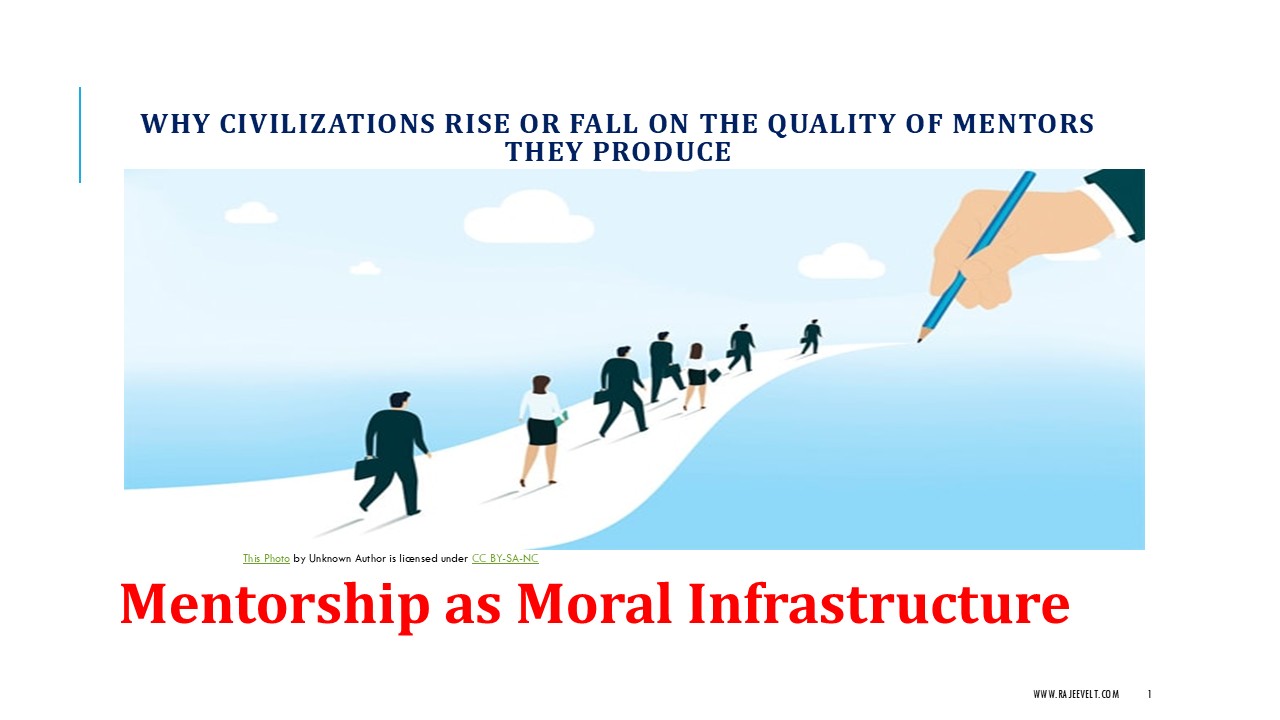
Mentorship as Moral Infrastructure:
Why Civilizations Rise or Fall on the Quality of Mentors They Produce
Civilizations are often evaluated by their economic power, technological advancement, or military strength. Yet history repeatedly demonstrates that these external markers are secondary to a deeper, less visible force: moral infrastructure. We believe mentorship is the primary mechanism through which this moral infrastructure is built, sustained, or eroded.


The Invisible Foundations of Civilization
Civilizations do not collapse suddenly. They erode gradually—from within.
We believe that before economies fail, values weaken. Before institutions decay, character diminishes. Before leadership collapses, conscience disappears. These failures rarely begin with external threats; they begin with internal neglect.
At the heart of this neglect lies a forgotten truth: every civilization is only as strong as the mentors it produces.
Mentorship is civilization’s quiet architecture. It operates beneath laws, policies, and technologies, shaping how power is used, how responsibility is understood, and how future generations inherit values. When mentorship flourishes, civilizations mature. When it deteriorates, societies drift—no matter how advanced they appear.
We observe impressive systems of instruction, governance, and innovation in the 21st century. Yet, we also witness ethical crises, leadership scandals, cultural fragmentation, and growing mistrust. We believe these are not accidental. They are symptoms of weakened mentorship.
What We Mean by Moral Infrastructure
Infrastructure is typically understood as physical or institutional—roads, systems, governance frameworks. Moral infrastructure, however, refers to the shared ethical foundation that governs behavior when enforcement is absent.
Moral Infrastructure Defined
We define moral infrastructure as:
- Internalized values
- Ethical judgment
- Responsibility beyond compliance
- Commitment to the common good
This infrastructure determines whether laws are respected or manipulated, whether power is exercised responsibly or abused.
Mentorship as the Builder of Moral Infrastructure
We believe moral infrastructure is not built through legislation alone. It is built through relationships, especially mentorship.
Mentorship is where:
- Values are demonstrated, not declared
- Ethics are practiced, not preached
- Responsibility is learned through example
Where mentorship weakens, moral infrastructure cracks.
Mentorship Beyond Instruction: A Civilizational Function
Modern societies often reduce mentorship to career advancement or skill development. This reduction is dangerous.
Instruction Builds Skills; Mentorship Builds Humans
Instruction answers what and how.
Mentorship addresses why and whether.
We believe civilizations do not fail due to lack of skill. They fail due to lack of wisdom.
Mentorship as Intergenerational Transmission
Mentorship is how civilizations transmit:
- Ethical boundaries
- Cultural memory
- Collective responsibility
We believe that without mentorship, each generation starts technically advanced but morally orphaned.
Historical Evidence: Civilizations and Their Mentors
History provides consistent evidence that civilizations rise on strong mentorship and decline when it disappears.
Ancient India: The Guru–Shishya System
Mentorship was sacred in ancient Indian civilization. The guru was responsible not merely for intellectual development but for moral and spiritual formation.
Knowledge (vidya) without righteousness (dharma) was considered dangerous.
We believe this is why Indian civilization demonstrated remarkable continuity despite political disruptions—it preserved mentorship even when empires fell.
Ancient Greece: Philosophical Mentorship
Socrates, Plato, and Aristotle represent a mentorship lineage that shaped Western thought. Their emphasis on self-examination and ethical inquiry created leaders capable of reflection rather than mere authority.
The decline of philosophical mentorship later gave way to rhetoric without ethics.
Confucian Civilization
Confucian mentorship emphasized moral cultivation and social responsibility. Leaders were expected to embody virtue before exercising power.
We observe that societies rooted in this mentorship ethic prioritized harmony over dominance.
Modern Decline Patterns
Empires that shifted from mentorship to mere training produced:
- Technically capable but ethically hollow leaders
- Administrators without accountability
- Power without restraint
History shows that such civilizations eventually fracture.
Neuroscience and the Moral Power of Mentorship
Modern neuroscience validates what civilizations intuitively understood.
The Brain Learns Through Relationship
Human brains develop moral reasoning through trusted relationships. Mentorship creates psychological safety, enabling ethical reflection rather than fear-driven compliance.
Mirror Neurons and Moral Modelling
We believe mentors shape behaviour more through example than instruction. Mirror neurons allow mentees to internalize:
- Emotional responses
- Ethical reactions
- Decision-making patterns
This explains why unethical mentors can corrode institutions silently.
Stress, Power, and Moral Collapse
Without mentors, individuals under pressure default to survival instincts. Mentorship regulates stress and anchors conscience—especially in positions of power.
Education Systems and Moral Infrastructure
Education is civilization’s primary mentorship arena.
The Crisis of Instruction-Heavy Education
We observe education systems obsessed with:
- Syllabi
- Metrics
- Rankings
Yet detached from character formation. We believe education without mentorship produces competent individuals who may lack moral direction.
Teachers and Leaders as Moral Architects
Teachers, principals, and academic leaders are mentors by position, whether they acknowledge it or not. Their conduct teaches students how authority behaves.
When educators mentor consciously, education becomes civilizational stewardship.
Leadership and the Mentorship Deficit
Leadership crises across politics, business, and institutions are fundamentally mentorship failures.
Skill-Rich, Conscience-Poor Leadership
We see leaders who:
- Follow rules but avoid responsibility
- Achieve targets while harming trust
- Exercise power without accountability
We believe these leaders were trained, not mentored.
Mentorship and Ethical Power
Mentorship teaches leaders that power is a trust, not a privilege. This understanding cannot be regulated—it must be internalized.
Mentorship as Social and Institutional Capital
Mentorship builds social cohesion.
- It bridges generational gaps
- It democratizes wisdom
- It fosters inclusion
Societies that neglect mentorship replace trust with enforcement—and enforcement is always fragile.
The Erosion of Mentorship in the 21st Century
We must confront uncomfortable truths.
Speed Over Depth
The modern world prioritizes speed, scalability, and efficiency. Mentorship requires patience, presence, and time.
Authority Without Accountability
Many institutions promote authority faster than ethical maturity. Without mentors, authority becomes dangerous.
Technology Without Wisdom
Technology amplifies capacity but not conscience. Without mentorship, it magnifies harm as easily as benefit.
Rebuilding Mentorship as Moral Infrastructure
We believe mentorship must be restored deliberately.
Cultural Reorientation
Mentorship must be recognized as a civilizational responsibility, not a soft skill.
Preparing Mentors
Mentors need:
- Ethical clarity
- Emotional intelligence
- Self-awareness
Expertise alone is insufficient.
Institutional Integration
Mentorship should be embedded in:
- Education systems
- Leadership development
- Governance structures
Long-Term Perspective
Moral infrastructure develops over generations, not quarters.
The Future of Civilization Depends on Mentorship
We believe the defining question of the 21st century is not technological, but moral:
Can humanity scale wisdom as fast as it scales power?
Mentorship is our only proven mechanism to do so.
Why Civilizations Rise or Fall
Civilizations rise when mentors:
- Teach responsibility alongside freedom
- Model integrity alongside success
- Place conscience above convenience
Civilizations fall when mentors:
- Chase authority without accountability
- Transmit skill without values
- Abandon their generational duty
We believe mentorship is destiny.
Not because it controls the future, but because it forms the humans who will shape it.
If we desire enduring civilizations, ethical leadership, and social trust, we must restore mentorship—not as a program, but as a moral infrastructure.
Civilizations do not collapse when laws fail, but when mentors stop producing humans worthy of freedom, power, and trust.
Resources and References
- Aristotle. Nicomachean Ethics.
- Confucius. The Analects.
- Plato. The Republic.
- Vygotsky, L. S. (1978). Mind in Society. Harvard University Press.
- Bandura, A. (1977). Social Learning Theory. Prentice Hall.
- Haidt, J. (2012). The Righteous Mind. Pantheon Books.
- Seligman, M. (2011). Flourish. Free Press.
- Palmer, P. J. (1998). The Courage to Teach. Jossey-Bass.
- Gardner, H. (2007). Five Minds for the Future. Harvard Business School Press.
- UNESCO (2015). Rethinking Education: Towards a Global Common Good?
[…] Weaknesses How True Mentorship Shapes Character, Courage, and Conscience Beyond Competence” Why Civilizations Rise or Fall on the Quality of Mentors They Produce Cat vs Dog Parenting-Which Companion Truly Fits Your LifestyleDownload […]
[…] Weaknesses How True Mentorship Shapes Character, Courage, and Conscience Beyond Competence” Why Civilizations Rise or Fall on the Quality of Mentors They Produce Brain-Based Strategies to Improve Focus, Learning, and Classroom Engagement- Neuroscience of Early […]
[…] Weaknesses How True Mentorship Shapes Character, Courage, and Conscience Beyond Competence” Why Civilizations Rise or Fall on the Quality of Mentors They Produce […]