


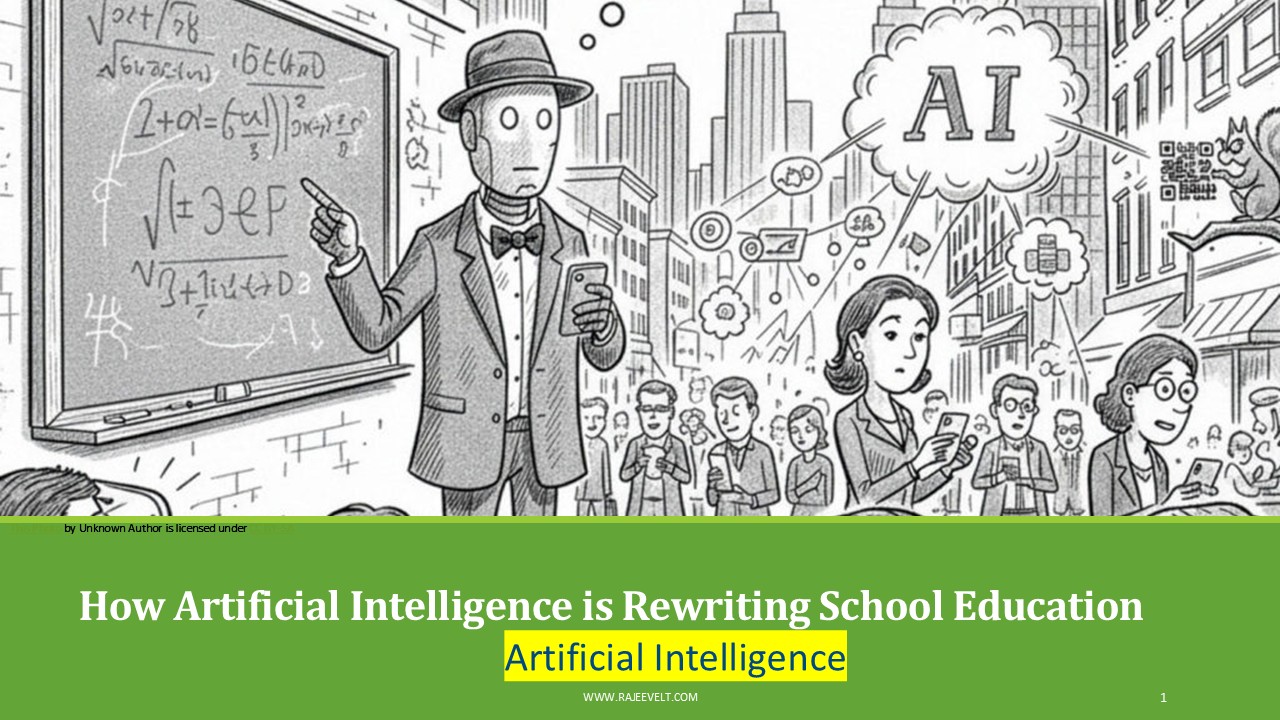
AI and Tech in the Classroom: How Artificial Intelligence is Rewriting School Education
Introduction
The artificial intelligence in schools was treated as a distant possibility — something for pilot programs, ed-tech conferences, and future-of-work panels. That distance has collapsed. AI is no longer an experiment sitting at the edge of the classroom; it is becoming part of the daily architecture of teaching and learning, from how lessons are planned to how students are assessed and even how schools communicate with parents. The global AI-in-education market, valued at roughly $7.5 billion in 2025, is projected to grow more than tenfold by the middle of the next decade — a trajectory that reflects just how quickly ministries of education, school boards, and individual teachers have moved from curiosity to implementation.
Nowhere is this shift more visible — or more consequential — than in India, which has just taken one of the boldest steps of any country in the world: making AI and computational thinking mandatory subjects from Class 3 onward, starting with the 2026-27 academic year.
The Global Picture: From Pilot to Infrastructure
Industry surveys and district leaders describe a consistent shift underway this year: AI is moving from being an optional add-on to becoming core infrastructure inside schools, touching instruction, tutoring, attendance tracking, family communication, and administrative workflows. Rather than chasing novelty, districts are increasingly demanding evidence that these tools actually improve outcomes, and many are consolidating a cluttered ed-tech landscape down to fewer, better-integrated tools.
The numbers being cited are striking. Surveys of teachers report that a majority believe AI tools have improved their teaching methods, and roughly half say the technology has freed up more time for direct interaction with students — arguably the opposite of the “AI replaces teachers” fear that dominated earlier debates. Meanwhile, research summarized in the OECD’s Digital Education Outlook found that in a study conducted in Turkey, students using a standard AI interface saw a meaningful short-term boost in performance, and those using a tutoring-style AI interface — one designed to guide rather than simply answer — saw an even larger gain. Meaningfully, when access to the AI tool was removed, those same students performed worse than peers who had never used it at all, a finding that has become a touchstone in debates about dependency versus genuine learning gain.
AI’s arrival in classrooms hasn’t been free of friction at the same time. A routine assignment using a school-approved AI image tool produced inappropriate content, triggering parental protest and a swift revision of state guidance in one widely discussed incident in a U.S. elementary school. Incidents like this have split schools and families into two camps: those who see AI primarily as a risk to be contained, and those who see it as an equalizer — a way to give every student access to differentiated instruction and immediate feedback regardless of the resources of their particular school.
India’s Big Bet: AI From Class 3
India’s move is significant not just for its ambition but for its timing. Following a stakeholder consultation in late October 2025 that brought together the Ministry of Education, CBSE, NCERT, and other bodies, the government confirmed that AI and Computational Thinking will be introduced progressively from Class 3, aligned with the National Education Policy (NEP) 2020 and the National Curriculum Framework for School Education (NCF-SE) 2023. The Union Budget for 2025-26 backed this with a dedicated allocation to establish a Centre of Excellence in AI for Education, and by early 2026 CBSE was already encouraging schools to enroll in a national AI foundational course, with the revised curriculum framework building in computational thinking and AI content for Classes III through VIII.
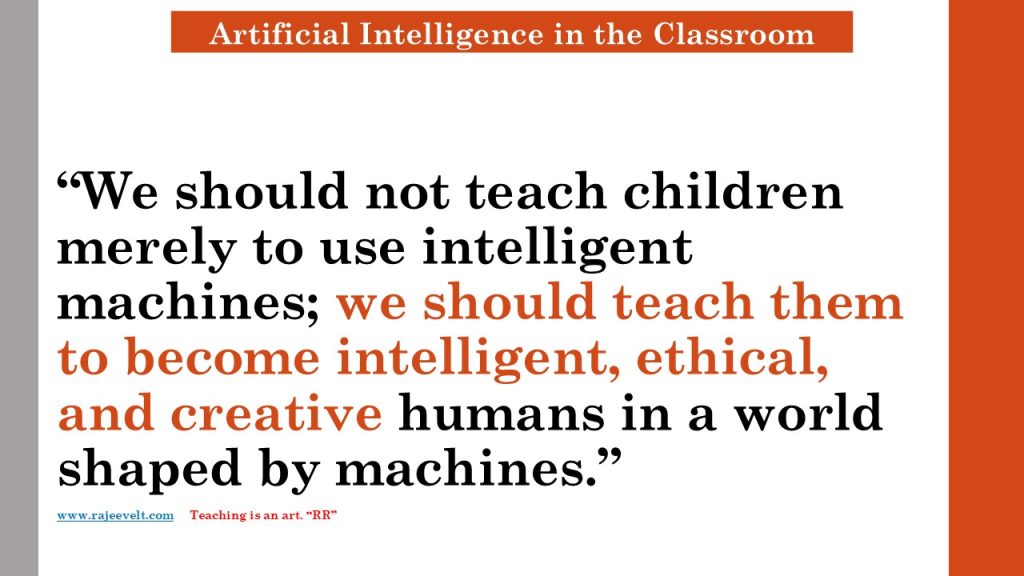
The philosophy behind the curriculum is deliberately not technical-skills-first. Officials have framed it around the idea of “AI for Public Good” — emphasizing ethical use, social responsibility, and problem-solving over coding proficiency, especially for younger students. The approach leans on interactive, concept-first learning rather than tool mastery for Classes 3-5. Teacher training is being rolled out through the existing NISHTHA program, using grade-specific, video-based modules aimed at helping over 10 million educators adapt.
That last detail points to the mandate’s biggest challenge. According to UDISE+ data cited in recent education reporting, only around two-thirds of Indian schools currently have computers, and a smaller share have functional digital infrastructure at all. Surveys suggest a similarly steep gap in educator readiness, with only a small fraction of teachers describing themselves as comfortable using AI tools. The result is a familiar tension in Indian education policy: an ambitious, well-designed national vision running up against uneven ground-level capacity, particularly in government schools compared to well-resourced private ones. How that gap is closed — or isn’t — will likely determine whether this becomes a genuine levelling force in Indian education or one more reform that widens the gap between well-off and under-resourced schools.
The Real Benefits — When AI is designed to teach, not just answer
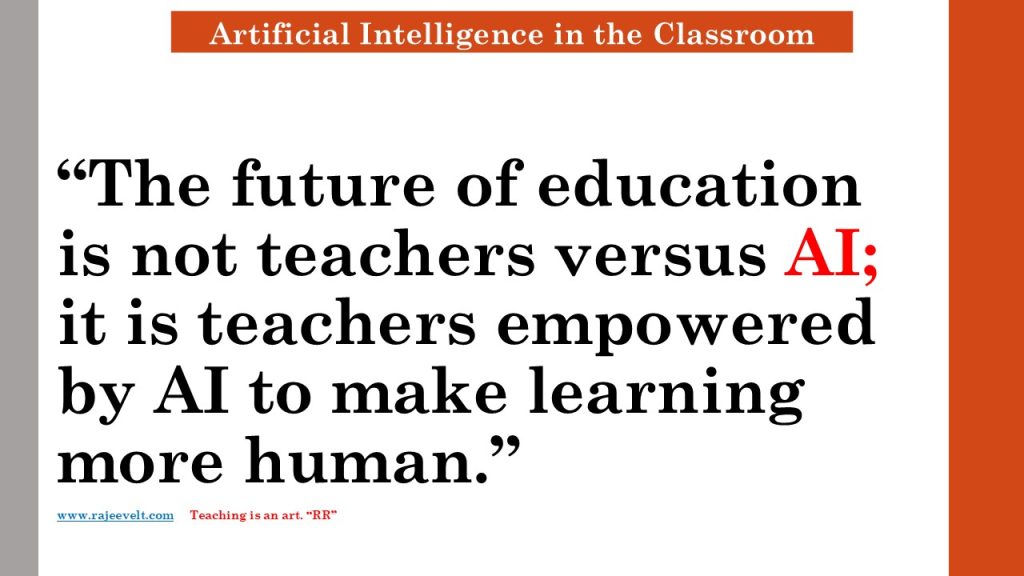
Set aside the headlines for a moment, and the underlying case for AI in schools is fairly concrete. Adaptive platforms can identify a struggling student’s specific knowledge gap in real time, rather than waiting for a unit test to reveal it. Language-learning tools are already extending personalized instruction to students in under-resourced settings who would otherwise never get one-on-one attention. AI-assisted workflows are freeing up hours for teachers drowning in grading, lesson planning, and paperwork, that can go back into actual mentoring — the part of teaching that’s hardest to automate and, by most accounts, the part that matters most to students.
Some voices in the ed-tech world go further, suggesting that AI will eventually deliver a large share of direct instruction while teachers shift toward the role of mentors, coaches, and facilitators of judgment and character rather than primary content-deliverers. Whether or not that vision fully materializes, it captures where much of the investment and policy energy is currently pointed.
The Real Risks — Data, Dependency, and Uneven Access
The Turkey study result is worth returning to, because it complicates the simple “AI helps students learn” narrative: the same tool that produced a large short-term performance boost also left students worse off than a no-AI control group once it was taken away. That’s not an argument against AI in education — it’s an argument for designing AI tools that build capability rather than substitute for it, and for measuring long-term learning outcomes rather than just immediate test scores.
Then there’s data privacy. More than 130 bills addressing AI in education were introduced in the United States alone, across roughly 30 states in a single legislative session this year, with recurring themes: preventing companies from training AI models on student data, requiring human oversight before AI can make consequential decisions about a student, and mandating that AI never fully replace a human teacher. Idaho, for instance, has already enacted a framework requiring statewide AI literacy standards, educator training, and data privacy protections, while explicitly prohibiting AI from replacing teachers. Other states are moving more cautiously, favouring research and transparency requirements over broad mandates — a sign that even enthusiastic policymakers recognize how much is still unknown.
Where This Leaves Schools
The throughline across every region and policy conversation is the same: the schools directing this transition well are not the ones banning AI outright, nor the ones adopting every new tool uncritically. They’re the ones building guardrails — human oversight, teacher training, data protections, and a clear-eyed focus on evidence — while still giving students and teachers room to benefit from what these tools can genuinely do.
The coming two to three years will be a real-time test for India, with its scale and its ambition to introduce AI literacy from the earliest years of schooling, whether policy can be matched by infrastructure and training fast enough to make the mandate meaningful rather than symbolic. The lesson emerging from 2026 seems to be the same for education systems everywhere else: AI in the classroom is no longer a question of “if.” The real questions now are how fast, how safely, and for whose benefit.
References
- ExcelinEd. (2026, May 26). State K-12 AI Policy in 2026: Milestones, Momentum and Missing Links. https://excelined.org/2026/05/26/state-k-12-ai-policy-in-2026-milestones/
- Faculty Focus. (2026). Designing the 2026 Classroom: Emerging Learning Trends in an AI-Powered Education System. https://www.facultyfocus.com/articles/teaching-with-technology-articles/designing-the-2026-classroom-emerging-learning-trends-in-an-ai-powered-education-system/
- MultiState. (2026, April 9). How States Are Regulating AI in Education this Legislative Session. https://www.multistate.us/insider/2026/4/9/how-states-are-regulating-ai-in-education-this-legislative-session
- DiMarco, B. FutureEd. (2026, July 13). Legislative Tracker: 2026 State AI in Education Bills. https://www.future-ed.org/legislative-tracker-2026-state-ai-in-education-bills/
- THE Journal. (2026, January 29). 2026 Predictions for AI and Ed Tech in K-12 Education: What Industry Leaders Are Saying. https://thejournal.com/articles/2026/01/29/2026-predictions-for-ai-and-ed-tech-in-k12-education-what-industry-leaders-are-saying.aspx
- eSchool News. (2026, January 1). 49 Predictions About Edtech, Innovation, and—Yes—AI in 2026. https://www.eschoolnews.com/innovative-teaching/2026/01/01/draft-2026-predictions/
- Think Academy. (2026). AI in the Classroom: What’s Actually Happening in U.S. Schools in 2026. https://www.thethinkacademy.com/blog/ai-in-the-classroom-whats-actually-happening-in-u-s-schools-in-2026/
- QuestionPro. (2026). AI Literacy in Indian Schools: Measuring Readiness Across Students, Teachers and Parents. https://www.questionpro.com/blog/ai-literacy-indian-schools-readiness-students-teachers-parents
- TechWire Asia. (2025, November). India Mandates AI Curriculum in Schools from Grade 3. https://techwireasia.com/2025/11/india-ai-curriculum-schools-2026/
- Peepul India. (2026). AI is Coming to Every Classroom in India from Class 3. Are Government School Teachers Ready? https://www.peepulindia.org/ai-is-coming-to-every-classroom-in-india-from-class-3-are-government-school-teachers-ready/
- CoinGeek. (2025). India to Introduce AI Curriculum in All Schools by 2026. https://coingeek.com/india-to-introduce-ai-curriculum-in-all-schools-by-2026/
- UKTU. (2026). AI in Education — Real Programs, Not Just Hype (India 2026). https://uktu.org/education/ai-in-education/
- Maddala, C. AI Ready School. (2026, March 10). India’s AI Curriculum Mandate Starts 2026-27: Is Your School Ready? https://aireadyschool.com/blog/indias-ai-curriculum-mandate-starts-2026-27-is-your-school-ready
- The News Mill. (2026, September). India Integrates AI into Education Amid Evolving Teacher-Student Roles. https://thenewsmill.com/2026/09/india-integrates-ai-into-education-amid-evolving-teacher-student-roles/
- News On Air. (2026, February 12). Education Minister Highlights Rapid AI Adoption in Indian Education. https://www.newsonair.gov.in/education-minister-highlights-rapid-ai-adoption-in-indian-education