


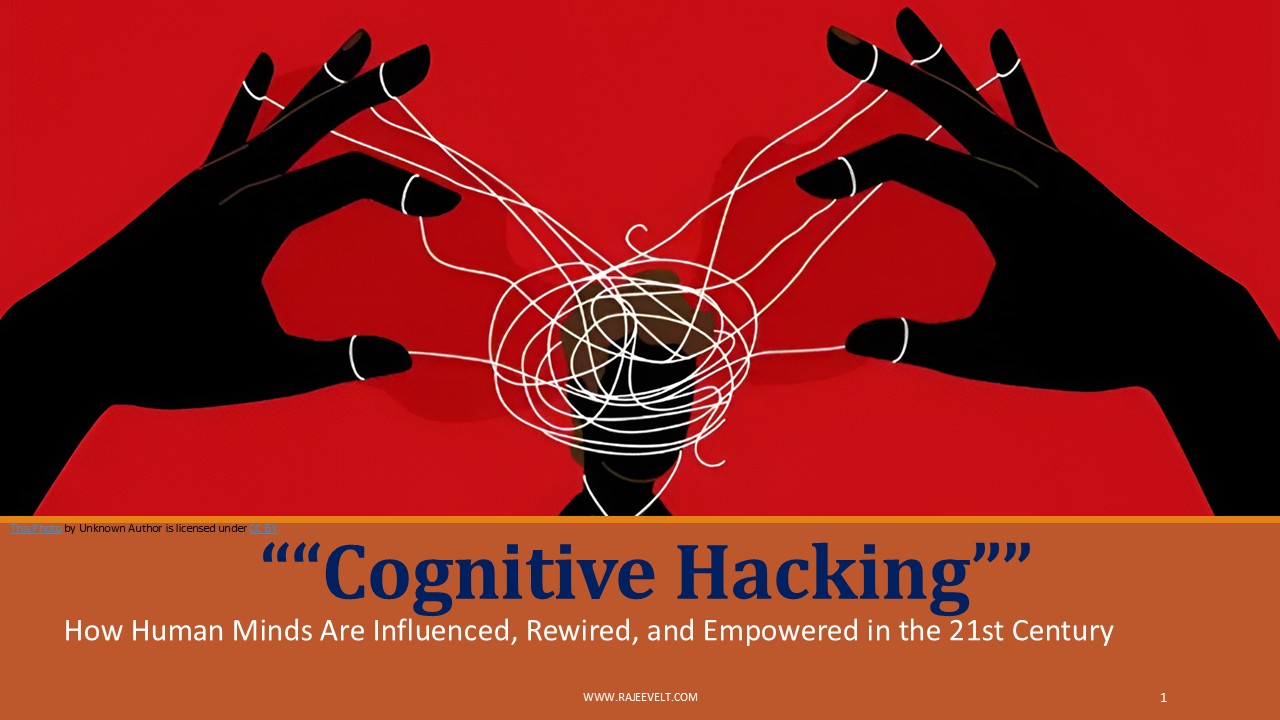
“Cognitive Hacking”
How Human Minds Are Influenced, Rewired, and Empowered in the 21st Century
We are living in a historical moment where influence travels faster than information, emotions spread quicker than evidence, and decisions are often made before conscious reasoning even begins. The human mind has become the most valuable—and most contested—space of the 21st century in boardrooms and classrooms, on social media feeds and family dining tables.
Today, we are not only informed by what we read or hear; we are shaped by what captures our attention, triggers our emotions, and line up with our identity. The result is a world where persuasion is continuous, subtle, and often invisible.
Cognitive hacking is not about science fiction, secret mind-control technologies, or dramatic conspiracies. It is about understanding how human cognition actually works—and how it can be influenced, redirected, or exploited through language, emotion, narrative, repetition, and social context. Whether we are leaders trying to inspire change, educators shaping learning, partners building trust, or citizens directing digital ecosystems, cognitive hacking affects us all.
The power no longer belongs only to those who control land, capital, or machines in the 21st century. Increasingly, it belongs to those who understand how minds work—and how minds can be guided.
What Is Cognitive Hacking?
Cognitive hacking refers to the deliberate or systematic influence of human perception, thinking, emotions, beliefs, and decision-making by exploiting cognitive biases, psychological vulnerabilities, neural mechanisms, and social conditioning.
Cognitive hacking is the practice of influencing how people interpret reality, often without their explicit awareness.
Cognitive hacking differs from persuasion and brainwashing in both method and intensity. Persuasion is typically transparent—you know someone is trying to convince you i.e. when a leader presents data to justify a new strategy and openly argues why it will benefit the organization; the intent is clear. Brainwashing, on the other hand, relies on coercion, isolation, repetition, and long-term psychological pressure. It removes alternative viewpoints and restricts autonomy. Cognitive hacking sits between these extremes. It does not rely on force or explicit argument; instead, it subtly shapes perception through framing, language patterns, emotional cues, and identity signals embedded in everyday communication.
One simple example is the strategic use of personal pronouns. When a leader says, “You must improve performance,” the message feels evaluative and possibly accusatory. But when the same message becomes, “We are building a culture of excellence,” it activates collective identity. The shift from “you” to “we” changes the psychological experience. “We” reduces defensiveness and increases belonging. Similarly, in digital platforms, phrases like “People like you prefer this option” subtly guide decisions by linking choice to identity. No force is used, yet cognition is nudged through social belonging and self-concept.
Cognitive hacking also appears in relationships and marketing. Saying, “I trust your judgment on this,” primes someone to act consistently with the identity of being trustworthy. The language plants a cognitive frame before the decision is even made. Unlike brainwashing, the individual retains freedom. Unlike overt persuasion, the influence is not always consciously recognized. It operates quietly—through pronouns, framing, narrative tone, and emotional anchoring—shaping how reality is interpreted rather than directly commanding what to think.
Cognitive hacking can be ethical or unethical, intentional or unconscious, and individual or mass-scale. A teacher motivating a class, a leader framing a vision, a partner reframing conflict, and a digital platform optimizing engagement may all be engaging in forms of cognitive hacking. Its moral value depends not on the method itself, but on intent, transparency, and respect for human autonomy.
Key Points
It is important to distinguish cognitive hacking from related concepts:
- Persuasion is usually transparent and openly intentional.
- Brainwashing involves coercion, isolation, and long-term conditioning.
- Cognitive hacking operates subtly within everyday communication, leadership narratives, digital systems, and relationships.
The Historical Evolution of Cognitive Influence
Although the term “cognitive hacking” is modern, the phenomenon is ancient. Early civilizations understood the power of rhetoric, myth, and symbolism. Greek philosophers studied persuasion as a civic skill. Religious traditions used stories, rituals, and moral framing to guide belief and behaviour. Kings and emperors understood that authority rested as much on narrative as on force.
The 20th century marked a turning point. Advances in mass media enabled propaganda on an unprecedented scale. Political regimes demonstrated how fear, repetition, emotional framing, and authority cues could mobilize entire populations—often against their own long-term interests.
Cognitive influence has entered a new phase in the 21st century. Digital platforms, algorithms, data analytics, and artificial intelligence have transformed persuasion into a continuous, personalized, and largely invisible process. Influence is no longer occasional; it is ambient. Cognitive hacking now occurs not only through speeches or advertisements, but through feeds, notifications, metrics, and digital environments designed to shape attention and behaviour.
Psychological Foundations of Cognitive Hacking
We should accept a simple truth to understand the psychological foundations of cognitive hacking: we are not purely rational thinkers. While we like to believe that we carefully analyse facts before making decisions, much of our thinking happens automatically. Our brains are designed to conserve energy. If we had to deeply analyse every choice—what to eat, what to believe, whom to trust—we would quickly become mentally exhausted. Cognitive hacking works precisely because it aligns with how the mind naturally operates, not because it overrides it.
One major foundation is cognitive biases and heuristics—the mental shortcuts we use to make quick judgments. For example, when a message says, “You already know this approach works,” it activates confirmation bias by nudging you to search for evidence that supports what you already believe. If someone says, “You’ve seen how often this problem happens,” they trigger the availability heuristic, making recent or vivid examples feel more common than they are. The anchoring effect appears when a sentence begins with, “Most successful leaders earn above this range…”—the first number you hear becomes your mental reference point. Similarly, “You don’t want to lose this opportunity” activates loss aversion, because psychologically, you feel the pain of loss more strongly than the pleasure of gain. Notice how the use of “you” makes the message personal and immediate, subtly guiding interpretation.
Dual-Process Theory is another core principle behind cognitive hacking, popularized by Daniel Kahneman. According to this theory, human thinking operates through two systems: a fast, emotional, automatic system and a slower, analytical, deliberate system. When someone tells you, “You must decide now,” or “You feel this is the right choice,” the language targets your fast system. It encourages emotional or intuitive reactions rather than reflective reasoning. Time pressure, emotionally charged words, and identity-based statements like “You are the kind of person who takes bold action” reduce the likelihood that your slower analytical system will question the message.
Cognitive hacking is effective because it speaks directly to the automatic mind while making the message feel personally relevant. When a leader says, “We are shaping the future together,” the pronoun “we” activates belonging and identity. When a marketer says, “You deserve better,” the word “you” creates emotional proximity. These sentence patterns do not force decisions; they shape the mental frame in which decisions are made. We become more aware—not only of how others may influence us, but also of how we influence others through everyday language.
Key points
We should begin with an honest recognition to understand cognitive hacking: human beings are not purely rational decision-makers.
Cognitive Biases and Heuristics
Our brains rely on mental shortcuts—known as heuristics—to conserve energy and respond quickly to complex environments. These shortcuts are efficient, but they come with predictable biases, including:
- Confirmation bias (favouring information that supports existing beliefs)
- Availability heuristic (judging likelihood based on what comes easily to mind)
- Anchoring effect (over-relying on initial information)
- Loss aversion (fearing loss more than valuing gain)
Cognitive hacking works by activating these biases intentionally, guiding conclusions without requiring deep reasoning.
Dual-Process Theory
Human thinking operates through two interacting systems:
- A fast, automatic, emotional system
- A slow, deliberate, analytical system
Most cognitive hacking targets the first system. Emotional, time-pressured, or identity-linked messages reduce the likelihood that the analytical system will engage.
Neuroscience Behind Cognitive Hacking
Cognitive hacking works because your brain is wired to prioritize emotion before logic from a neuroscientific perspective. When you encounter a message, your brain does not first ask, “Is this objectively true?” Instead, it quickly scans for emotional relevance: “Is this threatening? Is this rewarding? Does this affect me?” This rapid evaluation happens largely outside your awareness. So, when a message says, “You are at risk of missing out,” your emotional system activates before your analytical mind has fully assessed the claim.
A central structure in this process is the amygdala—the brain’s emotional alarm system. When you hear a statement like, “Your security is in danger,” or “People like you are being left behind,” the amygdala reacts to perceived threat or social exclusion. If that activation is strong—through fear, anger, urgency, or even intense belonging—it can temporarily reduce the activity of the prefrontal cortex, the region responsible for reasoning and impulse control. In simple terms, when you feel emotionally charged, you are less likely to pause and critically evaluate. That is why a sentence framed as “You must act now” can override your slower, more reflective thinking.
Neurochemistry also plays a powerful role. When you encounter messages that make you feel validated— “You are smart enough to see the truth”—your brain may release dopamine, a neurotransmitter linked to reward and reinforcement. Dopamine strengthens the neural pathways associated with that belief. The more often you hear a repeated statement like, “You’ve always known this,” the more familiar it becomes. Familiarity often feels like truth in the brain. Repetition does not just repeat information; it biologically reinforces it.
Over a period of time, emotionally reinforced ideas can feel self-evident, even when the supporting evidence is weak. If you repeatedly hear, “We are under constant threat,” your brain begins to encode that narrative as reality because it has been emotionally rehearsed. Data alone may not trigger strong neural activation, but emotionally charged stories— “This could happen to you or your family”—engage both emotion and memory systems. This is why narratives often persuade more effectively than statistics. Cognitive hacking works not by inserting new logic into your mind, but by shaping the emotional pathways through which you interpret what feels true.
Key Points
Cognitive hacking exploits the brain’s emotional architecture from a neuroscientific perspective.
The amygdala evaluates emotional significance and threat. When it is strongly activated—by fear, anger, urgency, or belonging—it can suppress activity in the prefrontal cortex, the region responsible for reasoning, impulse control, and long-term planning.
Neurochemicals such as dopamine reinforce behaviours and beliefs that are emotionally rewarding. Repetition strengthens neural pathways, making ideas feel familiar and therefore true. Over time, beliefs formed through emotional reinforcement can feel self-evident, even when evidence is weak. This is why emotionally charged narratives are often more persuasive than data alone.
Language, Framing, and Narrative Engineering
Language is not neutral. It shapes perception.
Framing determines whether information is interpreted as a threat or an opportunity, a loss or a gain. The same fact can produce entirely different reactions depending on how it is described.
Narratives organize information into meaning. Stories bypass analytical resistance by embedding ideas within emotion, identity, and causality. When narratives coordinate with who we believe we are—our values, profession, culture, or relationships—they become powerful cognitive anchors. This is why people often defend stories more fiercely than statistics.
Social and Cultural Dimensions of Cognitive Hacking
Human cognition is deeply social. We look to others for cues about reality.
Mechanisms such as social proof, authority bias, group identity, and norm conformity amplify cognitive hacking. What feels true or acceptable in one group can feel obviously correct, even if it would seem questionable in isolation.
Cultural context matters. Cognitive hacking operates differently across societies shaped by collectivism, individualism, hierarchy, or tradition. Narratives travel across cultural boundaries, often detached from their original context in a globally connected world.
A Step-by-Step Model “How Cognitive Hacking Works”
Cognitive hacking does not usually begin with force. It begins with observation. When we examine how it works, we notice a predictable psychological sequence—one that leverages normal human thinking patterns rather than overriding them.
1. We identify a cognitive or emotional vulnerability.
All of us carry mental shortcuts, biases, unmet needs, and emotional sensitivities. These might include fear of uncertainty, desire for belonging, pride in identity, or frustration with complexity. Cognitive hacking begins when someone recognizes these predictable patterns in us. The vulnerability is not a flaw—it is simply part of being human.
2. We experience an emotional trigger.
Once a vulnerability is identified, an emotion is activated. Fear makes us seek safety. Hope makes us lean forward. Urgency reduces our patience for analysis. Belonging strengthens group attachment. Emotions narrow our cognitive bandwidth and increase our reliance on intuitive thinking. When we are emotionally activated, we process information differently.
3. We are given a narrative that explains the emotion.
After the emotion is triggered, a story is introduced. The narrative tells us why we feel what we feel and who or what is responsible. Humans are natural meaning-makers. When we feel something strongly, we look for explanation. A well-crafted narrative provides coherence and direction, often simplifying complex realities into digestible interpretations.
4. We encounter repetition and social validation.
Repetition strengthens familiarity, and familiarity increases perceived truth. When we see others expressing agreement—through social media engagement, group discussions, or authority endorsement—the narrative gains credibility. Social proof reduces doubt. We begin to assume that if many people believe something, it must be reasonable.
5. We internalize the belief as our own.
Over a period of time, the narrative no longer feels external. It feels self-generated. We remember the conclusion more than the source. The belief integrates into our identity, and we defend it as if we discovered it independently. At this stage, influence becomes invisible.
The most effective cognitive hacking does not feel imposed. It feels natural, aligned with our emotions, and consistent with our existing worldview. That is precisely why awareness matters. When we understand the sequence, we become more reflective participants in our own thinking rather than passive recipients of shaped perception.
Key Points
Cognitive hacking often follows a recognizable sequence:
- Identify a cognitive or emotional vulnerability
- Trigger emotion (fear, hope, belonging, pride, urgency)
- Frame a narrative that explains the emotion
- Reinforce the narrative through repetition and social validation
- Normalize the belief until it feels self-generated
The most effective cognitive hacking does not feel imposed. It feels natural.
Ethical and Unethical Cognitive Hacking
Ethical cognitive hacking is grounded in respect for autonomy and long-term well-being. It recognizes that language shapes perception, but it uses that power to strengthen—not weaken—your capacity to think and act independently. In education, for example, a teacher might say, “You are capable of mastering this step by step,” activating confidence and growth mindset. In leadership, a sentence like “We are building something meaningful together” develops shared identity and resilience. The pronouns “you” and “we” are not used to control, but to empower. The intention is transparent: to help you engage, reflect, and grow.
Ethical cognitive hacking can gently reframe behaviour without coercion in therapy and public health. A therapist might say, “You have already shown strength in difficult moments,” reinforcing a healthier self-concept. A public health campaign could frame a message as, “We protect each other when we act responsibly,” appealing to collective responsibility rather than fear alone. Here, the psychological tools—framing, emotional resonance, repetition—are aligned with your long-term interests. You remain free to question, to decide, and to disagree. The goal is behavioural support, not psychological dependency.
Unethical cognitive hacking, however, shifts from empowerment to control. It uses similar psychological mechanisms—identity, emotion, repetition—but with the aim of narrowing your perception. In gaslighting, someone may say, “You’re imagining things; you always overreact,” slowly destabilizing your trust in your own judgment. In propaganda, a repeated phrase like “You can’t trust anyone but us” isolates you from alternative viewpoints. The pronoun “you” becomes accusatory or manipulative, while “we” is used to create exclusionary identity—“We are the only ones who see the truth.”
The defining feature of unethical cognitive hacking is the erosion of independent judgment. It often exploits fear, shame, or dependency through statements like, “If you leave, you will fail,” or “Without us, you are nothing.” Over time, such patterns reduce your willingness to question or critically analyse. Unlike ethical influence, which strengthens your reflective capacity, unethical influence seeks to bypass it. The difference ultimately lies not in the technique—since both may use emotional framing and pronouns—but in the intention and outcome: whether you become more autonomous and aware, or more controlled and dependent.
Key Points
Ethical Applications
Ethical cognitive hacking aims to support human flourishing. It is used in:
- Education, to design engaging learning
- Leadership, to inspire purpose and resilience
- Therapy, to support behavior change
- Public health, to encourage protective action
Ethical use respects autonomy, encourages awareness, and aligns with long-term well-being.
Unethical Applications
Unethical cognitive hacking seeks control rather than growth. It includes:
- Gaslighting and emotional manipulation
- Propaganda and misinformation
- Radicalization and cult recruitment
- Exploiting fear, shame, or dependency
Its defining feature is the erosion of independent judgment.
Cognitive Hacking in Leadership
Leadership operates at a cognitive level because before we act, we interpret. Before we implement strategy, we define meaning. When we frame a market downturn as a temporary cycle rather than a collapse, we influence whether teams respond with panic or disciplined focus. When we describe organizational change as an evolution rather than a disruption, we shape emotional readiness. For example, during major transformations at companies like Microsoft, leadership reframed internal competition into a “growth mindset” culture, encouraging learning over defensiveness. In such cases, we see that leadership is not merely operational; it is interpretive. The way we describe reality becomes the way others experience it.
Leaders also engage in cognitive influence through identity-based messaging and emotional anchoring. When we say, “We are innovators,” “We are public servants,” or “We are guardians of quality,” we connect tasks to identity. Identity strengthens commitment because people defend who they believe they are. For instance, Patagonia consistently frames its mission around environmental stewardship. By reinforcing the identity of being environmentally responsible, the company aligns employees and customers around shared values rather than transactional goals. Similarly, when leaders anchor strategy to pride, hope, or shared responsibility, we increase resilience during uncertainty. The emotional tone we set becomes the emotional climate others internalize.
However, the same cognitive tools can be used unethically. When we frame criticism as betrayal, when we create loyalty tests, or when we divide groups into “us versus them,” we narrow thinking and suppress dialogue. History provides cautionary examples. Under leaders such as Adolf Hitler, national identity was weaponized through fear-based narratives and division, leading to catastrophic institutional and human consequences. In organizational settings, similar patterns appear when executives silence dissent, exaggerate threats, or manipulate data to maintain authority. Fear may create short-term compliance, but it erodes long-term trust and adaptability.
Ultimately, ethical leadership requires discernment in how we shape cognition. When we reframe a challenge as a shared mission—such as global health initiatives led by organizations like World Health Organization—we mobilize cooperation rather than panic. When we invite debate instead of punishing disagreement, we strengthen collective intelligence. Over time, ethical cognitive framing builds cultures grounded in trust, shared meaning, and psychological safety. Manipulative framing, by contrast, creates fragile systems dependent on control. As leaders, we must therefore ask not only whether our narrative is persuasive, but whether it is responsible.
Leadership is fundamentally cognitive because before we execute strategy, we interpret reality. Before we act, we assign meaning. Leaders do not merely allocate resources or design plans; they shape perception. We frame problems, define priorities, and influence how others understand uncertainty. This is where cognitive hacking operates within leadership. We guide how people think about their roles and their future through vision framing, identity-based messaging, emotional anchoring, and narrative construction. When we ethically frame a challenge as a shared mission, we activate collective identity instead of individual fear. When we connect goals to shared values, we strengthen intrinsic motivation rather than impose compliance. Over time, repeated framing becomes culture; repeated narratives become norms; repeated emotional anchors become organizational memory. In this way, we do not just manage performance—we shape collective cognition.
However, the same mechanisms that build alignment can also distort it. When we rely on fear to accelerate obedience, when we demand loyalty over critical thinking, or when we construct “us versus them” narratives to silence disagreement, we shift from leadership to manipulation. Fear narrows thought. Division weakens trust. Suppression reduces innovation. History consistently demonstrates that when cognitive influence becomes coercive rather than ethical, institutions lose adaptability and eventually credibility. Sustainable leadership therefore requires discernment. We must ask not only whether our message mobilizes people, but whether it preserves autonomy, dignity, and truth. Ethical cognitive framing builds resilient cultures; manipulative cognitive control creates fragile systems.
Key Points
Leadership is fundamentally cognitive. Meaning should be created before strategies are executed.
Leaders engage in cognitive hacking through vision framing, identity-based messaging, emotional anchoring, and narrative construction. When used ethically, these tools create alignment, trust, and motivation.
In fact, reframing a challenge as a shared mission activates collective identity rather than fear. Over time, such framing shapes organizational culture.
Unethical leadership, however, uses fear, loyalty tests, and “us versus them” narratives to suppress dissent. History shows that when cognitive hacking in leadership becomes manipulative, institutional failure often follows.
Regards
Rajeev Ranjan
School Education
“Let knowledge grow from more to more.”
Alfred Tennyson, “In Memoriam”, Prologue, line 25
References
Kahneman, D. (2011). Thinking, fast and slow. Farrar, Straus and Giroux.
Thaler, R. H., & Sunstein, C. R. (2008). Nudge: Improving decisions about health, wealth, and happiness. Yale University Press.
Cialdini, R. B. (2009). Influence: Science and practice (5th ed.). Pearson Education.
Ariely, D. (2008). Predictably irrational: The hidden forces that shape our decisions. HarperCollins.
Tversky, A., & Kahneman, D. (1974). Judgment under uncertainty: Heuristics and biases. Science, 185(4157), 1124–1131.
Damasio, A. (1994). Descartes’ error: Emotion, reason, and the human brain. Putnam.
LeDoux, J. (1996). The emotional brain: The mysterious underpinnings of emotional life. Simon & Schuster.
Sapolsky, R. M. (2017). Behave: The biology of humans at our best and worst. Penguin Press.
Bandura, A. (1977). Social learning theory. Prentice Hall.
Milgram, S. (1974). Obedience to authority: An experimental view. Harper & Row.
Asch, S. E. (1956). Studies of independence and conformity: A minority of one against a unanimous majority. Psychological Monographs, 70(9).
Goffman, E. (1974). Frame analysis: An essay on the organization of experience. Harvard University Press.
Lakoff, G. (2004). Don’t think of an elephant! Know your values and frame the debate. Chelsea Green Publishing.
Haidt, J. (2012). The righteous mind: Why good people are divided by politics and religion. Pantheon Books.
McLuhan, M. (1964). Understanding media: The extensions of man. McGraw-Hill.
Zuboff, S. (2019). The age of surveillance capitalism. PublicAffairs.
Pariser, E. (2011). The filter bubble: What the Internet is hiding from you. Penguin Press.
Sunstein, C. R. (2017). #Republic: Divided democracy in the age of social media. Princeton University Press.
Fogg, B. J. (2003). Persuasive technology: Using computers to change what we think and do. Morgan Kaufmann.
World Economic Forum. (2020). Human-centred artificial intelligence: A framework for responsible leadership. World Economic Forum Publications.
OECD. (2021). Behavioral insights and public policy. OECD Publishing.
Attachment Theory & Relationships
Bowlby, J. (1969). Attachment and Loss: Vol. 1. Attachment. New York: Basic Books.
Ainsworth, M. D. S., Blehar, M. C., Waters, E., & Wall, S. (1978). Patterns of Attachment: A Psychological Study of the Strange Situation. Hillsdale, NJ: Erlbaum.
Mikulincer, M., & Shaver, P. R. (2007). Attachment in Adulthood: Structure, Dynamics, and Change. New York: Guilford Press.
Gottman, J. M., & Levenson, R. W. (1992). Marital processes predictive of later dissolution: Behavior, physiology, and health. Journal of Personality and Social Psychology, 63(2), 221–233.
Cognitive Bias & Dual-Process Theory
Kahneman, D. (2011). Thinking, Fast and Slow. New York: Farrar, Straus and Giroux.
Tversky, A., & Kahneman, D. (1974). Judgment under uncertainty: Heuristics and biases. Science, 185(4157), 1124–1131.
Evans, J. St. B. T. (2008). Dual-processing accounts of reasoning, judgment, and social cognition. Annual Review of Psychology, 59, 255–278.
Neuroscience of Emotion & Decision-Making
LeDoux, J. (1996). The Emotional Brain: The Mysterious Underpinnings of Emotional Life. New York: Simon & Schuster.
Phelps, E. A. (2006). Emotion and cognition: Insights from studies of the human amygdala. Annual Review of Psychology, 57, 27–53.
Damasio, A. R. (1994). Descartes’ Error: Emotion, Reason, and the Human Brain. New York: Putnam.
Gaslighting & Psychological Manipulation
Stern, R. (2007). The Gaslight Effect: How to Spot and Survive the Hidden Manipulation Others Use to Control Your Life. New York: Broadway Books.
Sweet, P. L. (2019). The sociology of gaslighting. American Sociological Review, 84(5), 851–875.
[…] Hacking in Leadership “Cognitive Hacking” How Human Minds Are Influenced, Rewired, and Empowered in the 21st Century Mentorship in the 21st Century-Hierarchical Instruction to Multidimensional Human Development […]