


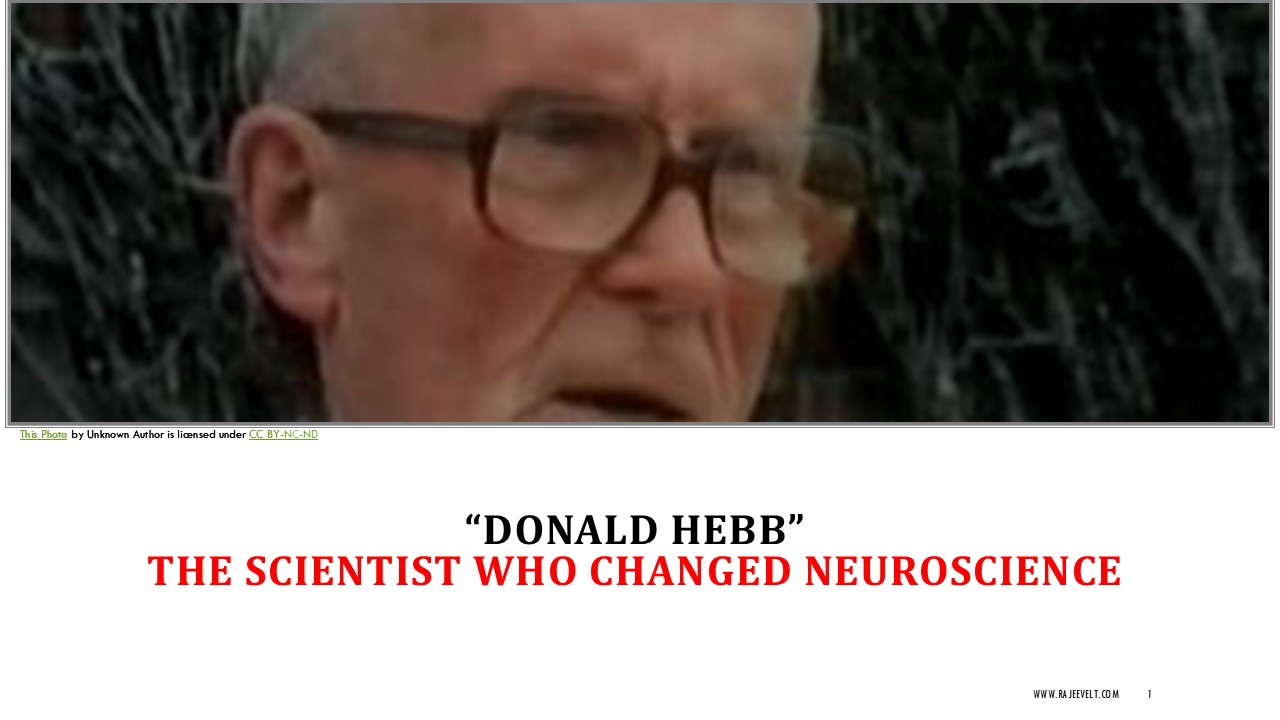
“Donald Hebb”
The Scientist Who Changed Neuroscience
Scientific revolutions are often associated with groundbreaking technologies, spectacular laboratory discoveries, or revolutionary experiments. Yet history reminds us that some of the most transformative advances begin with a single idea capable of changing how we understand the world. In neuroscience, few ideas have had a more enduring impact than the proposal that learning alters the strength of connections between neurons. This elegant yet profoundly influential principle emerged from the work of Canadian psychologist Donald Olding Hebb, a scholar whose intellectual vision transformed neuroscience, psychology, education, and, ultimately, our understanding of human learning and behaviour.
Today, Donald Hebb is widely recognised as one of the founding architects of modern neuroscience. Although many of the molecular mechanisms supporting his theory would not be discovered until decades after his death, Hebb possessed an extraordinary ability to integrate psychology with biology at a time when these disciplines largely operated in isolation. His work demonstrated that understanding human behaviour required more than observing actions alone; it demanded an explanation of the biological processes occurring within the brain. Hebb laid the conceptual foundation upon which contemporary neuroscience continues to build by proposing that experience physically modifies neural connections.
Donald Olding Hebb was born on 22 July 1904 in the small coastal community of Chester, Nova Scotia, Canada. He grew up in a family that deeply valued education and intellectual curiosity. His parents were physicians, and their commitment to learning fostered an environment in which questioning, observation, and independent thinking were encouraged from an early age. Unlike many scientists whose careers followed a predictable academic trajectory, Hebb’s professional journey evolved gradually through diverse experiences that profoundly influenced his scientific perspective.
Initially, Hebb did not envision himself as a neuroscientist or psychologist. He completed his undergraduate studies at Dalhousie University in 1925, earning a Bachelor of Arts degree with a concentration in English literature and philosophy. His early academic interests reflected a broad humanistic education rather than specialised scientific training. Literature cultivated his appreciation for human experience, while philosophy encouraged him to explore enduring questions concerning knowledge, consciousness, intelligence, and behaviour. These intellectual foundations later contributed to his distinctive ability to connect biological mechanisms with complex psychological processes.
Hebb began his professional life as a schoolteacher and later as a school principal in rural Canada. This period proved unexpectedly significant in shaping his future scientific career. Daily interactions with students exposed him to the remarkable variability in learning, motivation, and intellectual development among children. He observed that some students rapidly acquired new skills through repeated practice, while others struggled despite similar opportunities. These classroom experiences raised fundamental questions that conventional educational theories could not adequately answer. Why did experience appear to transform intellectual performance? How did repeated practice improve learning? What biological processes enabled the brain to change through education? These questions remained with Hebb long after he left the classroom.
Hebb returned to higher education during the early 1930s and enrolled at McGill University, one of Canada’s leading research institutions. There he studied under the distinguished physiologist Boris Babkin, whose work emphasised rigorous experimental investigation of the nervous system. At McGill, Hebb developed a growing interest in physiological psychology, recognising that understanding behaviour required careful examination of the biological mechanisms underlying cognition.
His intellectual development accelerated further through collaboration with Dr. Wilder Penfield, the internationally renowned neurosurgeon whose pioneering brain surgeries revolutionised neurological medicine. Penfield’s operations on patients with epilepsy demonstrated that stimulating different regions of the cerebral cortex could evoke vivid memories, sensory experiences, and voluntary movements. Observing these remarkable clinical findings convinced Hebb that psychological phenomena could not be separated from brain function. The mind and brain were fundamentally interconnected, and explaining one required understanding the other.
Hebb later pursued doctoral studies under the eminent psychologist Karl Lashley, whose research profoundly influenced twentieth-century neuroscience. Lashley sought to identify the physical location of memory within the brain but repeatedly encountered evidence suggesting that memory could not be explained by simple localisation alone. Rather than existing within isolated brain regions, cognitive functions appeared to emerge from complex interactions among distributed neural networks. Working alongside Lashley exposed Hebb to some of the most challenging questions in experimental psychology and inspired him to search for a more comprehensive theory capable of explaining learning, memory, and intelligence.
These diverse educational and professional experiences gradually converged into a remarkably original scientific vision. Hebb recognised that neither psychology nor neurophysiology alone could adequately explain learning. Behavioural observations described what people did, while neurophysiology described how neurons functioned. What remained missing was a theoretical bridge connecting these two levels of explanation. Hebb dedicated his career to constructing that bridge.
His research focused on one of the most fundamental questions in science: How does experience change the brain? At the time, surprisingly little was known about synapses, neurotransmitters, or neural plasticity. The molecular mechanisms of learning remained largely mysterious. Nevertheless, Hebb proposed an elegant hypothesis that would permanently reshape neuroscience. He argued that when one neuron repeatedly contributed to activating another, the efficiency of communication between them increased. Repeated co-activation strengthened synaptic connections, making future activation increasingly likely. Learning, therefore, resulted not from storing information in isolated brain cells but from strengthening relationships among interconnected neurons.
Perhaps Hebb’s most influential contribution was his concept of cell assemblies. Rather than imagining memories as residing within single neurons, Hebb proposed that thoughts, perceptions, and memories emerge from coordinated activity across large networks of interconnected neurons. These neural assemblies could become increasingly stable through repeated activation, allowing complex ideas and behaviours to be represented across distributed brain circuits. Modern neuroscience has repeatedly validated this insight. Functional magnetic resonance imaging (fMRI), electrophysiological recordings, and computational modelling consistently demonstrate that cognitive functions arise from coordinated activity within distributed neural networks rather than isolated brain regions.
Hebb’s theoretical framework reached its fullest expression in his landmark 1949 publication, The Organization of Behavior: A Neuropsychological Theory. Widely regarded as one of the most influential books in the history of neuroscience and psychology, this extraordinary work integrated knowledge from psychology, neurophysiology, philosophy, and behavioural science into a unified explanation of learning and cognition. Hebb argued that understanding behaviour required understanding the biological organisation of the brain itself at a time when many psychologists focused primarily on observable behaviour.
Although the book contained relatively little experimental data by today’s standards, its conceptual brilliance profoundly influenced generations of scientists. Hebb proposed that repeated neural activity strengthens synaptic connections, giving rise to stable neural assemblies capable of supporting perception, memory, language, reasoning, and behaviour. Many of the molecular details underlying these processes would only be discovered decades later through advances in cellular neuroscience. Nevertheless, subsequent research on long-term potentiation (LTP), synaptic plasticity, dendritic spine remodelling, experience-dependent cortical reorganisation, and functional connectivity has provided compelling support for the principles Hebb first articulated.
The influence of Hebb’s work extends far beyond neuroscience. Cognitive psychology adopted his ideas to explain learning and memory. Educational researchers found biological support for the importance of deliberate practice, retrieval learning, and spaced repetition. Clinical psychologists recognised that repeated thoughts and behaviours reshape neural pathways, providing scientific foundations for therapies such as Cognitive Behavioural Therapy (CBT) and mindfulness-based interventions. Rehabilitation specialists applied Hebbian principles to stroke recovery, demonstrating that repeated therapeutic exercises promote functional reorganisation of damaged neural circuits.
Perhaps one of the most remarkable legacies of Hebb’s ideas lies within the field of artificial intelligence. Long before the development of deep learning algorithms, Hebb proposed that learning results from adjustments in the strength of connections among interconnected units. This concept inspired early computational models of artificial neural networks and continues to influence machine learning, computational neuroscience, and brain-inspired computing. Although modern artificial intelligence employs sophisticated mathematical optimisation methods that extend far beyond Hebb’s original proposal, the fundamental concept of adaptive connection strength remains deeply rooted in his pioneering work.
Historically, Hebb occupies a unique position within science because he transformed not merely one discipline but the relationships among many disciplines. Before Hebb, psychology, neurophysiology, education, and cognitive science largely evolved independently. After Hebb, these fields increasingly converged around the shared recognition that experience modifies the biological organisation of the brain. His work encouraged scientists to view learning as a dynamic interaction between environment and neural architecture rather than as either a purely psychological or purely biological phenomenon.
Today, advances in neuroimaging, molecular genetics, connectomics, computational neuroscience, and cognitive psychology continue to refine our understanding of the mechanisms underlying Hebb’s original insights. Modern researchers now investigate spike-timing-dependent plasticity, homeostatic regulation, neuromodulation, and large-scale brain networks with technologies unimaginable during Hebb’s lifetime. Yet despite these extraordinary advances, the central principle that experience strengthens neural connectivity remains one of neuroscience’s most enduring foundations.
Donald Hebb passed away on 20 August 1985, but his intellectual legacy continues to shape scientific inquiry across the world. Every investigation into learning, memory, neuroplasticity, rehabilitation, expertise, child development, educational practice, leadership development, and artificial intelligence carries traces of the conceptual framework he established more than seven decades ago.
Few scientists have so profoundly altered our understanding of human potential. Hebb demonstrated that the brain is not a fixed organ determined solely by inheritance but a living system continuously reshaped by experience. His work transformed the study of learning from a descriptive science into a biological science, revealing that every meaningful repetition leaves a measurable imprint upon the nervous system. In doing so, Donald Hebb not only changed neuroscience—he changed the way we understand ourselves.
References
Brown, R. E., & Milner, P. M. (2003). The legacy of Donald O. Hebb. Nature Reviews Neuroscience, 4(12), 1013–1019. https://doi.org/10.1038/nrn1257
Hebb, D. O. (1949). The Organization of Behavior: A Neuropsychological Theory. Wiley.
Kandel, E. R., Koester, J. D., Mack, S. H., & Siegelbaum, S. A. (2021). Principles of Neural Science (6th ed.). McGraw-Hill.
Kolb, B. (2000). Donald O. Hebb: The organization of behavior. Canadian Psychology, 41(1), 37–47.
Milner, P. M. (1993). The autonomous brain: A neural theory of attention and learning. Lawrence Erlbaum Associates.
Squire, L. R., Berg, D., Bloom, F. E., du Lac, S., Ghosh, A., & Spitzer, N. C. (2021). Fundamental Neuroscience (5th ed.). Academic Press.