


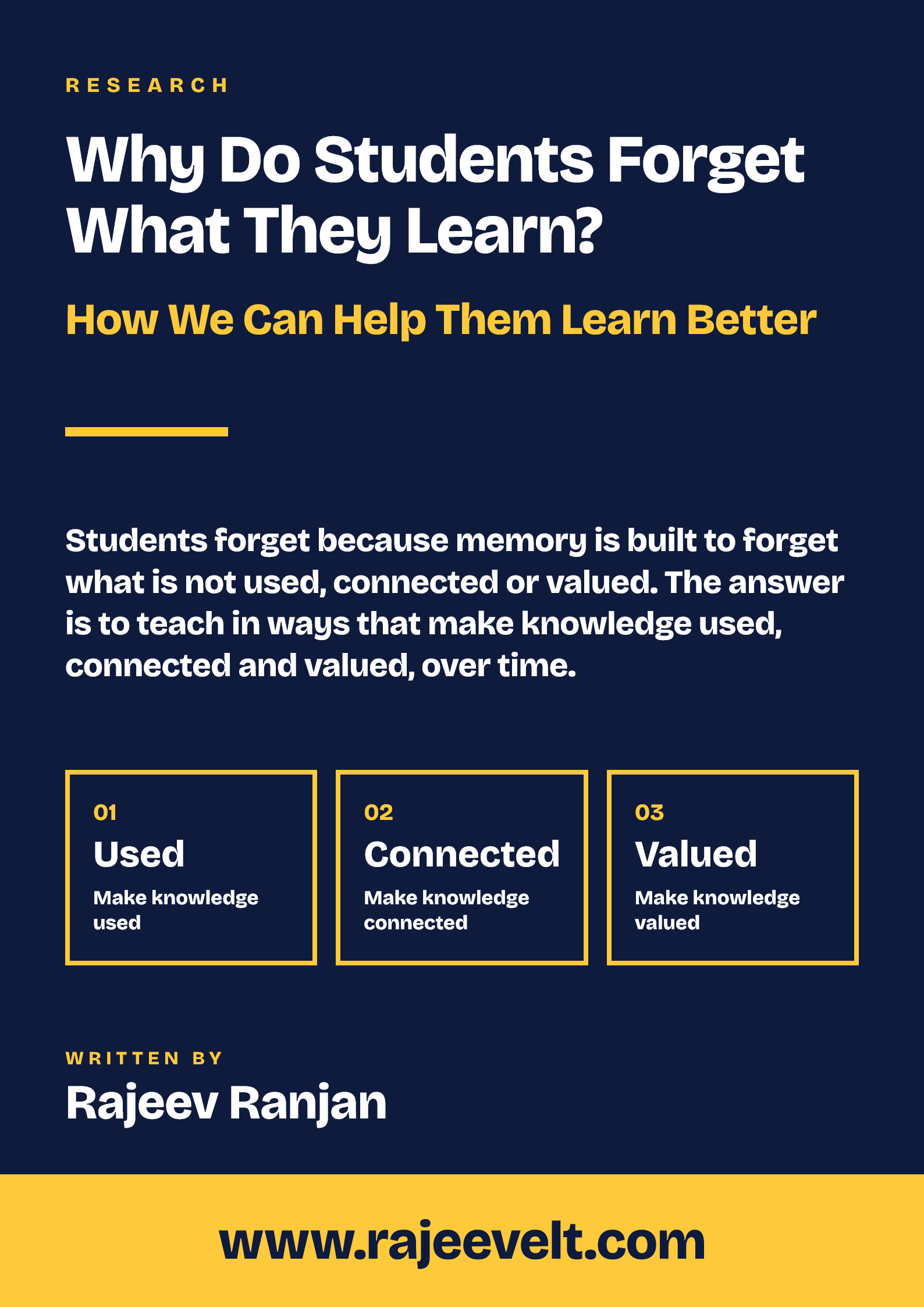
Why Do Students Forget What They Learn? How We Can Help Them Learn Better
Students forget most of what they are taught because forgetting is what human memory does by default, and most teaching is not designed to work against it. If forgetting is predictable, it can be planned for.
The bucket with a hole in it
Every teacher knows the scene. A lesson goes beautifully. Questions are sharp, heads nod, the board is full of tidy notes. Two weeks later, a quick check reveals blank faces and half-remembered scraps. The natural reaction is to blame the student (“they didn’t revise”), the curriculum (“too much to cover”) or ourselves (“I must not have explained it well”). Usually none of those is the real culprit.
The real culprit is a mismatch between how memory works and how schools tend to work. Memory is a leaky bucket that keeps what is used, connected and meaningful, and quietly let’s go of the rest. Schools, under pressure of time, often pour in a lot of water once, then move on to the next bucket.
This matters far beyond exam results. What students keep decides what they can build on next year, what they can apply in a job, what they can explain to a family member, and whether they come to believe they are “good at learning” at all. A student who forgets last term’s algebra struggles with this term’s physics. A learner who forgets vocabulary within a week concludes that English, or French, or Mandarin is simply “not for them”. Forgetting compounds, and so does remembering.
A word on “deep learning”
“Deep learning” has nothing to do with artificial intelligence. It means learning that is understood rather than merely recited, connected to other knowledge, durable over months and years, and transferable to new situations. Its opposite is not “shallow” students. It is memorise-and-forget teaching: learning designed to survive until the test and no longer.
An honest caveat
The research behind these ideas is strong, but it is not magic. Much of it comes from laboratory studies and from classrooms in a handful of countries, and findings always interact with age, subject, culture and context. Treat what follows as well-supported principles to adapt and test in your own setting, not as a script. Where the evidence is thinner or more contested———————-.
What forgetting actually is
Forgetting is not a malfunction. It is a feature of a memory system that has to decide, constantly, what is worth keeping. Understanding how that system decides is the key to teaching it.
The curve that started it all
In the 1880s the German psychologist Hermann Ebbinghaus did something no one had done systematically before: he measured forgetting. Using himself as the only subject, he learned lists of meaningless syllables, then tested how much effort it took to relearn them after different delays. The amount he saved on relearning dropped quickly at first and then levelled off. By the commonly cited figures from his tables, relearning was only about a third easier after a day, and about a fifth easier after a month. That shape, steep early loss and a long slow tail, is the famous forgetting curve.
Two cautions keep us honest. First, Ebbinghaus tested nonsense syllables, which are far harder to hold than meaningful material, so the size of the drop will be different for ideas students actually understand. Second, a replication by Jaap Murre and Joeri Dros, published in 2015, found a very similar curve in a modern repeat of the experiment, which suggests the shape is robust. It also found a small bump at 24 hours, plausibly linked to a night’s sleep.
The lesson for teachers is not a particular percentage. It is that most forgetting happens soon after learning, and that what survives depends heavily on what happens next.
Storage is not retrieval
Psychologists Robert and Elizabeth Bjork offer one of the most useful ways to think about this. They distinguish between two properties of any memory:
- Storage strength: how deeply a memory is embedded and connected to another knowledge. It builds up over time and rarely disappears.
- Retrieval strength: how easily a memory comes to mind right now. It rises quickly with study and falls quickly with disuse.
Much “forgetting” is really a loss of retrieval strength. The knowledge is still in there, which is why relearning something you once knew is so much faster than learning it fresh. But if the route to it is overgrown, it is as good as gone in an exam hall, a job interview or a conversation.
The Bjorks add a counter-intuitive twist: when retrieval strength is already high (just after a lesson, or after cramming), additional study adds little to storage strength. When retrieval is effortful but successful, storage strength grows the most. This single idea explains why so many popular study habits feel productive and deliver little, a theme we return to in the next section.
Why we forget on purpose
Forgetting also has a function. Cognitive scientists including John Anderson and Lael Schooler have argued that memory is tuned to the environment: information that has been needed recently and often is likely to be needed again, so it stays accessible. Information that has not been used fades. A system that remembered everything with equal ease would drown the useful in the trivial.
For learners, this carries a plain message. The brain keeps what appears to be useful, and it judges usefulness by use. A fact met once, in one context, and never needed again, is correctly filed as unimportant. Our job as teachers is to make sure the things that are important get used, repeatedly, in varied ways, over time.
Four reasons knowledge fades
The students forget for a handful of overlapping reasons. It helps to name them, because each point to a different remedy.
- It was never properly encoded. Attention was elsewhere, the explanation was not understood, or the material was processed only at a surface level (what a word looks like rather than what it means). We can fix attention, clarity and meaningful processing.
- It was encoded but never retrieved. Nothing in the student’s life asked them to recall it, so its retrieval strength decayed. We can fix retrieval practice.
- It was crowded out or confused. Similar items interfere with each other, such as two grammar rules, two historical causes or two formulae. We can fix contrast, interleaving and clear distinctions.
- It was isolated. The idea sits alone, unconnected to anything else the student knows, so there are few routes back to it. Fix: elaboration and building schemas.
How classrooms accidentally manufacture forgetting
The habits that feel most productive to students and teachers, including rereading, highlighting, cramming and racing through content, are often the ones that produce the weakest long-term memory. This is not because anyone is careless. It is because the signals we use to judge learning are misleading.
Learning versus performance
The most important distinction in this whole field is between performance (what a student can do during or right after instruction) and learning (the durable change in knowledge that lasts and transfers). Nicholas Soderstrom and Robert Bjork reviewed the research in 2015 and concluded that the two can come apart dramatically: conditions that boost performance in the moment often fail to produce lasting learning, and conditions that make performance look worse in the moment often produce more.
That is a troubling finding for anyone who judges lessons by how smoothly they go. A lesson in which students answer confidently, finish quickly and make few errors may be a lesson in which they are leaning on short-term retrieval strength, which will fade. A lesson that feels slightly harder and messier may be laying down far more durable knowledge.
The illusion of fluency
When material is in front of us, it feels familiar. When we reread a chapter, each sentence looks known, and we mistake recognising it for being able to produce it. Cognitive psychologists call this an illusion of competence or fluency. It is one of the best-documented traps in education.
Students fall into it constantly, because the study techniques they favour generate fluency cheaply. Jeffrey Karpicke, Andrew Butler and Henry Roediger surveyed university students in 2009 and found that rereading notes or textbooks was by far the most common strategy, while practising retrieval, such as self-testing, was much rarer and was often used only to check what had been learned, not as a way of learning. A large review by John Dunlosky and colleagues in 2013 rated ten popular techniques. Highlighting, underlining and rereading were rated low in utility, while practice testing and distributed practice were rated high.
None of this means rereading is useless. It means it is a weak way to build lasting memory, and that the feeling of “I know this now” is not evidence that the knowledge will still be there next month.
Six common habits that feed forgetting
- Cramming. Massing study into one long session before a test can produce a respectable score the next morning, because retrieval strength is high. But the knowledge decays quickly afterwards, because little was consolidated. Cramming is rational for the exam and irrational for the education.
- Coverage over mastery. Overloaded syllabuses push teachers to cover topics rather than secure them. A topic taught once and “done” is, in memory terms, a topic scheduled for forgetting.
- Blocked practice. Ten problems of the same type in a row, then a new topic and ten of that, feels smooth. But students never practise the harder skill of working out which method applies, and they are often unable to when topics are mixed in a real test.
- Test-and-dump assessment. If a unit ends with an exam and the content is never needed again, students correctly infer that it can be discarded. We have taught them to forget.
- Passive input. Listening, watching and copying notes involve little mental work on the material. Memory follows thinking: students remember what they have thought about, not what they have merely been exposed to.
- Feedback that arrives too late or says too little. A mark without explanation, returned weeks after the work, rarely changes what the student understands.
Why smart, hard-working students still forget
None of this is a story about lazy students. Many forgetful students are conscientious. They revise for hours, make beautiful notes and use highlighters in four colours. The effort is real; the method is the weak link. A student who studies for six hours by rereading may retain less than one who studies for two hours using self-testing and spacing. Hard work aimed at the wrong target is the single most common cause of disappointment we see in otherwise capable learners.
The good news is that every one of these habits can be replaced by something better, usually without extra time. The next seven sections show how.
Strategy 1: Make students retrieve, not just review
Pulling knowledge out of memory strengthens it far more than putting the same knowledge in again. This is the single most robust finding in the science of learning, and the easiest to act on tomorrow morning.
What the research shows
Henry Roediger and Jeffrey Karpicke asked students to read short prose passages in a widely cited 2006 study. Some then reread the passage, while others tried to write down everything they could remember, with no peeking. The re-readers did better on a test shortly afterwards. The pattern reversed on a test a week later: the students who had practised retrieving remembered clearly more. They had also predicted the opposite, believing rereading was the better method.
This “testing effect” or “retrieval practice effect” has since been replicated across ages, subjects and settings, from word lists and science facts to medical training and school classrooms. Karpicke and Roediger showed something subtler in 2008: when learners practised vocabulary pairs, what mattered for long-term memory was repeated successful retrieval. Once an item had been recalled correctly, students who dropped it from further practice did far worse a week later than those who kept retrieving it, even though they had spent the same total time.
The mechanism, in plain terms: every successful retrieval re-stores the memory in a stronger, more connected and more easily reachable form. Retrieval is not a measurement of memory; it is one of the most powerful ways of building it.
Retrieval is practice, not assessment
The word “test” gives the wrong picture. The most effective retrieval practice is low-stakes or no-stakes, frequent and followed by feedback. Its job is to help learning, not to grade it. Pioneering classroom work by Pooja Agarwal, Mark McDaniel, Henry Roediger and colleagues found benefits from frequent short quizzes in real school lessons, with students often reporting that they felt less anxious about exams, not more.
Ways to build retrieval into any lesson
None of the following needs special software or extra marking.
- Do-now questions. Begin each lesson with three to five questions on earlier material, not only last lessons. Students answer on paper or mini-whiteboards without notes.
- Brain dumps. “Write everything you remember about photosynthesis in two minutes.” Then compare with the notes and mark gaps.
- Exit tickets. One or two questions in the last five minutes that require recalling and using the day’s key idea.
- Cold-calling with thinking time. Ask a question, give everyone time to think, then choose a student. Retrieval happens in every head, not only the speakers.
- Flashcards done properly. Look at one side, produce the answer before turning over, and put cards you missed back in the pile sooner. Reading both sides together is rereading in disguise.
- Practice questions from memory first. Before opening the textbook, students attempt a past paper or problem set cold, then use the book to repair gaps.
- Teach-back. Students explain a concept to a partner or an imaginary class without notes.
- Free recall and cued recall. Mix “tell me everything you know about this topic” with specific prompts. Free recall is hard and powerful; cued recall gives more support.
Making retrieval work well
- Aim for the productive edge. Questions that are trivially easy do little; questions that are impossibly hard demoralise. If students are getting about 70 to 90 per cent right, you are usually in a good zone.
- Produce, don’t just recognise. Short-answer and free-recall formats generally beat multiple-choice for building memory, though well-designed multiple-choice can still help, especially if students must explain why the wrong options are wrong.
- Always close the loop with feedback. Retrieval followed by correction is better than retrieval alone, because it stops errors from being rehearsed.
- Keep it low-stakes. Make it clear that quizzes are for learning. Avoid public ranking. Let students track their own improvement.
- Return to old material. The retrieval that matters most is the retrieval of things that have started to fade, not things taught five minutes ago.
Common concerns
“Won’t students feel stressed?” Evidence from classroom studies suggests low-stakes retrieval often reduces test anxiety, because students gain a realistic sense of what they know and practise performing under mild pressure.
“Isn’t this just rote memorisation?” No. Retrieval practice can target concepts, explanations, applications and transfer, not only facts. Asking “why does this happen?” or “how would you solve this new problem?” is retrieval of understanding.
“Do I have time?” Five minutes a lesson is enough to start. Retrieval also saves time later, because less of the syllabus has to be retaught.
Strategy 2: Space it out
The same amount of study, spread across days and weeks, produces much more durable memory than the same amount packed into one sitting. Spacing is the closest thing education has to a free lunch.
The evidence
The spacing effect is among the oldest findings in psychology, noticed by Ebbinghaus himself and confirmed in hundreds of studies since. A major 2006 meta-analysis by Nicholas Cepeda and colleagues, covering well over three hundred experiments, found that spreading practice over time beat massing it, across a huge range of materials and learners. A follow-up study in 2008 mapped how long the gap between sessions should be. Its central insight is that the best gap depends on how long you need to remember. If a test is a week away, a gap of a day or so is ideal; if you need the knowledge in six months, much longer gaps work better. A rough rule of thumb from that work is a gap on the order of 10 to 20 per cent of the time until the test, though it should be treated as a guide, not a law.
Why does spacing work? Two explanations are commonly offered, and both probably play a part. When time passes, the learner should work harder to retrieve the material, and effortful retrieval strengthens memory (the retrieval effect from the previous section). And when study happens in different moments and contexts, the memory gets linked to a richer web of cues, giving more routes back to it.
Spacing feels worse and works better
Spaced practice feels less effective. Between sessions, some forgetting occurs, so the second session feels harder and students make more mistakes. Massed practice, by contrast, feels smooth and satisfying, and learners reliably rate it as better, even when their own test results show the opposite. If we let students judge by feel, they will choose the technique that serves them least.
This is why teachers have to build spacing into the structure of courses rather than leaving it to students’ good intentions, and why students need to be told, with evidence, that the discomfort of returning to old material is a sign that it is working.
Spacing in the classroom
- Revisit, don’t just finish. Plan for each important topic to return at least three or four times: soon after teaching, a few days later, a few weeks later and again later in the term or year.
- Spiral the curriculum. Rather than teaching Topic A, then B, then C and never looking back, weave earlier content into later units. Starter questions, homework and quizzes can carry old material forward at almost no extra cost.
- Space homework. A weekly homework mixing questions from this week, last week, last month and last term is more valuable than homework on today’s lesson alone.
- Expand gradually. Gaps can get longer over time: for instance, next day, then three days, then a week, then a month. Educators and language researchers have long used such “expanding retrieval” schedules, and flashcard systems such as the Leitner box method, and many modern apps, implement the same idea.
- Use the pre-exam period wisely. Students who start revising eight weeks before a test with short sessions will usually beat those who study the same total hours in the final week.
Helping students plan spaced study
A simple weekly plan can transform a student’s revision. Write down the topics and tick off a short retrieval session for each at intervals for each subject. For example, the first pass of a topic in week 1, a second in week 2, a third in week 4, and a fourth in week 8. A paper planner, a calendar or a shared spreadsheet is enough. Teachers can supply a template and model it in the first week of term.
Students often resist because it means studying topics, they “already did”. Reframe it: the goal is not to finish a topic but to keep it alive.
A fair limitation
Spacing is powerful, but more is not always better. Gaps that are too long relative to the retention goal can lead to near-complete forgetting, so that the second session is a relearn rather than a refresh. The aim is to review when memory is getting shaky but is still recoverable. Teachers do not need precision in practice; a roughly spread schedule beats a crammed one by a wide margin.
Strategy 3: Mix it up and keep it a little hard
Learning that feels slightly difficult, because it requires effort, discrimination or recall, tends to last longer than learning that feels easy. Robert and Elizabeth Bjork call these “desirable difficulties”, and interleaving is one of the best examples.
What are desirable difficulties?
Not every difficulty helps. Confusing instructions, missing background knowledge and sheer overload make learning harder in ways that achieve nothing. A desirable difficulty is different: it makes the task effortful in a way that engages the processes that build lasting memory, and it is something the student can actually overcome. Retrieval practice and spacing are both desirable difficulties. So are interleaving, varying the conditions of practice, and asking students to generate answers before being told them.
The key test is whether the student has the prior knowledge to succeed with effort. Difficulty is desirable when students can struggle and succeed; it is undesirable when they struggle and fail, with no way forward.
Interleaving: mixing topics instead of blocking them
Blocked practice means doing all the problems on one topic before moving to the next (AAA, BBB, CCC). Interleaved practice mixes them (ABC, BCA, CAB). It feels more chaotic, and learners usually think they are learning less. Yet the evidence points the other way.
- Painting styles. Nate Kornell and Robert Bjork showed participants paintings by different artists, either grouped by artist or mixed in a well-known 2008 study. People who studied mixed sets were later better at recognising the style of artists in new paintings, yet most believed that grouping had helped them more.
- Mathematics. Doug Rohrer and Kelli Taylor found in 2007 that students who practised different types of maths problem in mixed order did much worse during practice but far better on a test a week later. Later classroom trials by Rohrer and colleagues in middle-school mathematics found that interleaved review improved performance on delayed tests.
- Other domains. Benefits have been found in science, sport, music and medical diagnosis, though effects are strongest when the things being mixed are similar enough to be confused.
Why does it work? Interleaving forces learners to ask “which kind of problem is this?” before applying a method, which is exactly the skill that real tests and real-life demand. It also strengthens discrimination: seeing similar concepts side by side helps students notice what makes each one distinct.
Interleaving in practice
- Mixed problem sets. After teaching three types of equation, give a homework with a mixture, including some from earlier topics.
- Compare and contrast. Teach similar concepts together: mitosis and meiosis, present perfect and past simple, causes of two different wars. Ask students to explain how they differ.
- Rotate skills. In language classes, move between listening, speaking, reading and writing tasks that revisit the same vocabulary and structures.
- Start with blocked, then mix. For brand-new topics, a short run of blocked practice helps students get the basics. Once they can do each type, shift to mixed practice.
- Review across units. Mixed review quizzes covering the term, rather than the last unit alone, bring interleaving, spacing and retrieval together in one routine.
Other desirable difficulties
- Generation before instruction. Asking students to attempt a problem or predict an outcome before teaching them the solution, even when most attempts fail, often improves later learning, provided the attempt is followed by clear explanation. Researchers such as Manu Kapur have studied this under the name productive failure.
- Varying practice conditions. Studying in different rooms, at different times, or using different examples of the same principle can make knowledge more flexible and less tied to a single context.
- Reducing prompts over time. Gradually remove hints and scaffolding as competence grows, so students move from guided to independent performance.
Handling student resistance
Because these methods feel harder, students (and some parents and managers) may think they are not working. Be open about this. Explain the difference between feeling fluent and being durable. Share the evidence. Show them their own results: a retention quizzes a month later will often convince them better than any lecture. A line like “if this feels a bit hard, good, that is the feeling of your brain building something that lasts” can reframe the discomfort as progress.
Strategy 4: Build understanding, not just a pile of facts
Knowledge that is connected to what a student already knows is easier to learn, easier to keep and easier to use. Isolated facts are the first to go.
Memory follows thinking
Fergus Craik and Robert Lockhart proposed the levels of processing framework in 1972: material that is processed for meaning is remembered better than material processed only for surface features such as sound or appearance. Daniel Willingham has summed up the classroom version memorably: memory is the residue of thought. Students remember what they have thought about, and how they thought about it shapes what they keep.
This is why a student who copies a definition three times remembers less than one who has to apply that definition to a new case and explain why it fits.
Prior knowledge is the hook
The educational psychologist David Ausubel argued that the most important factor in learning is what the learner already knows. New ideas need something to attach to. A student with a rich mental model of the French Revolution can absorb a new fact about taxation or bread prices into a structure that already exists. A student without one is trying to hold the fact in the air.
This has three immediate implications for teaching:
- Find out what students already know, including misconceptions, before you teach. A two-minute diagnostic question can save a week of confusion.
- Teach the foundations deliberately. Fluent basics (number facts, core vocabulary, key dates, definitions) free up thinking for harder tasks, and they are the hooks on which later learning hangs.
- Link new to old, out loud. “This is like what we did with fractions last month, except…” makes the connection explicit instead of hoping students find it.
Schemas: how experts remember
Experts do not have better general memories than novices. They have richer, better-organised knowledge, which psychologists call schemas. A chess master recalls a real board position almost perfectly, but is no better than a novice with a random arrangement of pieces, because the real position fits patterns she already knows. The same pattern appears in reading, medicine and music: experts see structure where novices see a blur of detail.
The point for classrooms is that durable learning is not the accumulation of items but the construction of structure. The more a topic is organised into a coherent framework, the less it needs to be memorised piece by piece.
Techniques that build connected understanding
- Elaborative interrogation. Ask “why?” and “how?” questions. Why is this true? Why does it work this way? What would happen if…? Studies find that generating explanations for facts leads to better memory than simply reading them.
- Self-explanation. Michelene Chi and colleagues showed that students who explained worked solutions to themselves, line by line, learned more than those who read passively. Prompt students to explain each step of an example in their own words.
- Analogies and concrete examples. Abstract ideas stick better when paired with several varied examples. Use at least two or three examples of a concept, then ask students to identify what they have in common.
- Concept maps and retrieval maps. Drawing a map from memory, then checking it against notes, combines retrieval with organisation. Studies have found it can outperform copying notes or even making a map with the source in view.
- The generation effect. Information that students produce themselves, such as completing a sentence, generating a hypothesis or solving a problem, is remembered better than information they only read. This was documented by Norman Slamecka and Peter Graf in 1978 and has held up well.
- Teaching others. Preparing to teach or actually teaching a concept requires organising it, filling gaps and anticipating questions. Peer-teaching, “explain it to a Year 5” tasks and student-made study guides all use this.
- Active, constructive, interactive tasks. Chi and Ruth Wylie’s ICAP framework suggests a hierarchy: passive tasks (listening) produce less learning than active ones (underlining, copying), which produce less than constructive ones (explaining, generating questions), which produce less than interactive ones (debating, co-constructing with a partner). The framework is a useful lens, not a rule, but it reminds us to ask what students are doing with the material.
Teaching for transfer
Deep learning is not only about holding knowledge, but about using it somewhere new. Transfer is notoriously hard: students who can solve a problem set in one context often fail on a disguised version of the same problem. Research on transfer suggests a few levers: teach the underlying principle explicitly, offer varied examples across contexts, ask students to compare cases and extract the shared structure, and give practice applying knowledge to unfamiliar problems. A useful habit is to ask, regularly: “Where else would this idea apply?” and “What’s a case where it would not work?”
A caution about “discovery”
Understanding does not mean leaving students to work everything out for themselves. Reviews of the research, including a much-discussed 2006 paper by Paul Kirschner, John Sweller and Richard Clark, argue that novices learn better from clear, well-structured guidance than from minimally guided discovery. Understanding is built on knowledge that someone has taught explicitly. The best classrooms combine clear explanation with rich opportunities to practise, explain and apply.
Strategy 5: Protect working memory
No amount of clever revision helps if the lesson overloads a student’s working memory in the first place. What cannot be processed cannot be encoded, and what is not encoded cannot be remembered.
The bottleneck
Working memory is the mental workspace where we hold and manipulate information in the moment. It is strikingly limited: most people can juggle only a handful of new items at once, and for only a short time without rehearsal. Long-term memory, by contrast, is effectively unlimited. Learning is, in large part, the process of moving knowledge into long-term memory in organised form, where it can later be brought back into working memory in large, efficient chunks.
John Sweller developed cognitive load theory from the late 1980s onwards to apply this idea to instruction. It distinguishes between load that is intrinsic (the inherent difficulty of the material for this learner), extraneous (load created by poor presentation or irrelevant activity) and germane (effort that goes into building understanding). Good teaching manages intrinsic load by sequencing, minimises extraneous load, and directs freed-up capacity to the thinking that builds schemas. Later versions of the theory have tweaked these categories, but the practical message has held.
Practical ways to reduce unnecessary load
- Teach in manageable steps. Introduce a few new ideas at a time, practise them, then build. Rosenshine’s well-known Principles of Instruction (2012), drawn from classroom research and cognitive science, stresses small steps with practice after each.
- Use worked examples. Studying a fully solved example for novices, then a partly solved one, then solving independently (“fading”) is often more effective than jumping straight to problem-solving. The worked-example effect is among the most reliable findings in this field.
- Remove distraction. Decorative images, background music with lyrics, irrelevant anecdotes and busy slides add extraneous load. Richard Mayer’s work on multimedia learning describes the coherence principle: people learn better when extraneous material is cut.
- Combine words and visuals sensibly. Allan Paivio’s dual coding theory proposes that verbal and visual information are processed through partly separate channels, so a clear diagram with a brief explanation can help more than words alone. But the picture should carry meaning. Label diagrams next to the relevant parts rather than in a separate legend, and avoid reading out text that is already on the slide, which creates redundancy.
- Explain before you ask. Make sure students have the necessary prior knowledge before asking them to apply it. Struggle is only desirable when the knowledge needed is within reach.
- Chunk and sequence. Break complex procedures into named stages. Teach the vocabulary first if a lesson depends on it.
- Pause and check. Ask short questions throughout a lesson to catch misunderstanding before it hardens. A confused student will not encode what comes next.
The expertise reversal effect
What helps learners can hinder experts. Slava Kalyuga and colleagues found that detailed guidance and worked examples that are valuable for beginners can become redundant and even harmful as students gain expertise, because they should process information they no longer need. Therefore, the right amount of support changes over time. As competence grows, shift from worked examples to completion problems to full independent problems, and from heavy scaffolding to light prompting.
Attention is the gateway
Students cannot remember what they did not notice. Phones, chatter and multitasking fragment attention and make encoding shallower. Research on media multitasking and studying is mixed in detail but consistent in direction: switching between tasks while learning generally harms comprehension and retention. Practical measures include clear routines, phones out of sight during focused work, and giving students a single clear task at a time.
Teachers can also protect attention by being deliberate about what students are thinking about at every moment of a lesson. A useful question when planning is: “What will students be thinking about during this activity?” If the honest answer is “colouring in”, “finding the right font” or “waiting”, the activity is not building memory of the content, however enjoyable it may be.
A balanced view
Cognitive load theory is sometimes caricatured as an argument for lectures and against all open-ended work. It is not. Its practical point is that tasks should be matched to the learner’s current knowledge. Beginners need clear structure; learners with more knowledge can handle, and benefit from, greater openness. The goal is a path from supported to independent, not one fixed teaching style.
Strategy 6: Give useful feedback and teach students how to learn
Students who can judge accurately what they know, and who get timely, specific information about what to do next, learn more and forget less. Neither skill develops by accident.
Feedback that changes learning
John Hattie and Helen Timperley found in a landmark 2007 review that feedback can be one of the most powerful influences on achievement, but also that its effects vary widely, and some forms do little or even harm. Their analysis suggests feedback works best when it answers three questions for the learner: Where am I going? (clear goals), How am I going? (progress against those goals) and where to next? (specific steps to improve).
The level at which feedback is aimed matters. Feedback about the task (“this answer is missing the second cause”) and the process (“try drawing the situation before you pick a formula”) tends to help. Feedback about the self (“you’re so clever” or “you need to try harder”) tends to add little, and can distract from the work.
Principles of effective feedback
- Make it specific and actionable. “Good work” tells the student nothing. “Your argument is clear, but each paragraph needs one piece of evidence” gives a next step.
- Time it sensibly. Quick feedback is best for facts and simple skills. For complex tasks, a short delay can encourage students to think harder before receiving the answer. Research by Andrew Butler and Henry Roediger on feedback after tests found that feedback improves later performance, including correcting high-confidence errors, which are among the most important to fix.
- Correct errors without shame. Errors that students were sure about, sometimes called hypercorrection cases, are often corrected successfully when the right answer is shown, and they can be learning opportunities.
- Make students use the feedback. Feedback that is read and filed does little. Build in time to redo a task, answer a follow-up question, or rewrite a paragraph.
- Reduce marking, increase learning. Marking every line of every piece of work is rarely the best use of a teacher’s time. Whole-class feedback, targeted comments on key points and student self-marking against clear criteria can free time for planning better practice.
- Use mistakes as data. Quizzes and exit tickets tell you what to reteach. If most students miss the same item, the issue is with the teaching, not with them.
Metacognition: knowing what you know
Metacognition means thinking about one’s own thinking: planning how to study, monitoring understanding while doing so, and evaluating what worked. The Education Endowment Foundation’s teaching and learning toolkit, a widely used evidence summary, rates metacognition and self-regulation approaches as among the highest-impact for relatively low cost, though it also notes that effects depend on how well they are implemented.
The problem we met earlier, the illusion of fluency, is a metacognitive problem. Students misjudge what they know, and so they stop studying too soon and favour the wrong methods. Robert Bjork, John Dunlosky and Nate Kornell, reviewing the research on self-regulated learning in 2013, concluded that learners’ beliefs about how they learn best are frequently wrong, and that they need to be taught better strategies, not simply left to discover them.
Teaching students how to study
Most students are never taught how to study. A short, explicit programme at the start of the year can pay off for the whole year. Cover at least the following:
- How memory works in plain language: forgetting is normal; effort helps; fluency can fool you.
- Self-testing. How to quiz yourself using flashcards, blank-page recall, past papers and question-writing.
- Planning spaced sessions across the week and term, with a visible schedule.
- Judging your learning honestly. After studying, make a prediction (“I will get about 7 out of 10”), take the quiz, then compare. Over time, calibration improves.
- Reflection after assessments. Use an “exam wrapper”: a short form asking how a student prepared, what kinds of mistakes they made, and what they will change next time.
- Dealing with setbacks. Treat difficulty and error as normal parts of learning rather than evidence of limited ability.
Modelling expert thinking
Teachers can make their own thinking visible. When solving a problem or reading a text aloud, say what you are asking yourself: “What is this question really asking? What do I already know about it? Does this answer make sense?” Such think-aloud show students the internal monologue that experienced learners use. Then gradually hand the monologue over to students through prompts, checklists and practice, until it becomes habit.
Self-efficacy and calibration
Confidence matters, but it should be earned and accurate. Students who overestimate their knowledge stop revising; students who underestimate it may avoid challenge. The aim is calibration: a student’s confidence that matches reality. Regular low-stakes retrieval gives students honest information about what they know, which supports both caution and confidence in the right places.
Strategy 7: Look after the learner, not just the lesson
Memory is a biological process, and it depends on sleep, emotion, motivation and a sense of belonging as much as on technique. A brilliantly designed lesson will still be forgotten by a student who is exhausted, anxious or disengaged.
Sleep: where memories are consolidated
Sleep is not downtime for learning; it is part of learning. Reviews of the research by Susanne Diekelmann and Jan Born, among others, show that sleep, particularly deep slow-wave sleep and REM sleep, helps stabilise and reorganise newly formed memories, and may help extract general patterns from specific experiences. Sleeping soon after learning tends to preserve memories better than staying awake for the same period.
Adolescents are especially vulnerable. Their body clocks shift later during puberty, while many schools start early, so many teenagers are chronically under-slept. Poor sleep has been linked in numerous studies to weaker attention, memory and mood. Several districts and schools that have moved to later start times have reported improvements in attendance and alertness, though results vary and are still being studied.
Practical implications:
- Discourage all-nighters. An all-night cram trades away the very process that would have consolidated what was learned.
- Place revision before sleep, and revisit it after. A short review in the evening, followed by a retrieval attempt the next day, uses sleep as an ally.
- Talk about sleep openly. Include it in study-skills teaching and in conversations with parents.
Emotion and memory
Emotion shapes what we remember. Moderate arousal and personal relevance tend to improve memory; chronic stress and fear tend to impair it. A student who feels threatened, humiliated or constantly anxious will struggle to encode and retrieve information, because attention and working memory are being consumed by worry.
This cuts in several directions for teachers:
- Make learning psychologically safe. Students should feel able to answer wrongly. Retrieval practice and honest feedback only work in classrooms where errors are normal.
- Use meaning and story. Narrative, human stakes and connection to students’ lives make material more memorable. But keep the narrative on target; vivid but irrelevant details can distract from the key idea.
- Use curiosity. Studies of curiosity suggest that people learn information better when they are first made curious about it. Posing a puzzle or an intriguing question before the explanation primes attention and memory.
- Be careful with high-stakes pressure. Some pressure sharpens performance, but constant high-stakes testing can raise anxiety for some students. Frequent low-stakes practice can reduce that pressure.
Motivation: the will to return
Students forget what they do not care about, and they keep returning to what matters to them. Self-determination theory, developed by Edward Deci and Richard Ryan, proposes three basic psychological needs that support motivation: autonomy (a sense of choice), competence (a sense of growing mastery) and relatedness (a sense of belonging and connection). Classrooms that support these tend to produce more engaged, persistent learners.
Practical ways to support them:
- Offer meaningful choices within a structure: which topic to explore, which format to present in, which problem to start with.
- Design for visible progress. Retrieval quizzes, learning logs and “I can now…” statements help students see growth, which feeds competence.
- Explain the why. Connect learning to real uses, students’ goals and the wider world.
- Build relationships. Students work harder, and ask for help sooner, for teachers they trust.
- Praise process, not just outcomes. Acknowledge strategies, effort that is well directed and improvement.
Mindset: promise and caution
The idea that believing intelligence can grow leads to better learning, often called growth mindset, has been enormously popular. Evidence is more mixed than the headlines suggest. A large, pre-registered national experiment in the United States, led by David Yeager and colleagues and published in 2019, found small average benefits from a brief online mindset intervention, concentrated among lower-achieving students in supportive school environments. The lesson is not that mindset is irrelevant, but that slogans on classroom walls are not a substitute for teaching strategies, giving real feedback and creating conditions in which effort pays off.
Belonging and wellbeing
A student who feels they do not belong is less likely to engage, to ask questions or to persist when learning gets hard. Small acts matter: learning names, greeting students at the door, inviting every voice, responding fairly to misbehaviour and ensuring that what is taught reflects the diversity of the room. Wellbeing is not a distraction from academic work. It is part of its foundation.
Nutrition, movement and rest
Finally, the basics: students who skip breakfast, rarely move and seldom rest have less to learn with. Regular physical activity is associated with better attention and mood, and short movement breaks can help sustain focus for some learners. These are not magic bullets, but they remind us that a learner is a whole person.
A note for language teachers
Language learning is where forgetting is most visible, and where the remedies are most concrete. Words, phrases and structures are forgotten quickly unless they are met, recalled and used many times, in different contexts, across weeks and months.
Why language is especially vulnerable to forgetting
A language is not one body of knowledge but many: thousands of words and chunks, patterns of grammar and pronunciation, and the skill of using all of them in real time. A learner may “know” a word in the sense of recognising it on a list, yet be unable to retrieve it while speaking. Knowing a word well involves its form, meaning, typical collocations, grammatical behaviour and appropriate use, and each aspect has to be built through repeated, varied encounters.
Researchers such as Paul Nation, who has written extensively on vocabulary teaching, emphasise that a word usually needs many meetings before it is securely learned. Estimates vary with the learner, the word and the kind of exposure, and commonly cited figures run from around eight to twelve encounters or more, so the exact number matters less than the principle: one lesson on a word is a first meeting, not a finished job.
Nation’s four strands: a balanced course
Nation proposes that a well-balanced language course gives roughly equal time to four strands:
- Meaning-focused input: listening and reading material that learners can mostly understand, such as graded readers and stories.
- Meaning-focused output: speaking and writing to communicate real messages.
- Language-focused learning: deliberate study of words, grammar and pronunciation.
- Fluency development: practising what is already known, with speed and ease, on familiar material.
This framework is a useful corrective to courses that over-rely on one strand, such as heavy grammar explanation with little use, or lots of talking with no deliberate study. Each strand helps memory differently: input builds recognition and meaning, output forces retrieval, deliberate study fixes forms, and fluency work builds automaticity.
Applying the seven strategies to language classes
- Retrieval. Start lessons with a two-minute “what do you remember” task: words from last week’s story, phrases from a dialogue. Use cued recall (“a word meaning not enough“) and production tasks (translate from meaning into the target language, not only the reverse). Remember the finding from Karpicke and Roediger: once a word is recalled, keep it in circulation rather than dropping it.
- Spacing. Plan to meet new vocabulary at the start, then again after a day, a week and a month. Spaced-repetition flashcard tools and Leitner boxes, in which correctly recalled cards move to a box reviewed less often, put this into practice with almost no teacher effort.
- Interleaving. Mix tenses, question forms and vocabulary sets in practice exercises, rather than doing ten sentences with the same structure. Contrast confusable items such as make and do, say and tell, or the present perfect and past simple, side by side.
- Elaboration. Teach words in chunks and contexts (“make a decision”, “take a break”) rather than as isolated translations. Ask learners to create personal sentences and short stories using new words, since information connected to the self is better remembered.
- Cognitive load. Teach a small number of useful items thoroughly instead of dozens superficially. Prioritise high-frequency words and chunks first. Use clear examples and avoid overloading a single lesson with new grammar, new vocabulary and a difficult text at once.
- Feedback. Give prompt feedback on spoken and written errors, focusing on patterns that matter most. Recasts, prompts and short delayed correction after a speaking task all have a place. Let learners notice and repair their own errors where possible.
- Wellbeing. Anxiety is a major barrier to speaking. Pair work, small-group practice, supportive error correction and tasks with achievable goals make learners more willing to speak, which is itself retrieval and practice.
The output hypothesis and the power of using language
Merrill Swain argued in the 1980s that producing language, as opposed to merely hearing or reading it, pushes learners to notice gaps in what they know and to process grammar more deeply. Speaking and writing require retrieval under pressure, which is exactly the desirable difficulty that builds lasting memory. A learner who has used a phrase in a real conversation is far more likely to keep it than one who has only read it in a list.
Practical tasks that combine retrieval, output and spacing include:
- Retell and reformulate. Students retell last week’s story to a partner, then repeat with more detail the following week.
- Dictogloss. Learners listen to a short text, take notes and then reconstruct it together, noticing what they could not recall.
- Information-gap tasks recycling target language in new contexts.
- Weekly review journals in which students write a few sentences using words from earlier units.
- Extensive reading and listening. Reading large amounts of easy, interesting text exposes learners to known words again and again in new contexts, which builds depth and fluency.
A simple vocabulary cycle for any class
- Introduce a small set of words in meaningful context (a short text or dialogue).
- Process them with a meaning-focused task, such as sorting, matching with pictures or answering questions.
- Retrieve them the same day with a quick quiz or production task.
- Recycle them within a few days in a different skill, such as a speaking task, then a writing task.
- Space further retrievals after a week and after a month, using games, flashcards or mixed review.
- Use them in a final real-world task, such as a presentation, a letter or a role-play.
The cycle is not complicated. It is a way of making sure that words are met, recalled and used several times, with time between each, instead of being met once and left to fade.
A practical blueprint: the lesson, the week, the term
Turning research into results means building small, repeatable routines at three levels: inside the lesson, across the week and over the term. None of it requires more hours, only a different use of the hours already there.
The lesson: a 60-minute template
The timings below are a starting point, not a prescription. Adjust to the age group, subject and the length of your lesson.
| Phase | Minutes | What happens | Strategy at work |
| Retrieval starter | 5–8 | Four or five questions on earlier lessons, answered from memory, then checked | Retrieval, spacing |
| Clear explanation | 10–15 | Small-step teaching with a worked example and concrete examples; check understanding often | Cognitive load, prior knowledge |
| Guided practice | 10–15 | Students try partly worked or similar problems; teacher circulates and gives specific feedback | Feedback, fading support |
| Independent, mixed practice | 10–15 | Problems or tasks that mix today’s content with older material | Interleaving, transfer |
| Explain or apply | 5–8 | Students explain the idea to a partner or apply it to a new case | Elaboration, generation |
| Exit check | 3–5 | One or two questions to see what stuck; teacher notes what to reteach | Retrieval, feedback |
The order matters less than the principle: every lesson contains some retrieval of old material, some new teaching, some practice and some feedback.
The week: a rhythm that spaces itself
- Early in the week: a short quiz on last week’s content, not this week’s.
- Mid-week: teach new content, with starters on the previous unit.
- Homework: a mixed set with questions from this week, last week, last month and last term. Keep it short and regular.
- End of week: a brain dumps or a one-page summary from memory, followed by self-checking against notes.
- Weekend or free time (optional): a ten-minute flashcard session for students who want extra.
This creates a steady flow of retrieval and spacing without special revision sessions.
The term: planning forgetting in advance
Plan the term as a spiral. For each major topic, decide in advance when it will return. A simple planning grid is enough.
| Topic | First taught | First revisit | Second revisit | Third revisit |
| Topic A | Week 1 | Week 2 | Week 4 | Week 8 |
| Topic B | Week 2 | Week 3 | Week 5 | Week 9 |
| Topic C | Week 3 | Week 4 | Week 6 | Week 10 |
The revisits do not need to be full lessons. They can be a starter, a homework question, a mixed quiz or a reading task that happens to use the earlier knowledge. What matters is that they are planned rather than hoped for.
Assessment that supports memory
- Use frequent low-stakes quizzes instead of one or two big tests.
- Make tests cumulative. Include earlier content in later tests, so students learn that nothing is ever “done”.
- Return to errors. Keep a record of commonly missed items and put them into later starters and quizzes.
- Check retention, not just performance. A delayed quiz a few weeks after teaching tells you far more about learning than an immediate one.
- Share the results with students. Show the improvement from first to later attempts.
A student’s own study routine
If you teach older students, give them a routine they can run alone:
- Before studying: close the book and write down everything you remember about the topic.
- Check and repair: open the notes, mark gaps and errors, and study those parts.
- Quiz yourself using flashcards, questions at the end of chapters, or past papers; shuffle topics.
- Schedule the next session a few days away, then a week or two away.
- Explain it aloud to a friend, a parent or an imaginary class.
- Sleep well the night after studying.
A student who does this for forty-five minutes a day can well outperform one who rereads for two hours.
Starting small
Teachers often feel they must overhaul everything at once. Do not. Choose one change this week, such as a five-minute starter quiz. Add a second next month, such as mixed homework. Review the results with your students. Habits that begin small are habits that last, which, fittingly, is the whole point of this article.
Myths and mistakes that waste effort
Some of the most widely believed ideas about learning are unsupported by evidence, and they quietly steer time and money in the wrong direction. Dropping them is as valuable as adopting good practice.
Myth 1: Students have fixed “learning styles”
The belief that each student learns best through a preferred style (visual, auditory, kinaesthetic) is remarkably popular. A comprehensive review by Harold Pashler and colleagues in 2008 found no adequate evidence that matching teaching to a learner’s preferred style improves outcomes. What does help is matching the method to the content: diagrams for spatial relationships, listening for pronunciation, practice for skills. Students may prefer certain modes, and varying presentation can keep lessons interesting, but sorting learners into styles and teaching to the label is not supported.
Myth 2: We remember 10 per cent of what we read, 90 per cent of what we do
Percentages like these, often shown as a “cone of learning” or “pyramid”, circulate widely but have no credible research source. Different tasks suit different goals, and no table of tidy figures captures them. Treat any such graphic with suspicion.
Myth 3: Rereading and highlighting are good revision
We discussed earlier, large reviews rate these as low-utility techniques. They are fine as a first pass, but poor as the main method. Replace them, or at least follow them, with self-testing.
Myth 4: If it feels easy, it’s working
Ease is a poor guide to learning. Fluent, easy practice often produces strong short-term performance and weak long-term memory. A better indicator is whether the student can retrieve and use the knowledge after a delay.
Myth 5: Retrieval practice is “just testing” and creates anxiety
Retrieval practice is learning, not examining. Used with low stakes and feedback, it tends to be experienced positively and can reduce anxiety about formal exams.
Myth 6: Cramming is fine if it gets the grade
Cramming can produce a decent short-term result, and sometimes it is the only option. But it is a poor investment for anything students will need again, such as later courses, further study or the workplace. If a subject builds on itself, cramming leaves holes in the foundations.
Myth 7: Understanding means students don’t need to memorise
Understanding and knowledge are partners. Without fluent recall of basic facts, vocabulary, number bonds or definitions, students’ working memory is overloaded and higher-order thinking suffers. Critical thinking depends on having something to think with. The goal is not memorisation instead of understanding, but understanding and durable knowledge.
Myth 8: Discovery learning is always best
Students who are novices in a domain usually learn better from explicit teaching, with worked examples and guided practice, than from unguided exploration. Open tasks suit students with enough prior knowledge. See the expertise reversal effect above.
Myth 9: Multitasking is a harmless way to study
Studying while checking messages or watching videos divides attention, and divided attention generally weakens encoding. Quiet, focused sessions of moderate length beat long, interrupted ones.
Myth 10: Smarter students don’t need study skills
High-achieving students often get by on quick understanding and short-term memory until material grows too large to cram. Many hit a wall at university or in professional training. Study skills benefit every learner.
Mistakes in implementation
Even teachers who believe in these strategies sometimes apply them in ways that undermine them. Watch for these:
- Turning retrieval practice into a graded test. Once marks and rankings enter, anxiety rises and the learning purpose is lost.
- Skipping feedback. Retrieval without correction can leave errors in place.
- Making questions too easy. Trivial recall tasks give a pleasant feeling and little benefit.
- Spacing without planning. “We’ll review it at some point” rarely happens. Put revisits in the scheme of work.
- Interleaving too early. Mixing topics before students have grasped each one separately causes confusion. Start with blocks, then mix.
- Overloading lessons. Strategies do not rescue lessons that contain too much new content.
- Expecting instant results. Retention gains show up over weeks and months. If you test immediately, you may see no difference or even a dip, and then conclude that the method failed.
- Treating techniques as tricks. The strategies work together with good explanations, strong relationships and a coherent curriculum, not as a substitute for them.
What school leaders and parents can do
Teachers cannot fix forgetting alone. Timetables, curricula, assessment systems and home habits all shape what students remember, and each can be adjusted in ways that make memory work for learners rather than against them.
For school leaders
- Make the curriculum coherent and sequenced. A curriculum that builds knowledge in a deliberate order, with planned returns to earlier content, supports memory far better than a collection of disconnected units. Map what students should know by the end of each year, and where each key idea will be revisited.
- Prioritise depth over coverage. Where possible, reduce content to what can be taught well. A smaller set of ideas taught securely and revisited is worth more than a broad sweep students will forget.
- Build retrieval and spacing into school routines. Agree a few shared practices, such as starter retrieval questions, cumulative quizzes and mixed homework, so students experience them consistently across subjects.
- Invest in professional development that lasts. One-off training days rarely change classroom habits. Sustained, collaborative work such as lesson study, coaching and subject-based teams, focused on a few strategies at a time, is more likely to stick. Evidence summaries such as the Education Endowment Foundation’s toolkit can help choose priorities, with the caveat that implementation quality determines results.
- Rethink assessment. Use frequent low-stakes assessment for learning, cumulative tests to reward retention and delayed checks to see what has lasted. Reduce reliance on single end-of-unit exams that invite cramming.
- Protect teacher time. Strategies that depend on marking everything will fail. Encourage efficient feedback methods and trim administrative load so teachers can plan good practice.
- Look at sleep, start times and workload. Consider homework volume, scheduling of exams and, where possible, the timing of the school day for older students.
- Measure what matters. Track retention over time as well as grades at the end of units. Ask: “What do students still know from last year?”
- Evaluate, don’t just adopt. Try practices in a few classes, collect evidence, and refine. Local data on your own students is worth as much as any national study.
For parents and carers
Parents often want to help but are unsure how. The most helpful support is rarely sitting beside a child for hours; it is helping them build habits and a calm environment.
- Ask your child to teach you. “Explain what you learned today as if I knew nothing.” Listening gives them retrieval and explanation practice together.
- Quiz, don’t just check. Ask a few questions from earlier in the term, from memory. Keep it light and warm, and avoid turning it into an interrogation.
- Encourage short, regular study. Twenty to thirty focused minutes on several days beats one long marathon the night before.
- Support a good study space. A quiet place, phone out of reach, and a plan for the session.
- Protect sleep. Reasonable bedtimes and screens off before sleep matter more than late-night cramming.
- Praise effort and strategy. “I like how you tested yourself instead of just rereading” is more useful than “you’re so smart”.
- Normalise mistakes. Let children see that errors are part of learning. Share your own mistakes and what you learned from them.
- Talk to the teacher. Ask what retrieval and spacing strategies the school uses and how you can reinforce them at home.
- Avoid shortcuts that undermine learning. Doing homework for a child, or relying too heavily on tools that give answers, removes the effort that builds memory.
Technology
Digital tools can help or hinder. Spaced-repetition flashcard apps, low-stakes quiz platforms and tools that provide immediate feedback can make good practice easier. On the other side, endless notifications and tools that hand over finished answers can erode attention and the effortful thinking that produces learning. The question to ask of any tool is the same: does it make students think hard about the right things, at the right time, with feedback? If so, use it. If it mostly makes work look finished, it is probably not building memory.
Generative AI deserves a particular mention, since many students now use it. An assistant that explains a concept, quizzes a student, offers practice problems or gives feedback on an attempt can support learning. One that simply writes the essay or solves the problem removes the retrieval and effort that create memory. The same principle applies as to any tool: use it to prompt thinking, not to replace it.
Conclusion:
Learning that lasts
Students forget because memory is built to forget what is not used, connected or valued, and the answer is to teach in ways that make knowledge used, connected and valued, over time. That is the whole argument in a sentence. Everything else is detail on how.
The big ideas, in one place
- Forgetting is the default. Most of it happens soon after learning, and what survives depends on what happens next.
- Performance is not learning. A smooth lesson or a good score today does not guarantee lasting knowledge.
- Retrieve. Pulling knowledge out of memory strengthens it more than putting it in again.
- Space. Spread practice over days and weeks; match the gap to how long you need to remember.
- Mix and stretch. Interleave topics and keep tasks effortful but achievable.
- Connect and explain. Build on prior knowledge, ask “why”, and require students to explain and apply.
- Protect working memory. Teach in steps, use worked examples and cut distraction.
- Give feedback and teach metacognition. Help students judge what they know and know what to do next.
- Care for the learner. Sleep, safety, motivation and belonging are part of the machinery of memory.
When these ideas work together, a classroom changes character. Lessons start with students thinking, not waiting. Mistakes become information. Old topics reappear regularly, not as dull revision but as part of new, richer work. Students know what to do when they study, and why it works. And the results show up not only in tests, but in what students can still do and explain months and years later.
Why this matters beyond exams
The deepest reason to care about forgetting is not grades; it is what knowledge makes possible. A person who remembers what they learned can read with understanding, reason with evidence, spot a faulty argument, pick up a new skill quickly and talk across cultures. A person who has forgotten has little to build on. Education is, in the end, the long project of making people able to think with an increasingly large and organised store of knowledge, and that store only grows if we keep it.
This is also an equity issue. Students who come from homes rich in books, conversation and informed guidance often pick up good study habits implicitly. Those who do not rely on schools to teach them. Making effective learning explicit, for everyone, is one of the fairest things a school can do.
What do we think:
You do not need a new curriculum, a new budget or a new building. You need a few well-chosen habits, practised consistently, and the willingness to look at what students still know after the lesson has ended.
If you are a teacher, try one small change this week: five minutes of retrieval to open your next lesson. If you are a student, close your notes tonight and write down everything you remember from today. If you are a school leader or parent, ask the question that matters: what do our students still know?
Then watch what happens. Forgetting will not vanish; it is part of being human. But it will stop being the end of the story, and become the signal that tells you what to teach next.
Books for teachers and parents
- Peter Brown, Henry Roediger and Mark McDaniel, Make It Stick: The Science of Successful Learning (2014)
- Pooja Agarwal and Patrice Bain, Powerful Teaching: Unleash the Science of Learning (2019)
- Daniel Willingham, Why Don’t Students Like School? (2009)
- Barak Rosenshine, “Principles of Instruction”, American Educator (2012)
- John Sweller, Paul Ayres and Slava Kalyuga, Cognitive Load Theory (2011)
- Paul Nation, Learning Vocabulary in Another Language (2001; later editions)
- Education Endowment Foundation, Teaching and Learning Toolkit (online, regularly updated)
- Hermann Ebbinghaus, Über das Gedächtnis (1885), translated as Memory: A Contribution to Experimental Psychology
- Jaap Murre and Joeri Dros, “Replication and Analysis of Ebbinghaus’ Forgetting Curve”, PLOS ONE (2015)
- Fergus Craik and Robert Lockhart, “Levels of Processing: A Framework for Memory Research” (1972)
- Susanne Diekelmann and Jan Born, “The Memory Function of Sleep”, Nature Reviews Neuroscience (2010)
- Henry Roediger and Jeffrey Karpicke, “Test-Enhanced Learning”, Psychological Science (2006)
- Jeffrey Karpicke and Henry Roediger, “The Critical Importance of Retrieval for Learning”, Science (2008)
- Nicholas Cepeda and colleagues, “Distributed Practice in Verbal Recall Tasks: A Review and Quantitative Synthesis”, Psychological Bulletin (2006)
- Nicholas Cepeda and colleagues, “Spacing Effects in Learning: A Temporal Ridgeline of Optimal Retention”, Psychological Science (2008)
- John Dunlosky and colleagues, “Improving Students’ Learning With Effective Learning Techniques”, Psychological Science in the Public Interest (2013)
- Elizabeth Bjork and Robert Bjork, “Making Things Hard on Yourself, But in a Good Way: Creating Desirable Difficulties to Enhance Learning” (2011)
- Nicholas Soderstrom and Robert Bjork, “Learning Versus Performance: An Integrative Review”, Perspectives on Psychological Science (2015)
- Nate Kornell and Robert Bjork, “Learning Concepts and Categories: Is Spacing the ‘Enemy of Induction’?”, Psychological Science (2008)
- Doug Rohrer and Kelli Taylor, “The Shuffling of Mathematics Problems Improves Learning”, Instructional Science (2007)
- John Sweller, “Cognitive Load During Problem Solving: Effects on Learning”, Cognitive Science (1988)
- Paul Kirschner, John Sweller and Richard Clark, “Why Minimal Guidance During Instruction Does Not Work”, Educational Psychologist (2006)
- Slava Kalyuga and colleagues, “The Expertise Reversal Effect”, Educational Psychologist (2003)
- Michelene Chi and Ruth Wylie, “The ICAP Framework: Linking Cognitive Engagement to Active Learning Outcomes”, Educational Psychologist (2014)
- Norman Slamecka and Peter Graf, “The Generation Effect: Delineation of a Phenomenon” (1978)
- Richard Mayer, Multimedia Learning (2nd edition, 2009)
- John Hattie and Helen Timperley, “The Power of Feedback”, Review of Educational Research (2007)
- Jeffrey Karpicke, Andrew Butler and Henry Roediger, “Metacognitive Strategies in Student Learning: Do Students Practise Retrieval When They Study on Their Own?”, Memory (2009)
- Robert Bjork, John Dunlosky and Nate Kornell, “Self-Regulated Learning: Beliefs, Techniques, and Illusions”, Annual Review of Psychology (2013)
- Edward Deci and Richard Ryan, “The ‘What’ and ‘Why’ of Goal Pursuits: Human Needs and the Self-Determination of Behavior”, Psychological Inquiry (2000)
- David Yeager and colleagues, “A National Experiment Reveals Where a Growth Mindset Improves Achievement”, Nature (2019)
- Harold Pashler and colleagues, “Learning Styles: Concepts and Evidence”, Psychological Science in the Public Interest (2008)