


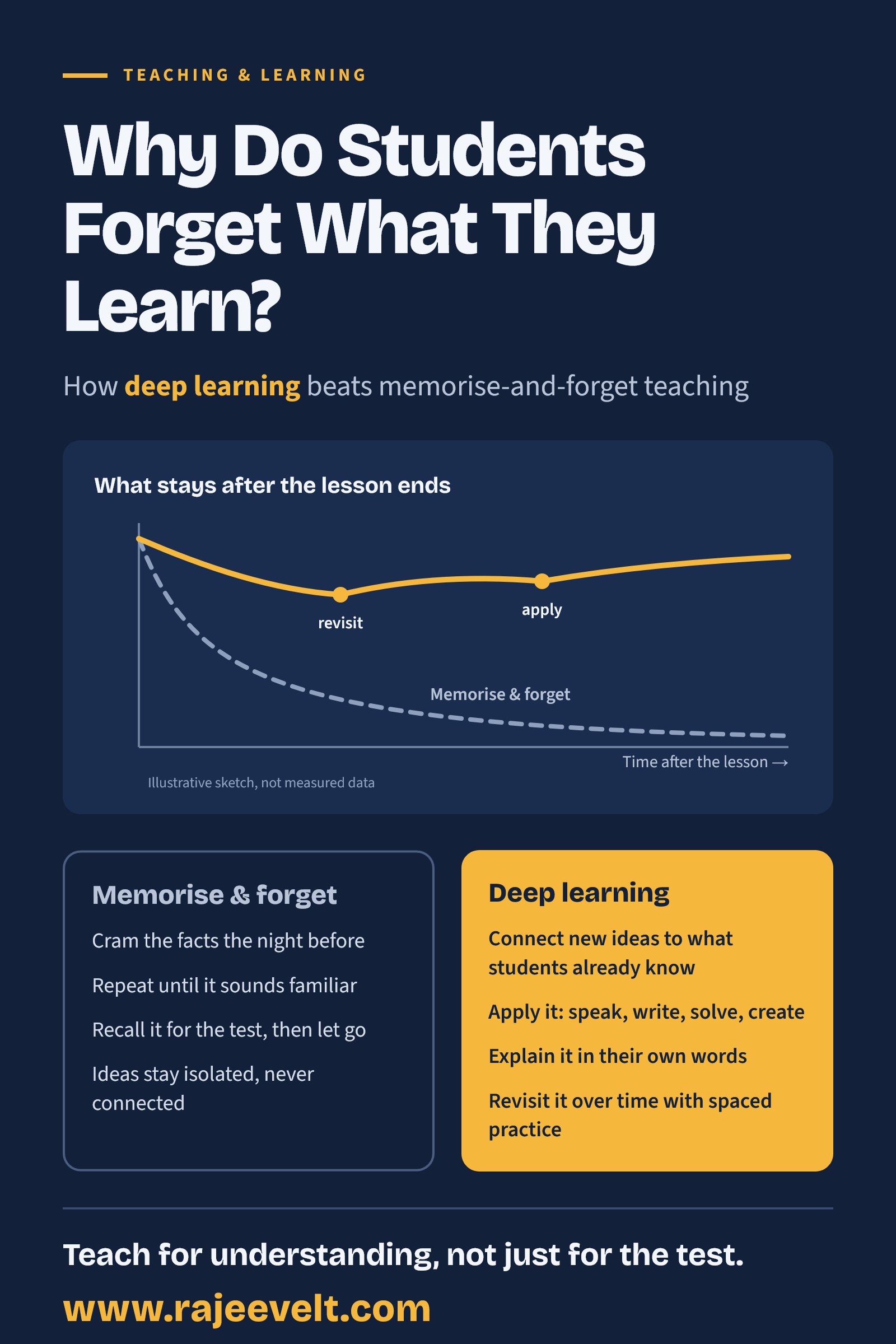
Why Do Students Forget What They Learn? How Deep Learning Beats Memorise-and-Forget Teaching
Student forgetting is the loss of learned knowledge over time. It happens less because students are incapable and more because teaching and assessment never ask them to connect, retrieve, apply or revisit what they learn. Deep learning is the opposite process: students build understanding they can explain, test and use in new situations.
Introduction:
Forgetting is a teaching problem
Students do not forget because they are incapable of learning. Forgetting is a normal feature of every human memory, and it tells us about the conditions in which learning took place.
Sometimes, we simply teach in ways that make forgetting easy. We cover a chapter, test it and move on. A few weeks after the examination, most of what students seemed to know has gone. We have all seen this. A student answers a question well in November and cannot answer a similar one in February. We call it a failure of the student. We think it is more often a failure of design.
Students forget mainly because they met an idea once, memorised it without understanding it, were never asked to retrieve it and never used it in a new situation. When we change those conditions, forgetting slows down.
What is forgetting?
Forgetting is the loss, or the temporary inaccessibility, of information that was once learned. It is not a defect in students. It is how memory works, and it even helps us: a mind that kept every detail with equal strength could not tell what matters.
The real question for teachers is which knowledge fades and why. We find it useful to separate three kinds of memory failure.
1. The student never learned it
Some “forgetting” is not forgetting at all. The student was present, but attention drifted, the explanation was unclear or the idea never made sense. Nothing was stored, so nothing can be recalled.
2. The student learned it weakly and cannot retrieve it
The knowledge was stored but held too loosely. Without cues or practice, the student cannot reach it. Often a small prompt brings it back, which shows the memory was not gone. It was out of reach.
3. The student learned it in one place and cannot use it in another
A student can solve a problem in the form taught in class and fail when the same idea appears in a different form. The knowledge is tied to one context. This is the failure teachers notice most, because it appears when the student needs to apply what they know.
Each kind needs a different response. Better explanation helps the first. Retrieval practice helps the second. Varied application helps the third. A school that treats all forgetting as one problem will fix none of them.
The Forgetting Curve: What it tells teachers
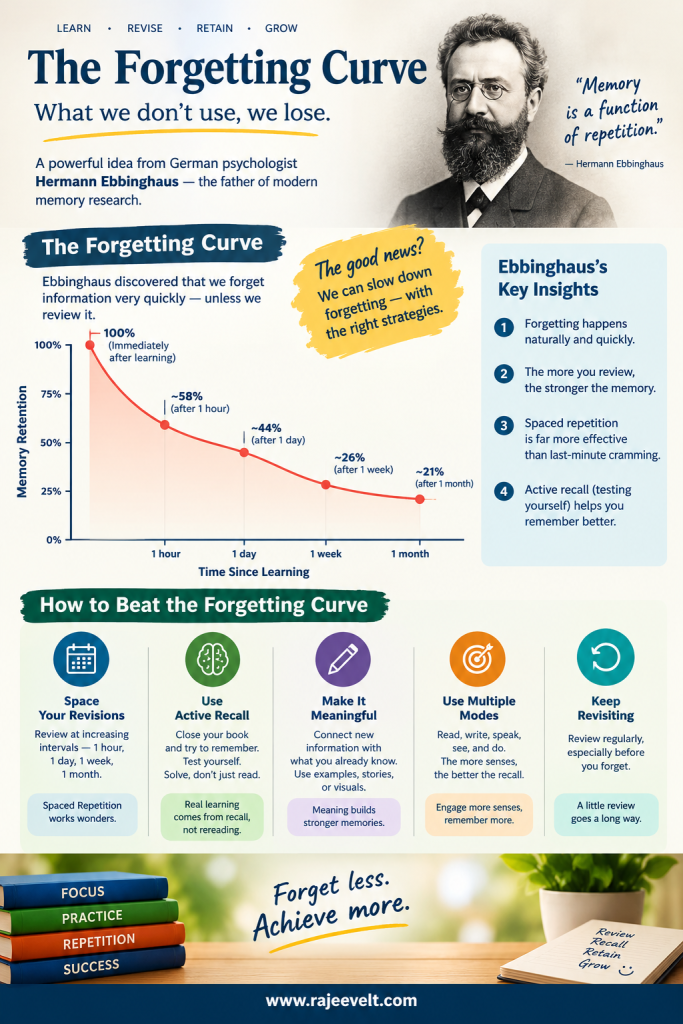
In 1885 the German psychologist Hermann Ebbinghaus tested his own memory. He learned lists of meaningless syllables, then measured how much effort he needed to relearn them after different delays. He found that forgetting is fastest soon after learning and then slows down. This pattern is known as the forgetting curve.
A later replication by Jaap Murre and Joeri Dros in 2015 found a similar shape. The curve is one of the most repeated findings in memory research.
We should read it with care. Ebbinghaus used nonsense syllables to remove meaning. Real school knowledge is meaningful, and meaningful material is forgotten more slowly. This is an argument for teaching ideas, not lists. Studies of long-term memory also show that knowledge which is practised and used over time can last for decades. Harry Bahrick’s work on Spanish learned in school is the best-known example.
Four lessons follow for teachers.
- The first days matter most. If students do not return to an idea soon after learning it, much of it fades quickly.
- One exposure is not enough. A single lesson, however good, is a weak foundation.
- Each return flattens the curve. Every time a student successfully recalls an idea, it fades more slowly afterwards.
- Meaning protects memory. Students who understand why an idea is true hold it longer than students who only know that it is true.
The forgetting curve does not say that students are doomed to forget. It says that memory needs maintenance, and that teaching can build that maintenance into the way we work.
Why Students Really Forget: Seven Causes We Can Change
Most causes of forgetting sit in our teaching and assessment, not in students. That is good news, because we can change them.
1. Students memorise without understanding
When a student learns a fact or procedure without knowing why it works, the knowledge has nothing to attach to. It stays as an isolated item, and isolated items fade quickly. Understanding creates links, and links make recall possible.
2. Learning happens once
Many units are taught in a block, tested at the end and never seen again. This pattern, called massed practice, produces fast gains and fast losses. Spreading the same time over several weeks produces far stronger memory.
3. Students re-read instead of retrieving
Re-reading notes feels productive because the text looks familiar. Familiarity is not memory. Researchers call this an illusion of competence: students judge that they know something because it feels easy to recognise, then fail when they must produce it unaided.
4. Retrieval is rare
Memory strengthens when we pull information out, not only when we put it in. If students never face a question without notes, they never practise the act that exams and real life demand.
5. Content overload crowds out depth
A packed syllabus pushes teachers to move on before ideas settle. Working memory is limited, and John Sweller’s work on cognitive load shows that too much new material at once prevents learning. Coverage can reduce understanding.
6. Knowledge stays in one context
If an idea is only ever met in one form, such as one textbook example or one type of question, students tie it to that form. They cannot recognise it elsewhere. Transfer needs varied practice.
7. Assessment rewards short-term reproduction
Students are rational. When marks reward fast recall of memorised answers, they study that way. When tests never return to earlier units, nothing tells students that old knowledge still matters.
Together these seven causes explain a large share of forgetting. None of them says the student is weak. All of them describe choices we make.
The Cycle That Makes Forgetting Easy: Read, Memorise, Reproduce, Forget
If learning is reduced to four steps, we should not be surprised when students forget after the examination.
- Read. The student meets the idea once, in a textbook, a lecture or a set of notes.
- Memorise. The student repeats it until it can be held for a short time. This often happens the night before a test.
- Reproduce. The student writes it out in the examination, often in the same form in which it was learned.
- Forget. The examination is over, the knowledge has served its purpose and nothing asks the student to keep it.
Every step in this cycle is rational. Students follow it because the system rewards it. If marks go to the student who reproduces the most in the shortest time, then cramming is the best strategy, and a smart student will use it.
The cycle also gives adults a hidden comfort. A syllabus can be marked as complete, results can be reported, and nobody has to ask what students actually understood. Coverage is easy to count. Understanding is harder to see.
The cycle ends at reproduction, so nothing in it builds the three things that make memory last: links between ideas, repeated retrieval and use in new situations. Deep learning adds exactly those things.
What Deep Learning is, and how it differs from surface learning?
Deep learning, in education, is learning in which students understand an idea well enough to explain it, connect it to other ideas and use it in a new situation. It has nothing to do with artificial intelligence. The term comes from research by Ference Marton and Roger Säljö in 1976, who showed that students approach the same text in two different ways: some look for meaning, and others look for facts to repeat.
Surface learning is not always wrong. Some facts, such as number bonds or vocabulary, must be known by heart. The problem begins when surface learning is the only kind we ask for.
| Feature | Surface learning | Deep learning |
| Student’s aim | Pass the test | Understand the idea |
| Student’s question | “What will be asked?” | “Why does this work?” |
| Typical activity | Re-read, copy, memorise | Explain, retrieve, apply, discuss |
| How knowledge is stored | As separate items | As connected ideas |
| Typical task | Reproduce a known answer | Solve a new problem |
| After the exam | Fades quickly | Lasts and can be rebuilt |
| Teacher’s question | “Have I covered it?” | “Do they understand it?” |
The goal of teaching is not to remove surface learning. It is to make sure it grows into understanding.
Nine Opportunities Students Need for Deep Learning
Deep learning requires something different from the read-and-reproduce cycle. Students need opportunities to do nine things. Each one is a practical change a teacher can make in a normal lesson.
1. Connect new knowledge with what they already know
Students understand new ideas through the ideas they already hold. The educational psychologist David Ausubel argued that prior knowledge is the strongest influence on what a learner can take in. We should therefore find out what students know before we teach.
In practice, open a topic with a short question: “What do you already know about this? What does it remind you of?” Ask students to link a new idea to an old one in a sentence or a simple map. Use analogies, and then ask where the analogy breaks down.
2. Explain ideas in their own words
If a student can only repeat the textbook’s sentence, we do not know whether they understand it. When they explain an idea in their own words, gaps in understanding show up, for the student and for us. Research on self-explanation by Michelene Chi and colleagues found that students who explained material to themselves learned more than those who only read it.
In practice, ask for a one-minute written explanation at the end of a lesson. Ask students to explain an idea to a younger child, a parent or a friend who missed the class.
3. Retrieve information
Every act of successful recall strengthens memory. Henry Roediger and Jeffrey Karpicke showed that students who practised recall remembered more after a week than students who spent the same time re-reading, even though the re-readers felt more confident.
In practice, start lessons with three short questions on earlier material, answered without notes. Use blank-page recall: students write everything they remember about a topic, then check against their notes. Keep these tasks low-stakes so that students use them to learn, not to be ranked.
4. Apply concepts
Understanding shows when students use an idea in a situation they have not seen before. Grant Wiggins and Jay McTighe describe the ability to transfer learning as a central sign of understanding.
In practice, replace some repeated exercises with new problems. In science, ask students to predict what will happen in an unfamiliar experiment. In history, ask them to use an idea from one period to explain events in another. In mathematics, mix problem types so that students must choose a method, not just follow one.
5. Make mistakes
Mistakes are information. Students who never risk an error rarely test the edges of their understanding. Manu Kapur’s research on productive failure found that students who struggled with a problem before receiving instruction often understood the concept more deeply than students who were told the method first.
In practice, use error analysis: give students a worked solution with a hidden mistake and ask them to find it. Praise a good wrong answer that reveals how a student was thinking. Make it clear that mistakes in practice cost nothing.
6. Discuss
Talking forces students to organise their thinking and meet other views. A good discussion has a purpose, a clear question and a rule that claims need reasons.
In practice, use think-pair-share, small-group problem solving and structured debates. Ask students to build on or challenge a classmate’s point using evidence. Listen for the quality of reasoning, not only for the right answer.
7. Question
Students who ask good questions are thinking about the idea. Many classrooms train students to answer questions and rarely to ask them.
In practice, ask students to write the questions they would put to the author, the scientist or the historical figure. Ask them to rank their questions and choose the one most worth investigating. A question board, kept visible and revisited, shows that curiosity has a place.
8. Teach someone else
Preparing to teach changes how a student studies. Experiments by Nestojko and colleagues found that students who expected to teach material later remembered more of it than students who expected only to be tested. Teaching also exposes weak spots quickly, because a listener asks what the student has not thought about.
In practice, assign each student a short idea to teach a partner. Have students prepare a two-minute explanation with one example and one question to check understanding.
9. Revisit what they have learned
Returning to an idea after a delay is the most reliable way to keep it. A major review by Nicholas Cepeda and colleagues found that spacing study over time gives longer-lasting memory than studying the same amount in one block.
In practice, plan each unit with return points: a short recall task one week later, a mixed review three weeks later, and a cumulative question in later tests. Interleave topics so that students practise choosing the right idea, not only using the idea of the day.
What the Research Says About Making Learning Last
Cognitive psychologists have studied durable learning for more than a century. Their findings agree closely with the nine opportunities above. A widely cited review by John Dunlosky and colleagues in 2013 compared ten common study techniques. It rated practice testing and spaced practice as the most useful, and rated re-reading and highlighting as the least useful, though students use them most.
| Strategy | What students do | What the evidence shows |
| Practice testing | Recall without notes, then check | Strong gains in long-term memory (Roediger and Karpicke, 2006; Dunlosky et al., 2013) |
| Spaced practice | Return to material over days and weeks | Longer-lasting memory than one block of study (Cepeda et al., 2006) |
| Self-explanation | Explain why each step or fact holds | Better understanding and transfer (Chi et al., 1994) |
| Interleaving | Mix different problem types in one session | Better choice of method on later tests (Rohrer and Taylor, 2007) |
| Teaching others | Prepare to teach, or teach a peer | Better recall when students expect to teach (Nestojko et al., 2014) |
| Re-reading | Read notes again and again | Feels useful, helps little over time (Dunlosky et al., 2013) |
| Highlighting | Mark key passages | Low benefit unless paired with other strategies (Dunlosky et al., 2013) |
Why harder can be better
Robert Bjork uses the term desirable difficulties for conditions that make learning feel slower but make it last longer. Retrieval, spacing and interleaving all fit this idea. Students and teachers often judge them as less effective because performance during practice looks worse. Performance during practice is a poor guide to long-term learning.
This matters for how we talk to students. We should tell them that struggling to recall something is a sign that learning is happening, not that it is failing.
Retrieval beats note-making
In 2011 Jeffrey Karpicke and Janell Blunt compared retrieval practice with building concept maps from the text. Retrieval produced stronger learning on later tests, including questions that required inference. Making notes and maps still has value. It works best when students then close the notes and try to recall.
Feedback completes the loop
Retrieval without feedback can lock in mistakes. Teachers close the loop by letting students check their answers, correct them and try again. Paul Black and Dylan Wiliam’s review of formative assessment in 1998 found that regular, informative feedback raises achievement, especially for lower-attaining students.
A note of caution
Most of these studies took place in controlled settings, and effects vary with age, subject and task. We should treat them as strong guides, not guarantees. The best test is always what happens with our own students, which is why we recommend small trials and delayed checks, described later in this article.
A Practical Week: Routines Teachers Can Start Tomorrow
We do not need a new curriculum to reduce forgetting. We need small routines that repeat. The table shows one possible pattern for a single class. It takes about 45 minutes in a week and replaces time that would otherwise go to re-teaching.
| Day | Routine | Time | What it builds |
| Monday | Starter recall: three questions on last week’s work, answered without notes | 5 min | Retrieval and spacing |
| Tuesday | Explain it: each student writes a one-minute explanation of today’s key idea in their own words | 5 min | Explanation and understanding |
| Wednesday | Mixed practice: problems from this unit and earlier units, shuffled | 15 min | Interleaving and application |
| Thursday | Teach a partner: a two-minute explanation, then the partner asks one question | 10 min | Teaching and discussion |
| Friday | Blank-page recall, then check, correct and note one gap to revisit | 10 min | Retrieval with feedback |
Two additions each month strengthen the pattern. Run one cumulative quiz that includes material from earlier units. Run one error-analysis lesson in which students find and fix mistakes in sample work.
Three steps for tomorrow
A teacher who wants to begin does not need to do everything at once. We suggest three first steps.
- Open tomorrow’s lesson with three recall questions on material from a previous week, answered without notes.
- Close the lesson with a one-minute explanation written in the student’s own words.
- Put one return date in your plan for the topic you teach this week, and keep it.
“But we do not have time”
We hear this often, and the worry is fair. Our answer is that these routines replace time, not add it. A class that has to re-teach a unit before every examination is already spending the time. Short, regular retrieval removes much of that cost, because students arrive at revision with something to revise.
Beyond the Classroom: Schools Should Measure Learning, Not Coverage
There is a significant difference between completing a syllabus and creating learning. Every teacher knows the difference. Every school should measure it.
Most schools measure what is easy to count: chapters covered, lessons delivered, marks in end-of-unit tests. These numbers describe activity. They do not tell us what students still understand a month later. A school that wants to reduce forgetting needs measures that look further.
| What we usually count | What we should also look at |
| Percentage of the syllabus completed | Percentage of key ideas students can still explain after a delay |
| Marks in the test straight after teaching | Marks on the same ideas four to six weeks later |
| Number of tests given | Number of tests that include earlier units |
| Students’ answers to familiar questions | Students’ answers to unfamiliar problems |
| Teachers’ lesson plans | Samples of student explanations and corrected work |
How to run a delayed check
A delayed check is the simplest tool we know. It costs little and shows a great deal.
- Choose five key ideas from a unit that finished four to six weeks ago.
- Write one short question for each idea, including at least one that asks students to apply the idea in a new setting.
- Give the questions without warning and without notes, as a low-stakes task.
- Record how many students answer each question correctly, and look for patterns by idea, not by student.
- Re-teach the ideas that faded and change how they are taught next time.
The point is not to judge students or teachers. The point is to learn which kinds of teaching produce knowledge that lasts.
What school leaders can change
Leaders set the conditions that make deep learning possible.
- Reduce the weight of coverage. If a syllabus is too full to teach well, agree which ideas matter most and teach those deeply. Teaching fewer ideas with depth usually beats teaching many ideas thinly.
- Make assessments cumulative. Include earlier material in later tests, so that old knowledge keeps its value.
- Value low-stakes retrieval. Treat frequent short quizzes as practice, not as grades, so that students do not fear them.
- Look at student work together. Teachers learn about forgetting when they study what students actually wrote and explained.
- Protect teachers’ time. Teachers need time to plan return points and to review evidence. Professional learning that gives teachers that time supports better student learning.
When a school changes what it measures, it changes what everyone pays attention to. That is where reform becomes real.
Common Mistakes to Avoid
Well-meaning schools make the same errors again and again. We list seven, with a fix for each.
- Treating recap as retrieval. When a teacher summarises the last lesson, the teacher does the remembering. Fix: ask students to produce the summary from memory first.
- Making every quiz high-stakes. Fear of marks turns retrieval into anxiety. Fix: keep most quizzes low-stakes and use them for learning.
- Confusing busy with deep. A lesson full of activities can still ask only for copying. Fix: judge each task by the thinking it demands, not by how active it looks.
- Skipping feedback. Recall without correction can strengthen wrong answers. Fix: let students check and fix their answers soon after.
- Testing only the latest unit. Students learn that old content no longer matters. Fix: include earlier material in later tasks.
- Adding strategies all at once. Teachers who try six new routines usually keep none. Fix: pick one or two, run them for a term and review the results.
- Blaming students. “They just don’t revise” ends the conversation. Fix: ask what in our teaching made revision unnecessary or impossible.
Avoiding these mistakes does not take special resources. It takes a habit of asking what each task asks students to do.
The Question That Matters: Covered or Understood?
The goal of teaching should not be: “Have I covered the chapter?”
That question is about the teacher’s progress. It can be answered with a tick on a plan, and it can be answered “yes” while students understand very little.
A better question is: “Have my students understood the idea deeply enough to use it?”
That question is about the student’s learning. It cannot be answered by looking at a schedule. It can only be answered by watching students explain, apply, question and recall, and by returning to see what remains.
| “Have I covered the chapter?” | “Have my students understood the idea deeply enough to use it?” | |
| Who it is about | The teacher | The student |
| What it measures | Progress through content | Understanding that can be used |
| How we answer it | Check the plan | Ask students to explain and apply |
| What it leads to | Moving on | Practising, correcting and returning |
| What students do afterwards | Forget | Remember and use |
The second question changes daily practice. A teacher who asks it plans a retrieval task, listens to student explanations and notices which students cannot yet apply the idea. That teacher is creating learning, not just completing a syllabus.
Conclusion:
Teach so that forgetting is hard
Students do not forget because they are incapable of learning. They forget when learning is a single read, a night of memorising and an answer written once.
We can make forgetting harder. We can help students connect new ideas to old ones, explain in their own words, retrieve, apply, make mistakes, discuss, question, teach and return. None of these needs’ special technology. Each needs a small change in how we plan a lesson and what we ask students to do.
We can also change what we measure. A school that counts coverage will get coverage. A school that looks at what students still understand, and can use, will get learning.
There is a significant difference between completing a syllabus and creating learning. Every teacher knows the difference. Every school should measure it.
Frequently Asked Questions
Why do students forget what they learned after exams?
Most exam preparation relies on short-term memorisation, and the knowledge is not used or revisited afterwards. Memory fades fastest soon after learning, so material that is not retrieved or applied again is quickly lost.
Is forgetting a sign of low ability?
No. Forgetting is normal for every learner. Students with strong ability forget too when they learn through single exposure and rote repetition.
What is the best way to help students remember?
Research points to retrieval practice, spaced review, self-explanation and varied application. Each works better than re-reading or highlighting, which students use most often.
What is the difference between deep learning and surface learning?
Surface learning aims to reproduce information for a test. Deep learning aims to understand an idea well enough to explain it and use it in a new situation. Deep learning is the term from education research, and it is different from deep learning in artificial intelligence.
How often should students revisit a topic?
There is no single schedule. A useful starting pattern is a short recall task within a week, a mixed review after about three weeks, and cumulative questions in later tests. The best gap depends on how long the knowledge must last.
Does retrieval practice take too much class time?
It takes a few minutes a day, and it usually saves time later because students need less re-teaching before examinations.
How can a school tell whether students are really learning?
Run delayed checks: ask students about key ideas four to six weeks after teaching, without warning or notes, and include questions that need application. Compare the results with marks from the original test.
Resources and Learning Resources Web-links
References and Further Reading
- Ausubel, D. P. (1968). Educational Psychology: A Cognitive View. Holt, Rinehart and Winston.
- Bahrick, H. P. (1984). Semantic memory content in permastore: Fifty years of memory for Spanish learned in school. Journal of Experimental Psychology: General.
- Bjork, R. A. (1994). Memory and metamemory considerations in the training of human beings. In J. Metcalfe and A. Shimamura (Eds.), Metacognition: Knowing about Knowing. MIT Press.
- Black, P., and Wiliam, D. (1998). Assessment and classroom learning. Assessment in Education: Principles, Policy and Practice.
- Cepeda, N. J., Pashler, H., Vul, E., Wixted, J. T., and Rohrer, D. (2006). Distributed practice in verbal recall tasks: A review and quantitative synthesis. Psychological Bulletin.
- Chi, M. T. H., De Leeuw, N., Chiu, M.-H., and LaVancher, C. (1994). Eliciting self-explanations improves understanding. Cognitive Science.
- Dunlosky, J., Rawson, K. A., Marsh, E. J., Nathan, M. J., and Willingham, D. T. (2013). Improving students’ learning with effective learning techniques. Psychological Science in the Public Interest.
- Ebbinghaus, H. (1885). Über das Gedächtnis. Duncker and Humblot.
- Kapur, M. (2014). Productive failure in learning math. Cognitive Science.
- Karpicke, J. D., and Blunt, J. R. (2011). Retrieval practice produces more learning than elaborative studying with concept mapping. Science.
- Koriat, A., and Bjork, R. A. (2005). Illusions of competence in monitoring one’s knowledge during study. Journal of Experimental Psychology: Learning, Memory, and Cognition.
- Marton, F., and Säljö, R. (1976). On qualitative differences in learning: I. Outcome and process. British Journal of Educational Psychology.
- Murre, J. M. J., and Dros, J. (2015). Replication and analysis of Ebbinghaus’ forgetting curve. PLoS ONE.
- Nestojko, J. F., Bui, D. C., Kornell, N., and Bjork, E. L. (2014). Expecting to teach enhances learning and recall of text information. Memory and Cognition.
- Roediger, H. L., and Karpicke, J. D. (2006). Test-enhanced learning: Taking memory tests improves long-term retention. Psychological Science.
- Rohrer, D., and Taylor, K. (2007). The shuffling of mathematics problems improves learning. Instructional Science.
- Sweller, J. (1988). Cognitive load during problem solving: Effects on learning. Cognitive Science.
- Wiggins, G., and McTighe, J. (2005). Understanding by Design (2nd ed.). ASCD.