


Why Do Students Forget, and How Can We Help? A Teacher’s Perspective for Grades K-12
Students forget because the brain naturally let’s go of information it does not use. Forgetting is most likely when learning is overloaded, passive, crammed into one session, disconnected from what students already know, or never retrieved. It is also made worse by poor sleep, stress, and distraction. Teachers can help by teaching in small steps, making recall a daily habit through low-stakes quizzes and starter questions, spacing and mixing review over weeks and months, teaching students how to study, and supporting their wellbeing. These strategies work across ages 5-18 (Grades K-12) and in every subject, and none of them requires expensive resources.
Introduction:
The Question Every Teacher Asks
Every teacher knows the moment. We teach a lesson that goes well. Students nod, answer questions, and complete the task. Three weeks later we ask about the same idea and meet blank faces. The blankness may come with a cheerful shrug in a kindergarten classroom. It may come in a Grade 11 classroom with a sinking feeling and the words, “We never did this.”
It is tempting to conclude that students were not listening, did not revise, or do not care. Years of classroom experience and more than a century of research in cognitive psychology tell a more complicated and more hopeful story. Forgetting is not a defect in our students. It is a normal feature of how every human brain works. It affects the strongest and the weakest learners, in every country and every curriculum, from the youngest child to the most experienced teacher.
Once we understand why students forget, we can stop blaming them and start designing instruction that works with memory rather than against it. We will mainly discuss five things:
- It explains the causes of forgetting from a teacher’s point of view.
- It shows how forgetting looks at different ages, from kindergarten to Grade 12.
- It sets out practical, research-informed strategies we can use anywhere in the world, regardless of resources.
- It shows how those strategies apply in the major school subjects.
- It grounds the advice in real classroom research and in illustrative vignettes.
Part One: Understanding Forgetting
Forgetting is natural, and even useful
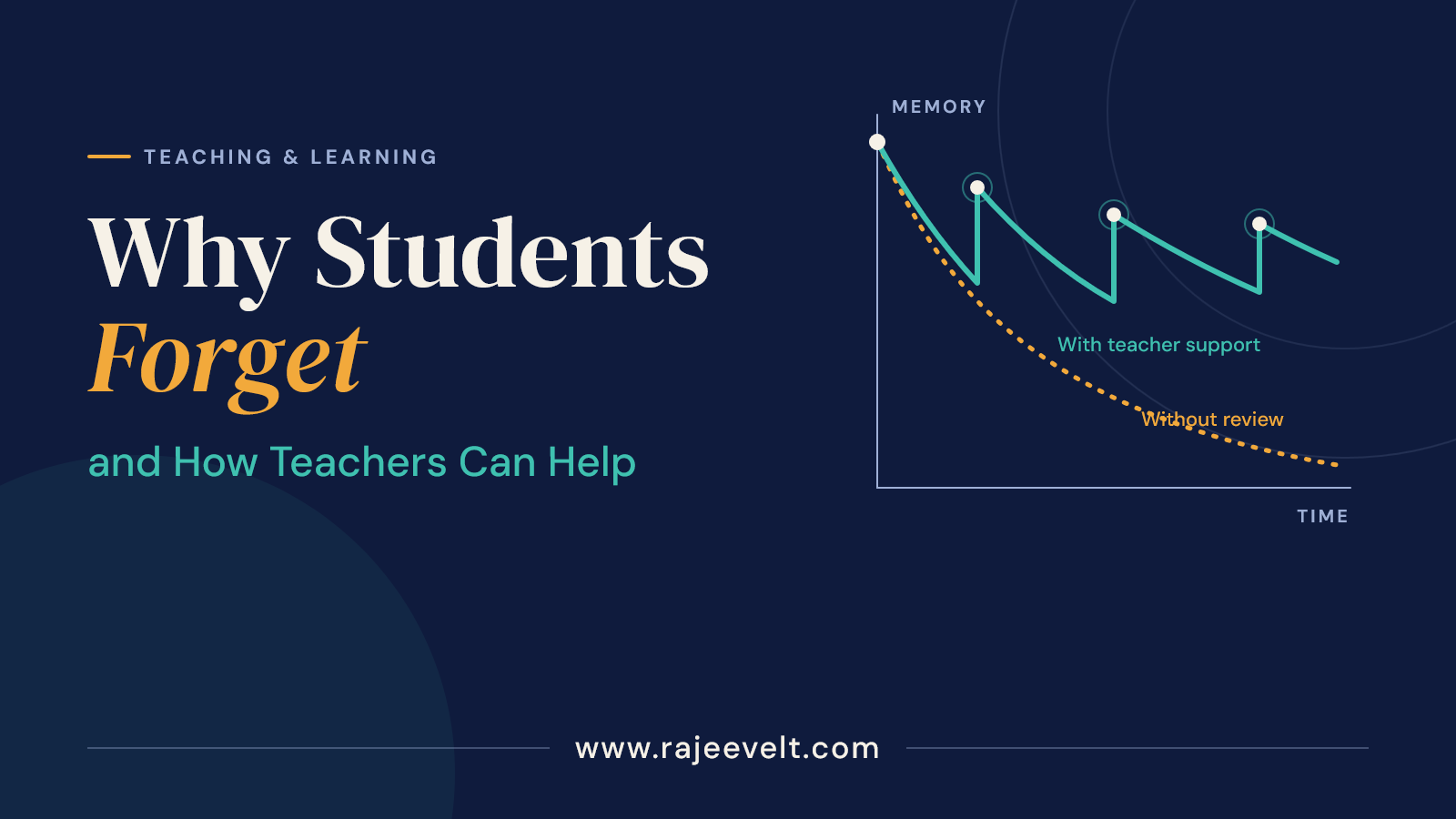
The German psychologist Hermann Ebbinghaus(1880) memorised lists of meaningless syllables and tested himself at intervals. He found that memory declines quickly soon after learning and then more slowly. This pattern became known as the forgetting curve. Later research has confirmed its general shape: without reinforcement, a large share of new information fades within days.
The brain is not designed to keep everything. At every moment we are flooded with sights, sounds, and facts. Memory has evolved to keep what is used repeatedly, what carries emotional weight, and what connects meaningfully to what we already know, and to let go of the rest. When a student forgets a Tuesday lesson on fractions, the brain is doing what it does with any information it judges unimportant.
Our task is therefore not to eliminate forgetting. It is to signal to the brain, through the way we teach, that this knowledge matters and should be kept.
How Memory Works, in Brief
Teachers do not need a neuroscience degree, but a simple model helps.
- Attention decides what enters the system at all. What is not noticed is rarely remembered.
- Working memory is the small mental workspace where we hold and manipulate information in the moment. Its capacity is very limited, and most people can handle only a few new items at once. Young children have even less capacity to work with.
- Long-term memory is the large, durable store. Learning means changing it. Knowledge held there frees working memory, which is why experts find new material in their field easier to learn.
- Consolidation is the process by which fragile new memories become stable. It continues after the lesson ends, and sleep plays an important role.
- Retrieval is the act of pulling information back out. Each successful retrieval makes the memory easier to retrieve next time.
The Main Reasons Students Forget
- The information never reached long-term memory.
If a lesson delivers too much too quickly, working memory is overloaded and the information is never encoded properly. John Sweller’s cognitive load theory describes this clearly: students may seem to follow along but retain little. In such cases the student has not forgotten the material, because it was never securely learned.
- Learning was passive.
Listening, watching, and re-reading feel productive but create what psychologists call an illusion of fluency. Familiar material feels known. Yet familiarity is not the ability to recall and use knowledge independently. Research reviewed by John Dunlosky and colleagues found that popular techniques such as highlighting and re-reading are among the least effective for durable learning.
- Practice was massed rather than spaced.
Cramming works in the short term, which is why students rely on it. But knowledge learned in a single burst fades quickly. The spacing effect, documented for over a century, shows that distributing learning over time produces far stronger long-term retention than the same study packed into one session.
- Knowledge was not connected to anything.
Isolated facts are fragile. Information that links to existing knowledge through a story, a pattern, or a real-life example has many routes by which it can be retrieved later. Memorising without understanding leaves information on a single thin thread.
- The student lacked foundational knowledge.
New learning builds on prior learning. If earlier concepts are shaky, new material has nothing to attach to and is quickly lost. This is why gaps in the early years compound in later years.
- Emotional and physical conditions interfered.
Chronic stress, anxiety, hunger, poor sleep, and heavy screen use all damage the brain’s ability to encode and consolidate memories. A tired student is not only less attentive but also less able to store what was learned.
- Distraction and divided attention.
Phones, noise, multitasking, and wandering minds all weaken encoding.
8. Low motivation, relevance, or belonging.
When students cannot see why something matters, or do not feel safe and valued in the classroom, they invest less mental effort, and low effort produces shallow memory.
- Interference from similar information.
New learning can disrupt older learning and the reverse. Students who learn similar concepts in quick succession, such as two grammar rules, two historical periods, or two chemical reactions, often confuse them.
- Insufficient retrieval.
Perhaps the most important cause is this: memories are strengthened by being retrieved. If students never need to pull information out of memory, the brain has little reason to hold it.
Part Two: Forgetting Across the Ages, From K to 12
The causes of forgetting are the same throughout schooling, but they show up differently as children develop. Matching our approach to the age of our students makes it far more effective.
Early Years and Early Primary (Roughly Ages 4 to 7; Kindergarten to Grade 2)
Young children have small working-memory capacity and short attention spans. They learn best through play, movement, songs, stories, and concrete objects. They forget quickly when instructions are long, but they also remember vividly when learning is joyful and physical.
What helps.
- Short, clear instructions, given one or two at a time, supported by gestures and visuals.
- Daily routines, songs, chants, and rhymes that build repetition into enjoyable activity.
- Retrieval through games: “What did we find in the garden yesterday?”, sorting games, “show me” with fingers or picture cards, and oral recall in a circle.
- Concrete objects before symbols, such as counters before numerals and real objects before pictures.
- Stories that carry facts and sequence.
- Predictable, warm, safe classrooms, because young children cannot learn when they feel anxious.
- Attention to sleep, nutrition, and routines, working closely with families.
Upper Primary (Roughly Ages 8 to 11; Grades 3 to 5)
Children now read and write independently, and their working memory has grown. This is the stage at which study habits begin. They are usually eager to please and willing to try new routines, which makes it an ideal time to build habits of recall.
What helps.
- Daily starter questions and weekly “memory games” or low-stakes quizzes.
- Teaching children simple self-testing, such as cover-and-recall, flashcards, and “tell a partner what you remember.”
- Consistent routines for homework and short, regular practice at home.
- Introducing the idea that effort in remembering is a sign of learning, using child-friendly language such as “brain exercise.”
- Building vocabulary and background knowledge systematically, since they become the foundation of reading comprehension.
- Explicit revisiting of number facts, spelling patterns, and key vocabulary at spaced intervals.
Middle Years (Roughly Ages 11 to 14; Grades 6 to 8)
Students face many subjects, many teachers, and rising demands for organisation. Adolescence brings changes in sleep patterns, social pressure, and identity. Memory problems at this stage are often problems of organisation, motivation, and overload more than of intelligence.
What helps.
- Explicit teaching of study skills, including planners, spaced revision timetables, summarising from memory, and self-quizzing.
- Cumulative review, so that content from earlier units keeps returning.
- Interleaved practice, introduced after methods have been taught.
- Metacognition: helping students judge honestly what they know and do not know.
- Coordination between teachers, so that assessments do not all arrive in the same week.
- Sensitivity to belonging and self-image, because many students decide at this age whether they are “good at” a subject.
- Conversations about sleep, phones, and wellbeing.
Upper Secondary (Roughly Ages 14 to 18; Grades 9 to 12)
Content is more abstract and the volume is much larger, and high-stakes examinations loom. Students face long-term retention demands, since final examinations may cover two years of material. Stress, part-time work, screens, and late nights compete with study.
What helps.
- Revision begun months, not days, before examinations, built on spaced retrieval of key content.
- Practice with past papers under varied conditions, with feedback.
- Teaching students to use retrieval-based study methods in place of re-reading and highlighting.
- Mixed practice that resembles the format of the final examination.
- Open conversations about stress, anxiety, and sleep, and links to counselling support.
- Helping students see connections across subjects and the “big ideas” within each one.
- Preparing students for independent learning beyond school.
Teenagers’ sleep deserves special mention. Adolescence brings a natural shift in sleep timing, and many teenagers get less sleep than they need. Common health guidance suggests roughly 8 to 10 hours for teenagers, with more for younger children, though individual needs vary. Early start times, late-night screens, and heavy homework loads all work against this need, and we can at least talk about it openly with students and families.
Part Three: How We, as Teachers, Can Help
The encouraging news is that most causes of forgetting are within our influence. These strategies draw on cognitive science and classroom practice, and none requires expensive technology.
1. We can reduce cognitive overload.
We protect working memory by planning carefully.
- Teach in small steps, introducing a limited amount of new material at a time and checking understanding before moving on.
- Model before expecting independence. Worked examples, where we think aloud and show each step, help novices far more than being left to discover everything alone.
- Remove clutter. Busy slides, dense text read aloud, and decorative extras compete for attention.
- Use clear, simple language first, then introduce technical vocabulary gradually.
2. We can make retrieval a daily habit.
Retrieval practice is the most powerful and best-supported way we can help students remember. Studies by Henry Roediger and Jeffrey Karpicke, among others, showed that students who practised recalling information outperformed those who simply re-studied it, even though the re-studiers felt more confident.
- Starter questions. Begin each lesson with three to five questions on yesterday, last week, and last month.
- Low-stakes quizzes. Short, frequent, ungraded or lightly graded quizzes make recall normal rather than frightening.
- Brain dumps. Students write everything they remember about a topic, then check against their notes.
- Cold-calling, mini whiteboards, and choral response, so that every student answers, not only volunteers.
- Flashcards and self-quizzing, taught explicitly.
- Exit tickets that ask students to recall, not merely react.
We should explain to students that struggling to remember is not a sign of failure. The effort is exactly what strengthens the memory.
3. We can space our teaching.
We plan to return to it instead of teaching a topic once and moving on.
- Build revisit points into the term, so that a key idea reappears after a day, a week, a month, and a term.
- Use “do now” activities that mix old and new topics.
- Design homework that includes questions on earlier units.
- Share the idea of spacing with students and help them plan revision that begins early.
A commonly cited rule of thumb from spacing research is that the best gap between study sessions depends on how long the knowledge needs to last: the longer the goal, the longer the useful gap. We do not need exact schedules. We simply need to avoid teaching topics once and never touching them again.
4. We can interleave and vary practice.
When students practise only one problem type at a time, they can succeed by routine without learning to choose the right method. Interleaving, mixing different problem types or topics within practice, feels harder but improves long-term learning and transfer. It is most valuable in mathematics, science, and languages, and it works best once each method has been taught.
5. We can build meaning and connections.
- Link new ideas to prior knowledge. Ask, “What does this remind you of?”
- Use analogies, stories, and real-world examples. A concrete image gives an abstract idea something to hold onto.
- Use dual coding, combining words with diagrams, timelines, and sketches to create two pathways to the same memory.
- Encourage elaboration. Ask students to explain in their own words, to say why something is true, and to compare it with something similar.
- Teach the big ideas of a subject, so that details have a framework to sit in.
6. We can check for understanding continuously.
Formative assessment lets us catch misunderstanding before it hardens. Questions, exit tickets, thumbs-up signals, and short written responses tell us who has learned and who has not. When we notice a gap, we respond at once with reteaching, a different explanation, or more practice. Forgetting is often the visible end of a misunderstanding that began earlier.
7. We can provide timely, useful feedback.
Feedback that tells students what was correct, what was not, and what to do next supports memory. Without feedback, errors can be remembered as facts. We aim for feedback that is specific, focused on the task rather than the person, and given while it can still be used.
8. We can teach students how to learn.
Many students have never been taught how to study. Explicitly teaching metacognition, thinking about one’s own thinking, is among the most valuable things we can do.
- Explain the forgetting curve and why cramming fails.
- Show students how to self-quiz, space revision, and summarise from memory.
- Encourage them to predict their performance and compare it with the actual result, so they learn to judge their own understanding accurately.
- Help them recognise the difference between “I recognise this” and “I can recall this.”
When students understand how memory works, they become partners in their own learning.
9. We can create emotionally safe, engaging classrooms.
Students remember what they care about and where they feel safe.
- Build warm, respectful relationships. A student who fears humiliation avoids risk.
- Normalise mistakes as part of learning.
- Make lessons relevant by connecting content to students’ lives, cultures, interests, and futures.
- Use curiosity: a puzzle, a question, or a surprising fact at the start of a lesson captures attention.
- Celebrate effort and progress, not only results.
10. We can support the whole child.
Memory is a biological process, so we cannot ignore students’ wellbeing.
- Talk with students and families about sleep, nutrition, and physical activity.
- Be alert to signs of stress, anxiety, hunger, or difficulty at home, and work with counsellors and colleagues to support students who need help.
- Include movement breaks and manageable workloads.
- Teach students to manage phones and digital distractions during study.
11. We can support students with additional needs.
Some students forget more because of learning differences such as dyslexia, ADHD, language barriers, or working-memory difficulties. For them we can use clear structure, visual supports, chunked instructions, repetition, checklists, and extra time, and we can work closely with specialists and families. Teaching of this kind helps every student, not only those with identified needs.
12. We can involve families.
Families are important partners. We can share simple ideas: asking children to explain what they learned that day, short regular practice at home, and consistent routines for sleep and study. We should be sensitive to circumstances, because not every family has the time, resources, or confidence to help. Small, realistic suggestions work best.
13. We can use technology wisely.
Digital quizzing tools, spaced-repetition apps, and online flashcards can make retrieval and spacing easier to organise. But technology is a tool, not a solution in itself. Poorly used devices distract and overload students. We choose tools that increase active recall and avoid those that merely entertain.
Part Four: Helping Students Remember in Every Subject
The same principles apply across the curriculum, but each subject has its own challenges and opportunities.
Mathematics
Common problem. Students can follow a procedure in the lesson but cannot choose or recall it later. Foundational gaps, such as number facts, fractions, and place value, undermine later topics.
What helps.
- Worked examples, followed by gradually faded support.
- Daily retrieval of number facts and key procedures in the early grades, building fluency so that working memory is free for problem-solving.
- Cumulative review and interleaved problem sets that mix topics once each method has been taught.
- Asking students to explain why a method works, not only how.
- Diagnosing misconceptions early, because errors in fractions or algebra spread.
Science
Common problem. Students hold misconceptions that survive teaching, and they memorise vocabulary without understanding the underlying models.
What helps.
- Retrieval of key concepts and models at spaced intervals, using short quizzes and diagrams drawn from memory.
- “Predict, observe, explain” activities, which confront misconceptions directly.
- Dual coding: labelled diagrams, process flows, and models students redraw from memory.
- Linking experiments to the ideas behind them, so that practical work is not remembered only as an activity.
- Careful building of vocabulary, with regular retrieval of terms and definitions.
Language, Literacy, and Reading (First Language)
Common problem. Students who lack background knowledge and vocabulary struggle to understand what they read, and weak early decoding limits comprehension later.
What helps.
- Systematic, spaced review of phonics patterns, spelling, and vocabulary in the early grades.
- Building background knowledge through rich texts, read-alouds, and topic-focused units, since comprehension depends heavily on what students already know.
- Retelling, summarising from memory, and discussion of texts.
- For writing: retrieval of grammar rules and sentence structures, planning before drafting, and modelling of good writing.
- Regular reading, which strengthens vocabulary and knowledge over time.
Foreign and Additional Languages
Common problem. Vocabulary and grammar fade rapidly without frequent use.
What helps.
- Spaced, retrieval-based vocabulary practice, such as flashcards and quick oral recall.
- Frequent speaking and writing, so that students produce language and not only recognise it.
- Interleaving grammar points and vocabulary themes.
- Using songs, stories, and real communication to give language meaning.
- Revisiting earlier units regularly instead of treating them as finished.
History, Geography, and Social Studies
Common problem. Students experience these subjects as long lists of names, dates, and places, which are easily forgotten and easily confused.
What helps.
- Teaching through narrative and cause and effect, because stories and “why” questions create connections.
- Timelines, maps, and concept maps students rebuild from memory.
- Regular low-stakes quizzing on key people, places, and events, mixing old and new content.
- Asking students to explain why events happened and how they compare, which deepens memory through elaboration.
- Revisiting big themes across units, so that details attach to a lasting framework.
The Arts and Music
Common problem. Skills need repeated practice, and students may not see the value of structured repetition.
What helps.
- Short, regular, spaced practice of technique, since distributed practice generally outperforms one long session.
- Mixing skills within a session instead of repeating one skill in a block.
- Specific feedback and opportunities to try again.
- Retrieval of terms, notation, and techniques through short oral or written checks.
- Reflection on practice, so that students learn how they improve.
Physical Education and Health
Common problem. Motor skills and rules fade without regular practice, and students may see PE as separate from “learning.”
What helps.
- Frequent, short practice of skills, spread across the term.
- Varied, mixed practice, because it develops adaptable skills as well as repeated routines.
- Clear demonstrations, simple cues, and prompt feedback.
- Recall of rules, tactics, and health knowledge through quick questions and games.
- Links between physical activity and wellbeing, which supports students’ memory and attention more widely.
Computer Science, Design, and Technology
Common problem. Students can follow instructions while building something but cannot reproduce the underlying ideas independently.
What helps.
- Worked examples and tracing code or processes by hand.
- Short retrieval exercises on syntax, concepts, and tools.
- Mixed problem sets that require choosing the right approach.
- Opportunities to explain, debug, and modify existing work, which builds understanding.
- Revisiting key concepts as projects grow more complex.
Across All Subjects
Three questions help us in every subject:
- What are the key ideas we want students to remember in a year?
- How, and when, will students retrieve them again?
- How will we know who has forgotten, and what will we do about it?
A Case Study
Part Five: Evidence from Real Classrooms
Case Study: “Can Short Quizzes Really Help Students Remember?”
Much of what we know about memory comes from laboratory experiments with adults, so a fair question is whether the same ideas work in ordinary classrooms. A research group led by Mark McDaniel, Henry Roediger, Kathleen McDermott, and Pooja Agarwal set out to answer that question in real schools.
One school was a public school in a rural part of Illinois in the United States, serving a middle to upper-middle-class community with a wide range of student achievement. The researchers studied science and social studies classes with the cooperation of the classroom teachers.
What the teachers did in the eighth-grade science study? Students took multiple-choice quizzes with feedback, covering some of the content that would later appear on unit exams but not all of it. Because quizzed and non-quizzed material sat side by side in the same classes with the same teachers, the researchers could compare the two directly.
What they found. Quizzing produced gains of between 13% and 25% on the unit exams, with the biggest benefit from quizzes used as a review shortly before the exam. The advantage was still present on semester and end-of-year exams. A second set of experiments in a sixth-grade social studies course at a suburban middle school used three low-stakes multiple-choice quizzes and used the course’s own graded tests as measures. The authors concluded that retrieval practice can improve performance under real classroom conditions.
The same research programme also reported on classroom-based retrieval practice and test anxiety, in a publication titled “Classroom-Based Programs of Retrieval Practice Reduce Middle School and High School Students’ Test Anxiety.” This matters for us as teachers: frequent low-stakes quizzing, handled well, can make testing feel routine rather than threatening.
What students believe. Jeffrey Karpicke and Janell Blunt compared two ways of studying science texts. Across two studies involving 200 university students, practising retrieval beat elaborative study with concept mapping in every comparison. The result is striking because most students predicted that concept mapping would work better, yet they learned more by practising retrieval. Students often choose the strategy that feels more comfortable, not the one that works.
What this means for us.
- The benefits of retrieval practice are not limited to the laboratory. They appeared in real schools using real content and real exams.
- The quizzes were low-stakes and came with feedback. Both features matter.
- Timing matters: review quizzes shortly before an exam helped especially, and quizzing during the unit also helped.
- Students cannot judge for themselves which methods work best. They need us to design practice for them and explain why it works.
These studies took place mainly in schools in the United States, in particular subjects and age groups, and the Karpicke and Blunt study involved university students. Results in other countries, languages, class sizes, and curricula may differ, and effect sizes vary between studies. We should treat the evidence as strong guidance to try in our own contexts and evaluate carefully, not as a guarantee.
Case Study:
Mixing Practice Problems in Mathematics
Many mathematics classes practise one type of problem at a time: ten questions on one method, then ten on the next. Douglas Rohrer and colleagues tested whether mixing problem types, called interleaved practice, would help. In a large trial, 54 real seventh-grade mathematics classes, with 787 learners and 15 teachers across five Florida schools, were randomly assigned to mixed or one-type-at-a-time practice worksheets over four months.
Learners who had practised with mixed problems scored 61%, against 38% for those who had practised one type at a time on a test given a month later. The researchers were candid about the limits. The trial covered one country, one age group, and one subject, and every teacher reported that the mixed worksheets took longer. It also tested mixing alongside feedback and after learners already had some grounding in each method. We should therefore teach a method first, then mix practice, and allow extra time.
Part Six: Classroom Vignettes
These vignettes are composites. They reflect patterns that teachers commonly describe and that the research above helps explain. They are not reports of particular real classrooms or individuals. For publication, we recommend replacing at least one with a true account from your own teaching, with names changed and permission given where needed.
Vignette 1: “The Counting Song” (Kindergarten)
We taught the numbers to ten on a Monday with counters, fingers, and a counting song in our kindergarten class. Several children could not say what comes after seven by Thursday. We could have repeated the lesson, but we tried something different. Each morning, we sang the song while children pointed to counters laid out on the carpet, and we added “mystery number” games in which a child hid a counter under a cup while the rest guessed how many remained.
Within two weeks the children were counting confidently, and they asked for the games. They were retrieving and spacing without knowing it, and the learning belonged to them.
What it illustrates: Retrieval and repetition work best for young children when they are physical, playful, and part of a routine.
Vignette 2: “The Monday Starter” (Lower Secondary Science)
We asked our class of thirteen-year-olds on a Monday morning in a crowded classroom to explain what happens to particles when a solid melts, a topic we had taught five weeks earlier. The room went quiet. Several students were sure we had never covered it.
We were frustrated at first, then curious. The topic had been taught clearly and the students had done the work, but the knowledge had not been revisited since.
Therefore, we changed one habit. Every lesson began with four short questions on the whiteboard: one on yesterday’s lesson, one on last week’s, one on last months, and one from earlier in the term. Students answered on mini whiteboards, with no names and no marks. Within a few weeks the blank stares gave way to attempts. Some answers were wrong, but they were attempts, and we could see exactly which ideas needed attention.
What it illustrates: Retrieval practice and spacing, delivered in five minutes a day. The wrong answers were useful information, not failures.
Vignette 3: “Which Method Do I Use?” (Middle School Mathematics)
Our students could solve any problem on the worksheet as long as every question used the same method. On the unit test, with questions mixed together, many were lost. They could carry out the procedures but could not decide which procedure a problem needed.
We rebuilt our practice sets. After teaching each method properly, we mixed problems from several recent topics into each assignment and kept some questions from earlier units. At first, students complained. The worksheets felt harder and practice scores dipped. We explained why: the difficulty was the point, because choosing a strategy is the skill the test demands. We also gave ourselves more time, remembering that mixed practice takes longer.
What it illustrates: Interleaving trades a little comfort during practice for stronger learning later. It works best after students have learned each method, and it needs time and patience.
Vignette 4: “The Night-Before Student” (Upper Secondary History)
Anaya was one of the hardest-working students we taught. Before each test she stayed up late, re-reading her notes and highlighting them in several colours. She felt well prepared, and her marks were still modest. After a few weeks she told us, “I read it all and it felt like I knew it, but when the question came, my mind went white.”
We sat with her and explained the illusion of fluency: re-reading makes material feel familiar, and familiarity is not recall. We showed her a different routine. After reading a section, she closed her notes and wrote down everything she could remember, then checked what she had missed. She spread this over several short sessions across two weeks instead of one long night.
The first attempts were uncomfortable. She remembered much less than she expected. But within a month she told us that revision felt “harder, but I actually keep it now.”
What it illustrates: Students often choose methods that feel easy but work poorly, consistent with Karpicke and Blunt’s finding that students predicted the less effective method would be better. The remedy was explicit teaching of how to study, not more effort.
Vignette 5: “Too Tired to Learn” (Upper Primary)
Dilip was a bright boy who seemed to forget everything by Friday. We assumed he was not trying. Then a conversation with his family revealed that he shared a small, noisy home, often went to bed very late, and sometimes came to school without breakfast.
We did not excuse the forgetting, but we changed what we looked at. With the school counsellor we found ways to support his family. We gave him short, clearly structured tasks, a quiet place to work, and a daily retrieval question in class that he could succeed at. Over the term his confidence grew, and so did what he remembered.
What it illustrates: Forgetting is sometimes a signal about a student’s wellbeing, not just about study habits. Sleep, food, stress, and safety shape memory, and a strong lesson cannot fully compensate for a student who is exhausted, hungry, or afraid.
Part Seven: Common Mistakes We Should Avoid
Even well-intentioned teachers can unintentionally make forgetting worse.
- Racing through the curriculum. Coverage is not learning. A topic taught quickly and never revisited will be forgotten.
- Relying on revision only at the end. Last-minute revision cannot replace long-term reinforcement.
- Assuming a correct answer today means lasting learning. Performance during a lesson is not retention weeks later.
- Praising “easy” learning and avoiding difficulty. Some difficulty during learning, which Robert Bjork calls “desirable difficulty,” is beneficial.
- Overloading slides and handouts.
- Treating forgetting as laziness. This damages motivation and trust.
- Using assessment only to grade. Tests are most valuable when they also serve as learning tools.
- Mixing practice too early. Interleaving works best after students have learned each method.
- Ignoring wellbeing. Memory depends on sleep, food, safety, and belonging.
Part Eight: Putting It Into Practice
A Weekly Pattern Any Teacher Can Adapt
- Every lesson: Begin with a five-minute retrieval starter covering yesterday, last week, and last month. Teach in small steps with checks for understanding. Finish with an exit question.
- Weekly: A short low-stakes quiz mixing old and new topics. Use the results to decide what to reteach.
- Monthly: A review lesson using concept maps or brain dumps. Students identify weak areas and plan their revision.
- Each term: A cumulative review before major assessments, with revision begun well in advance.
- Ongoing: Regular conversations about sleep, study habits, and wellbeing.
Adapting the Pattern by Age
| Stage | Retrieval format | Review rhythm | Focus beyond memory |
| K–Grade 2 | Oral games, songs, picture cards, “show me” | Daily routines; weekly revisiting | Play, security, routines, sleep |
| Grades 3–5 | Starter questions, quiz games, partner recall | Daily and weekly | Building study habits; vocabulary and background knowledge |
| Grades 6–8 | Mini whiteboards, quizzes, brain dumps | Weekly and monthly cumulative review | Organization, metacognition, belonging, sleep |
| Grades 9–12 | Past papers, self-quizzing, mixed problem sets | Spaced revision started months ahead | Exam strategy, stress, independent learning |
School-Wide Approaches
Individual teachers can do a great deal, but schools can multiply the effect.
- Shared language. When all teachers use the same terms, such as “retrieval,” “spacing,” and “brain dump,” students recognise the routines across subjects.
- Curriculum planning for return. Departments map when key ideas will be revisited across a term and a year.
- Coordinated assessment calendars, so that students are not overloaded in one week.
- Professional learning. Time for teachers to share routines, observe each other, and discuss what students remember.
- Family communication. A simple, shared message about sleep, routines, and short regular practice.
- Wellbeing support that is connected to teaching, not separate from it.
Part Nine: The Teacher’s Own Reflection
We also forget. Teachers forget names, dates, and details too, and recognising this helps us stay patient and empathetic. When our own memory fails, we can remember that students are going through the same process with far less experience.
We should also reflect on our practice by asking:
- Do my students retrieve information regularly, or do they mainly listen?
- Do I revisit important ideas at intervals?
- In which of my classes do students most often say, “I’ve never seen this before”? What would a five-minute retrieval starter look like there?
- Have I taught students how to study, in a way suited to their age?
- Which students’ forgetting might be a sign of something beyond study habits?
- Do my students feel safe enough to try, fail, and try again?
Honest answers point to the areas where small changes will make the most difference. We do not need to change everything at once. One habit, such as a daily starter, is enough to begin.
Ten the best key points about Students Forgetfulness and Strategies to Overcome Challenges
- Forgetting is normal. The brain naturally discards information it does not use.
- Overload, passive learning, cramming, weak connections, stress, poor sleep, and lack of retrieval are the main causes.
- Retrieval practice, spacing, and interleaving are the most powerful strategies for lasting memory, and classroom studies support them.
- Strategies must fit the age: play and routine in the early years, habit-building in upper primary, organisation and metacognition in the middle years, and early, spaced revision in upper secondary.
- Every subject has its own forgetting problem and its own best response, but the principles are shared.
- Meaning, relevance, and emotional safety strengthen attention and encoding.
- Explicitly teaching students how to learn gives them tools for life.
- Supporting the whole child, including sleep, nutrition, and wellbeing, supports memory.
- Teachers who see forgetting as a design challenge can change outcomes.
Conclusion: Turning Forgetting into Learning
Forgetting is not the enemy of education. It is a fact of human biology that we can work with. When students forget, it usually tells us something about how learning was designed: too much too quickly, too little practice, too few connections, too little time, or too little support.
We cannot stop memory from fading, but we can slow the fade and strengthen what remains. We do this by teaching in manageable steps, making recall a regular habit, spacing and mixing practice, building understanding and connections, giving meaningful feedback, teaching students how to learn, caring for their wellbeing, and creating classrooms in which they feel safe and valued. We adapt all of this to our students’ ages, from the kindergarten carpet to the Grade 12 examination hall, and to the demands of each subject.
None of this requires extraordinary resources, only intention, consistency, and a willingness to see forgetting as a design challenge instead of a student failure. When we do this, our students leave our classrooms with knowledge that lasts and with the confidence and skills to keep learning for life.
Frequently Asked Questions
1. Why do students forget what they learn?
Memory is designed to keep what is used often, what matters emotionally, and what connects to existing knowledge, and to let the rest fade. Students forget when information was overloaded and never stored, when study was passive (such as re-reading), when learning was crammed, or when they never had to recall it. Tiredness, stress, and distraction add to the problem.
2. Is it normal for students to forget quickly after a lesson?
Yes. Research on the forgetting curve, which began with Hermann Ebbinghaus in the 1880s, shows that memory declines fastest soon after learning and then more slowly. Without review, a large share of new material fades within days. Forgetting is a normal feature of human memory, not a sign of laziness or low ability.
3. What is the forgetting curve?
The forgetting curve is the pattern in which memory fades quickly at first and then levels off if information is not revisited. Each time information is retrieved or reviewed, it becomes more durable and fades more slowly. Teachers can use this by building planned revisits into their teaching.
4. What is retrieval practice, and why does it work?
Retrieval practice means asking students to recall information from memory, without looking at their notes, before checking the answer. Examples include starter questions, short quizzes, “brain dumps,” and flashcards. The effort of recalling strengthens the memory. In classroom studies of low-stakes quizzing in middle-school classes, led by Mark McDaniel, Henry Roediger, and colleagues, quizzed material produced gains of roughly 13% to 25% on unit exams, and the benefit persisted on later exams.
5. How does spacing help students remember?
Spacing means spreading learning over time instead of concentrating it in one session. Returning to a topic after a day, a week, a month, and a term helps it move into long-term memory. Cramming can produce a short-term pass, but spaced practice leads to much longer-lasting learning.
6. What is interleaving, and when should teachers use it?
Interleaving means mixing different topics or problem types within practice, instead of practising one type at a time. It feels harder but helps students learn to choose the right method. In a large randomized trial of seventh-grade mathematics classes in Florida, students who practised mixed problems scored 61% on a test a month later, against 38% for those who practised one type at a time, although mixed practice took longer. Teachers should introduce interleaving after students have learned each method.
7. Why doesn’t re-reading and highlighting work well?
Re-reading and highlighting make material feel familiar, which creates the illusion of fluency: students feel they know something because it looks familiar. But recognising something is not the same as being able to recall and use it. Reviews of learning research have found these techniques to be among the less effective ways to study, and they are best replaced with self-testing.
8. How do sleep, stress, and well being affect student memory?
The brain consolidates new learning during sleep, so a tired student is less able to store what was learned. Chronic stress, anxiety, hunger, and heavy screen use also reduce attention and memory. Teachers can support memory by talking with students and families about sleep and routines, creating emotionally safe classrooms, and working with counsellors when a student seems to be struggling.
9. How should teaching differ for younger and older students?
Young children (about ages 4 to 7) learn best through play, songs, stories, and real objects, with short instructions and daily routines. Upper primary students (about 8 to 11) can begin simple self-testing and habit-building. Middle-years students (about 11 to 14) need help with organisation, spaced revision, and metacognition. Upper secondary students (about 14 to 18) benefit from revision started months ahead, practice under exam conditions, and attention to stress and sleep.
10. What is the simplest first step a teacher can take tomorrow?
Begin the next lesson with a five-minute retrieval starter of three to five questions: one on yesterday’s lesson, one on last weeks, and one on last months. Have students answer on paper or mini whiteboards, with no marks, then check together. This single habit builds retrieval, spacing, and diagnostic information about who has forgotten what, with no extra preparation beyond writing the questions.
Rajeev Ranjan
School Education
“Let knowledge grow from more to more.”
Alfred Tennyson, “In Memoriam”, Prologue, line 25
Reading References:
- Agarwal, P. K., D’Antonio, L., Roediger, H. L., McDermott, K. B., & McDaniel, M. A. Classroom-based programs of retrieval practice reduce middle school and high school students’ test anxiety.
- Bjork, R. A. Work on desirable difficulties in learning.
- Cepeda, N. J., Pashler, H., Vul, E., Wixted, J. T., & Rohrer, D. (2006). Distributed practice in verbal recall tasks: A review and quantitative synthesis. Psychological Bulletin.
- Dunlosky, J., Rawson, K. A., Marsh, E. J., Nathan, M. J., & Willingham, D. T. (2013). Improving students’ learning with effective learning techniques. Psychological Science in the Public Interest.
- Ebbinghaus, H. (1885). Über das Gedächtnis (Memory: A Contribution to Experimental Psychology).
- Karpicke, J. D., & Blunt, J. R. (2011). Retrieval practice produces more learning than elaborative studying with concept mapping. Science, 331(6018), 772–775.
- McDaniel, M. A., Agarwal, P. K., Huelser, B. J., McDermott, K. B., & Roediger, H. L. (2011). Test-enhanced learning in a middle school science classroom: The effects of quiz frequency and placement. Journal of Educational Psychology, 103(2), 399–414.
- Roediger, H. L., Agarwal, P. K., McDaniel, M. A., & McDermott, K. B. (2011). Test-enhanced learning in the classroom: Long-term improvements from quizzing. Journal of Experimental Psychology: Applied, 17(4), 382–395.
- Rohrer, D., Dedrick, R. F., & Stershic, S. (2015). Interleaved practice improves mathematics learning. Journal of Educational Psychology.
- Rohrer, D., Dedrick, R. F., Hartwig, M. K., & Cheung, C.-N. A randomized controlled trial of interleaved mathematics practice. Journal of Educational Psychology.
- Rosenshine, B. (2012). Principles of instruction: Research-based strategies that all teachers should know. American Educator.
- Sweller, J. Work on cognitive load theory.