


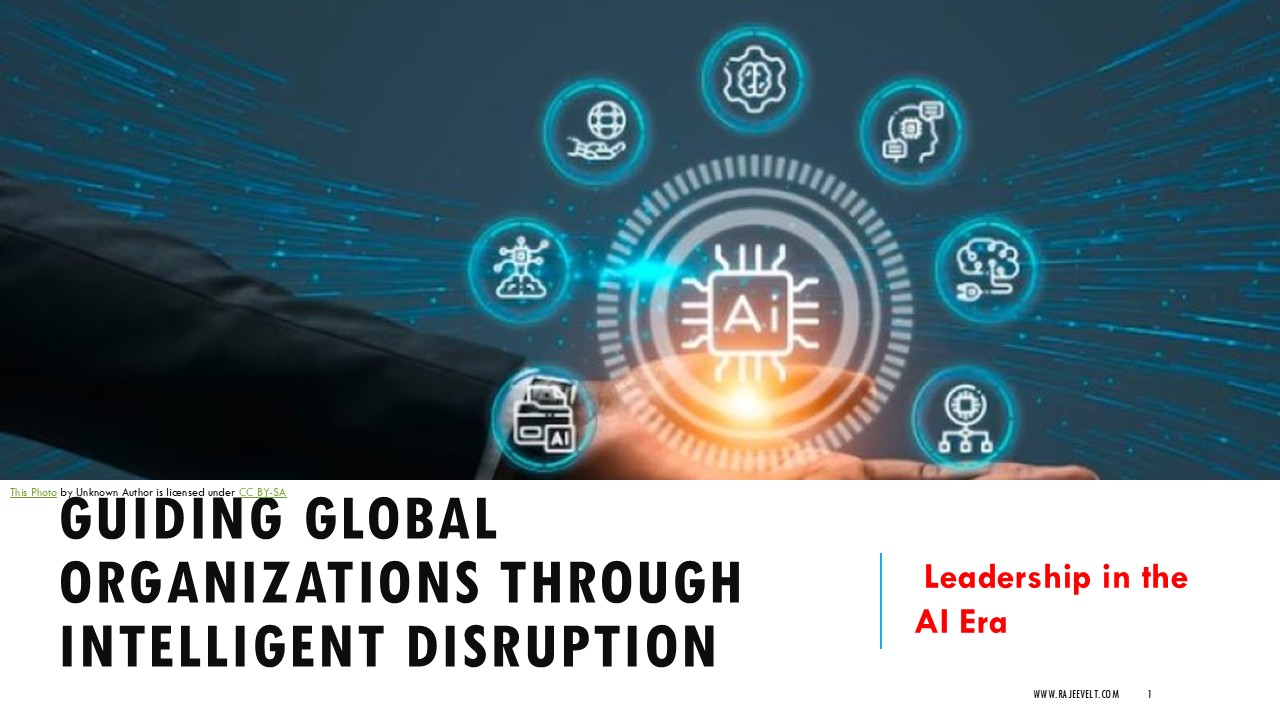
Leadership in the AI Era: Guiding Global Organizations Through Intelligent Disruption
Introduction
We stand at a defining moment in the history of leadership. Artificial intelligence is no longer a distant innovation reserved for technology companies — it has become the operating fabric of global business, governance, and society. We are witnessing a fundamental shift in how decisions are made, how value is created, and how leaders are expected to think from boardrooms in New York to manufacturing floors in Shenzhen, from public policy institutions in Brussels to startups in Nairobi.
This is not simply a technological transition. It is a leadership transition. The organizations that will thrive over the next decade will not be defined solely by the sophistication of their algorithms, but by the wisdom, adaptability, and human judgment of the leaders who deploy them. We are entering an era where leadership itself must be reimagined — not replaced by AI, but redefined alongside it.
The New Leadership Paradigm
Leadership was measured by command of information for generations — the leader who knew the most, saw the furthest, and controlled the flow of knowledge within an organization. AI has upended that model. Machines can now process more data in seconds than a human leader could review in a lifetime. Predictive models can forecast market shifts, customer behaviour, and operational risks with remarkable precision.
Yet this abundance of intelligence creates a paradox: the more powerful our tools become, the more essential human leadership becomes. We no longer need leaders who simply possess information — we need leaders who can interpret it, contextualize it, and act on it with integrity. In this new paradigm, leadership is defined less by what we know and more by how wisely we choose, how ethically we govern, and how effectively we align people around a shared purpose in a world of constant technological change.
Pillar One: Strategic Vision Beyond the Algorithm
AI can identify patterns, but it cannot create meaning. It can optimize a supply chain, but it cannot decide what an organization stands for. Our first responsibility is to hold the vision as international leaders that AI cannot generate on its own.
We should ask the questions that matter most: What kind of organization are we building? Whose lives will our technology touch, and how? What trade-offs are we willing to accept in the pursuit of efficiency, and which ones are we not?
Leaders who outsource strategic thinking entirely to algorithms risk building organizations that are efficient but directionless. The most successful global enterprises of the coming decade will be led by executives who treat AI as a powerful advisor — never as a replacement for human judgment and long-term vision.
Pillar Two: Ethical Governance and Trust
Trust has always been the currency of leadership. It becomes more fragile in the AI era — and more valuable — than ever before. Algorithmic bias, data privacy violations, and opaque decision-making systems can erode public confidence in an instant, regardless of geography or industry.
We have a responsibility to build governance structures that ensure AI systems are transparent, auditable, and aligned with human values. This means establishing clear accountability for AI-driven decisions, ensuring diverse perspectives are represented in system design, and communicating openly with employees, customers, and regulators about how these tools are used.
International leaders operate across varied legal, cultural, and ethical landscapes — from the European Union’s AI Act to emerging governance frameworks in Asia, Africa, and the Americas. Navigating this complexity requires more than legal compliance; it requires a genuine commitment to responsible innovation that respects local values while upholding universal standards of fairness and human dignity.
Pillar Three: Reimagining Talent and Culture
AI is transforming the nature of work itself. Routine and repetitive tasks are increasingly automated, while human capabilities — creativity, empathy, critical thinking, cross-cultural collaboration — are becoming the true differentiators of organizational success.
The leaders should invest deliberately in reskilling and upskilling our workforces. This is not a one-time training initiative; it is a continuous cultural commitment. We should foster environments where employees feel empowered to experiment with AI tools rather than threatened by them, where curiosity is rewarded, and where human-AI collaboration becomes a core organizational competency rather than a source of anxiety.
Equally important is preserving the human elements of culture that no algorithm can replicate: mentorship, shared purpose, psychological safety, and genuine connection between people. Leaders who neglect these dimensions in favour of pure technological efficiency risk creating organizations that are highly optimized but deeply disengaged.
Pillar Four: Global Collaboration in a Fragmented World
AI does not respect borders, yet its governance, development, and impact vary enormously by region. The leaders are uniquely positioned to bridge these divides. We should engage not only with our own organizations but with policymakers, industry coalitions, and civil society to help shape AI governance that is fair, inclusive, and globally coherent.
This requires humility. No single country, company, or leader holds a monopoly on wisdom in this domain. The leaders who will shape the next era of global progress are those willing to listen across cultures, share knowledge across borders, and collaborate even with competitors when the stakes — such as AI safety and ethical standards — are shared by all of humanity.
The Risks We Cannot Ignore
Leadership in the AI era also demands clear-eyed awareness of risk. Over-reliance on AI systems can erode critical thinking within organizations. Bias embedded in training data can perpetuate inequality at scale. Automation can displace workers faster than reskilling programs can adapt. Cybersecurity threats grow more sophisticated as AI itself becomes a tool for malicious actors.
We should resist the temptation to treat AI adoption as a race to be won at any cost. Sustainable leadership means pairing ambition with caution, innovation with oversight, and speed with responsibility. The leaders who succeed will be those who ask not only “can we do this?” but “should we do this, and how do we do it well?”
The Path Forward
Leadership in the AI era is ultimately about balance — between speed and reflection, automation and empathy, global ambition and local sensitivity, technological confidence and ethical humility. It calls on us to be lifelong learners, ethical stewards, and unifying forces in organizations and societies undergoing profound transformation.
We believe the leaders who will define this era are not those with the most advanced algorithms, but those with the clearest values. AI can enhance our capacity to lead — but it cannot replace the judgment, courage, and humanity that leadership has always required.
Conclusion
The AI era is not a distant future; it is our present reality. The international leaders carry the responsibility of ensuring that this powerful technology serves people, strengthens institutions, and builds a more equitable global economy. The path ahead demands vision without arrogance, innovation without recklessness, and progress without losing sight of the human beings at the center of every decision we make.
We do not need to fear artificial intelligence. We need to lead it — wisely, ethically, and together.