


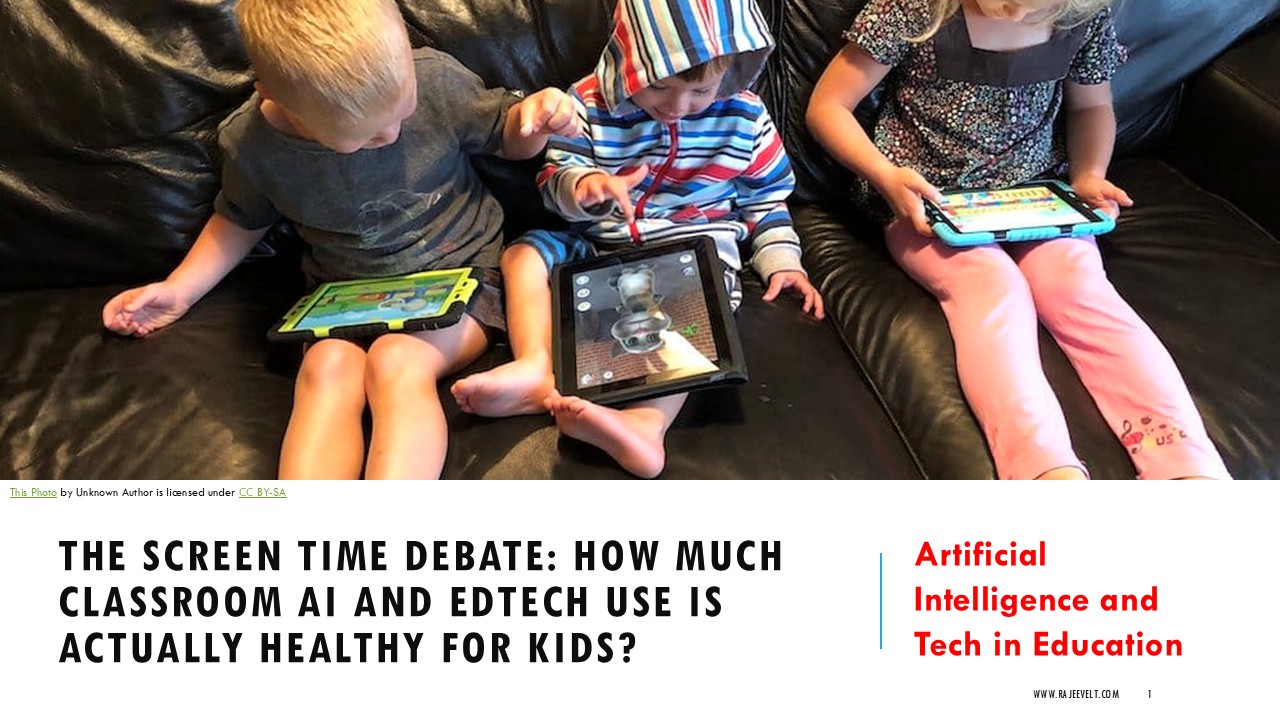
The Screen Time Debate: Balancing EdTech Benefits with Overexposure Concerns
A research-based, international look at how much classroom screen and AI time is genuinely healthy — through the lens of psychology and neuroscience
Introduction
We think few debates in modern parenting and education are as confusing as this one, and for good reason: the advice keeps changing. For nearly two decades, parents and teachers were handed a simple rule — no more than two hours of screen time a day. The American Academy of Pediatrics quietly retired that rule altogether in January 2026. In fact, it replaced two decades of hour-based limits with something far more nuanced: a framework built around context and quality rather than a stopwatch. That shift alone tells us something important — the science has matured to the point where researchers now understand that not all screen time is equal, and the real question was never simply “how much,” but “what kind, at what age, and displacing what.”
What’s Actually Happening Inside a Child’s Brain
To understand why age matters so much in this debate, it helps to understand what screens are doing neurologically, not just behaviourally.
The developing brain is uniquely vulnerable.
Neuroscience research consistently describes early childhood as a “blueprint” period for brain architecture — a stage in which neural pathways are being rapidly built and pruned based on a child’s real-world experiences. It is observed that the interactive, unpredictable nature of face-to-face human interaction — a caregiver’s changing facial expressions, tone, and responsiveness — stimulates brain development in ways that passive or even semi-interactive screen content generally cannot replicate at this stage.
The dopamine reward system plays a central role.
We think this is the single most important mechanism in the entire debate, and it’s backed by consistent research: digital platforms, especially those designed for engagement (autoplay video, notifications, intermittent rewards, unpredictable content feeds), trigger dopamine release in a manner strikingly similar to other reward-seeking behaviours. Over time, researchers have found this repeated stimulation can lead to a desensitization of the brain’s reward system — meaning real-world activities like reading a book, playing outdoors, or having a conversation can start to feel comparatively under-stimulating to a child whose reward system has adapted to high-intensity digital feedback loops.
A landmark longitudinal study adds hard evidence.
A December 2025 study published in eBioMedicine (The Lancet), conducted by researchers at Singapore’s A*STAR Institute for Human Development and the NUS Yong Loo Lin School of Medicine, followed children for more than a decade and found that high screen exposure before age two was linked to accelerated maturation of brain networks responsible for visual processing and cognitive control. Accelerated maturation might sound positive, but researchers caution it likely reflects networks developing out of their natural sequence, rather than developing “better” — a distinction that matters enormously for long-term cognitive and attentional outcomes.
Attention, executive function, and self-regulation show measurable effects.
Across multiple studies, researchers have documented associations between excessive early screen exposure and reduced attention, weaker decision-making and cognitive control, delays in fine motor skills relevant to handwriting, and reduced vocabulary and eye-contact behaviours — the building blocks of early social-emotional development. Separate cross-sectional research has found children exceeding two hours of daily screen time show significantly higher rates of behavioural abnormalities and ADHD-like symptoms compared to children under 30 minutes, a pattern researchers link back to the same dopamine-driven reward mechanisms described above.
Not all of this is deterministic, and context matters enormously.
It’s worth being precise here: researchers are consistently careful to note that screens rarely cause psychiatric or developmental disorders directly. Problems tend to emerge specifically when screens become a child’s primary way of regulating emotion, avoiding boredom or distress, or replacing face-to-face connection altogether — and children with existing vulnerabilities, including ADHD, autism spectrum traits, or anxiety, appear particularly susceptible to problematic patterns of use.
What the New 2026 Guidelines Actually Say
The American Academy of Pediatrics’ 2026 update — its most significant revision in over a decade — replaced rigid hour-based limits with what it calls the “5 Cs” framework: Child (their individual developmental stage and needs), Content (educational and thoughtfully designed versus purely passive or algorithmically addictive), Calm (whether screens are being used to soothe emotional dysregulation, which can interfere with a child’s own coping development), Crowding Out (whether screen time is displacing sleep, physical activity, or in-person connection), and Communication (whether parents and children are actively discussing screen content together, rather than consuming it in isolation).
Despite this more flexible framework, some age-specific anchors remain firm, and it is genuinely useful to lay them out clearly by age group:
- Under 18 months: Screens should be avoided almost entirely, with the sole exception of video-calling family members — because a responsive human face on a screen function more like real interaction than passive screen media, engaging the same social-cognitive systems as an in-person conversation.
- 18–24 months: If screens are introduced at all, the guidance is not “start now” but “if you do, choose high-quality content and co-view it together.” In practice, most pediatricians suggest keeping any exposure to roughly 15-30 minutes a day, in short sessions.
- 2–5 years: Guidance generally suggests limiting screens to around one hour per day of high-quality, ideally co-viewed programming — with the World Health Organization’s own guidelines aligning closely, recommending no screens under age one and no more than one hour daily for ages one to four.
- School-age children and adolescents (6+): Rather than a fixed number, current guidance shifts toward the 5 Cs framework — with particular emphasis on whether screen use is crowding out sleep, physical activity, and real-world social connection, and whether the content itself is developmentally appropriate and engagement-optimized versus genuinely educational.
Crucially, current AAP and comparable international guidance distinguish school and learning-app use from recreational and social media use — treating them as fundamentally different categories rather than lumping all “screen time” together, a distinction we think is long overdue and central to any serious EdTech policy discussion.
How Different Countries are Handling This
We found the international comparison here particularly revealing, because it shows how much culture, academic pressure, and policy infrastructure shape outcomes even when the underlying neuroscience is universal.
Asia: high exposure, increasingly assertive regulation.
In South Korea, Japan, China, and Singapore, screen exposure among children and adolescents tends to run high, driven by intense academic pressure and dense digital infrastructure. South Korea has formally recognized digital overuse as a public health issue. Japan’s guidance specifically emphasizes reducing screen exposure before bedtime, given strong evidence linking evening screen use to disrupted sleep architecture. China has taken the most interventionist approach among major economies, enforcing strict statutory gaming time limits for minors. Notably, these policies concentrate heavily on gaming addiction, academic displacement, and sleep disruption rather than educational screen use specifically.
Europe: comprehensive, research-driven frameworks.
Countries including Finland, Italy, and France have developed some of the more comprehensive national guidelines, often integrating screen-time guidance directly into broader child health and education policy. France, notably, recommends no screen exposure before age three — a full year beyond the international consensus of age two — reflecting a particularly cautious national stance grounded in ongoing cohort research such as the nationwide Elfe birth cohort study.
South Asia: high exposure, thin regulatory infrastructure.
Comparative research places daily adolescent screen time in Pakistan, India, and Bangladesh well above the 3.5-4-hour mark, with 68-75% of adolescents in these countries exceeding recommended limits — compared to just 30% in Finland, where average daily screen time sits closer to two hours. The same comparative data shows digital eye strain affecting more than 60% of youth in Pakistan and India, versus roughly a quarter of young people in Finland. Strikingly, national screen-time guidelines remain only partial or ad hoc in Pakistan and India, and entirely absent in Bangladesh — illustrating a broader pattern researcher have flagged: guidance and regulatory infrastructure in many low- and middle-income countries has not kept pace with the rate of digital exposure itself.
A universal core, despite different numbers.
Despite this variation in specific limits and regulatory maturity, it is genuinely striking how consistent the underlying principles are across every country and organization studied: minimize passive, algorithm-driven content, especially in early childhood; protect sleep and physical activity from being displaced; prioritize co-engagement and real-world interaction; and evaluate content quality rather than simply counting hours.
Where EdTech and AI Screen Time Genuinely Help
None of this neuroscience is an argument against classroom technology — and we think it would be a serious mistake to read it that way. Rather, it sharpens exactly where the real educational value lies.
Interactive, responsive learning tools differ meaningfully from passive content.
The psychological and neuroscience research is fairly consistent on this point: content that requires a child to actively respond, make decisions, and receive immediate, contextualized feedback — the hallmark of well-designed adaptive learning software — engages very different cognitive processes than passive video consumption or algorithmically optimized entertainment feeds. This is precisely the distinction current guidelines are trying to draw when they separate “homework and learning apps” from “recreational and social media use.”
AI-powered personalization can reduce, not increase, unproductive screen exposure.
When AI tutoring tools correctly identify a specific knowledge gap and deliver a targeted five-minute intervention, rather than requiring a student to sit through an entire generic lesson, the total time spent on a screen to reach mastery may actually decrease compared to less-targeted digital or even traditional instruction.
Structured, purposeful use supports executive function rather than eroding it.
Researchers distinguish clearly between screen use that requires sustained attention toward a defined goal (a coding exercise, a structured research task, a well-designed educational game with genuine learning mechanics) and screen use engineered primarily to maximize engagement and time-on-app. The former can plausibly support the development of focus and self-regulation; the latter, evidence suggests, tends to undermine it.
Where Overexposure Creates Real Concern in Classrooms
At the same time, we think it would be equally dishonest to wave away the overexposure risks simply because a tool is labelled “educational.”
“Educational” branding doesn’t guarantee good design.
Plenty of EdTech products marketed for classroom use are built on the same engagement-optimization principles as recreational apps — badges, streaks, autoplay-style progression, and notification-driven re-engagement — features that trigger the same dopamine mechanisms researchers have flagged as concerning, regardless of the academic content wrapped around them.
Displacement remains the central risk, not screens themselves.
In line with the AAP’s “Crowding Out” principle, the more useful classroom question isn’t “how many minutes on a device,” but “what is this screen time replacing?” Time spent on a well-designed adaptive learning tool that replaces a passive worksheet may be a net positive; the same amount of time spent on a device that displaces group discussion, hands-on experimentation, physical movement, or unstructured social interaction between students carries a very different developmental cost.
Sleep and evening use deserve particular caution.
Multiple national guidelines — Japan’s most explicitly — single out evening and pre-bedtime screen use as a distinct risk category, given strong, consistent evidence linking screen exposure close to bedtime with disrupted sleep architecture, which in turn affects next-day attention, mood regulation, and memory consolidation — all of which are directly relevant to classroom learning outcomes.
Younger children need categorically more protection than older students.
The neuroscience is unambiguous on this point: the case for caution is strongest and most evidence-backed in early childhood, given the brain’s heightened plasticity during this window, and becomes progressively more nuanced — shifting from strict duration limits toward content-and-context judgment — as children move into adolescence, where self-regulation capacity and critical media literacy are more developed.
A Practical, Age-Based Framework for Schools and Parents
Bringing the research together, here is what a genuinely evidence-informed approach looks like across developmental stages:
Early childhood (under 5): Minimize screen exposure generally, prioritize co-viewing and interactive over passive content when screens are used at all, and treat this stage as the period requiring the strongest precaution, in line with both AAP and WHO guidance.
Primary/elementary years (roughly 6-10): Shift from “how many minutes” toward “what kind and what’s it replacing.” Favor interactive, adaptive EdTech with genuine feedback loops over passive or purely entertainment-driven content, and protect sleep, physical activity, and unstructured play time explicitly.
Middle and secondary years (roughly 11-18): Continue applying the 5 Cs framework, with particular attention to evening screen use and sleep displacement, while recognizing that at this age, digital and AI literacy — including critical evaluation of algorithmically driven content — becomes an educational goal in its own right, not just a risk to manage.
Across all ages: Prioritize active, communicative, purpose-driven screen use over passive or engagement-optimized use; keep adults involved in what’s being consumed and why; and treat “is this crowding out something more developmentally valuable” as the central diagnostic question, rather than a fixed hourly limit.
What we think?
We think the honest takeaway from this research is that the old “screen time” debate — framed as a simple battle between hours used and hours avoided — was asking the wrong question all along. The neuroscience is clear that a young child’s brain responds very differently to a responsive human face than to a passive video feed, and that dopamine-driven engagement design carries real developmental costs, particularly early in life. But the same body of research is equally clear that well-designed, interactive, purposeful EdTech and AI tools operate on entirely different cognitive pathways than the engagement-optimized content the original guidelines were built to warn against. The path forward, echoed now by the AAP, the WHO, and researchers across very different education systems worldwide, isn’t a stricter number — it’s a sharper question: what is this specific screen doing for this specific child, right now, and what is it displacing? Get that question right, in classrooms and at home, and the healthiest possible balance between EdTech’s real benefits and overexposure’s real risks becomes far easier to find.
Frequently Asked Questions
What replaced the old “two hours a day” screen time rule?
The American Academy of Pediatrics (January 2026) retired hour-based limits in favour of the “5 Cs” framework — Child, Content, Calm, Crowding Out, and Communication — which evaluates screen use by context and quality rather than a fixed number of minutes.
Is educational screen time treated differently from entertainment screen time?
Yes. Current AAP guidance, along with comparable international frameworks, explicitly differentiates homework and learning-app use from recreational and social media use, recognizing that interactive, purposeful content engages different cognitive and neurological pathways than passive or engagement-optimized entertainment.
At what age is screen exposure most risky for brain development?
The strongest evidence for caution applies to children under two, when the brain is in a particularly plastic, formative stage. Research including a 2025 longitudinal study found high screen exposure before age two was linked to accelerated — and potentially prematurely sequenced — brain network development.
Do screen time guidelines differ significantly by country?
Yes, in specific numbers and regulatory maturity — France recommends no screens before age three, for example, while guidance in several South Asian countries remains only partial. However, the underlying scientific principles across nearly every country studied are strikingly consistent: minimize passive early exposure, protect sleep, and prioritize content quality over duration.
Can AI-powered learning tools reduce overall screen time?
Potentially, yes. Because AI-driven personalization can target a student’s specific knowledge gap directly, rather than requiring a full generic lesson, well-designed adaptive tools may achieve learning outcomes with less total screen exposure than less-targeted alternatives.
References and Resource for Intensive Reading
- Prodigy Education. (2026). The AAP’s New 2026 Screen Time Guidelines, Explained. https://www.prodigygame.com/main-en/blog/screen-time-aap-guidelines-2026
- Lynch, M. (2026). Warning: The AAP Just Rewrote Screen Time Rules — What You MUST Know About 2026 Guidelines. https://www.drmattlynch.com/warning-the-aap-just-rewrote-screen-time-rules-what-you-must-know-about-2026-guidelines/
- National Center for Biotechnology Information. (2025). Assessing the Impact of Screen Time on the Motor Development of Children: A Systematic Review. https://www.ncbi.nlm.nih.gov/pmc/articles/PMC12258109/
- MDPI Journal. (2025). Impact of Screen Time on Development of Children. https://www.mdpi.com/2227-9067/12/10/1297
- Your Leap Forward. (2026). The Impact of Screen Time on Children’s Brain Development: What Parents Need to Know in 2026. https://www.yourleapforward.com/post/the-impact-of-screen-time-on-children-s-brain-development-what-parents-need-to-know-in-2026
- Dr. Look AI. (2026). Screen Time Guidelines by Age: The AAP 2026 Parent’s Reference. https://drlookai.ai/blogs/blogs/screen-time-guidelines-by-age
- Srinivas AIIMS. (2026). Global Screen Time Guidelines for Children: A Science-Based International Perspective. https://srinivasaiims.com/global-screen-time-guidelines-for-children-a-science-based-international-perspective/
- American Optometric Association. New WHO Guidance: Very Limited Daily Screen Time Recommended for Children Under 5. https://www.aoa.org/news/clinical-eye-care/public-health/screen-time-for-children-under-5
- National Center for Biotechnology Information. (2023). Screen Time and Its Health Consequences in Children and Adolescents. https://pmc.ncbi.nlm.nih.gov/articles/PMC10605067/
- Grand Review. (2026). Screen Time and the Developing Brain: What Neuroscience Reveals for Students and Parents. https://www.grand-review.com/article/screen-time-and-the-developing-brain-what-neuroscience-reveals-for-students-and–mteu2pa9
- National Center for Biotechnology Information. (2023). The Relationship Between Screen Time and Attention Deficit/Hyperactivity Disorder-like Behavior in Preschool Children. https://pmc.ncbi.nlm.nih.gov/articles/PMC10347872/
- Acta Médica Portuguesa. (2026). Guideline Recommendations and Estimates of Excessive Screen Time in Children. https://www.actamedicaportuguesa.com/revista/index.php/amp/article/view/24635
- National Center for Biotechnology Information. (2023). Assessment of Risk of Behavioral Problems in Children Below Five Years in Relation to Screen Time: A Cross-Sectional Study. https://pmc.ncbi.nlm.nih.gov/articles/PMC11589389/
- National Center for Biotechnology Information. (2023). Screen Time Among School-Aged Children Aged 6-14: A Systematic Review. https://www.ncbi.nlm.nih.gov/pmc/articles/PMC10113131/