


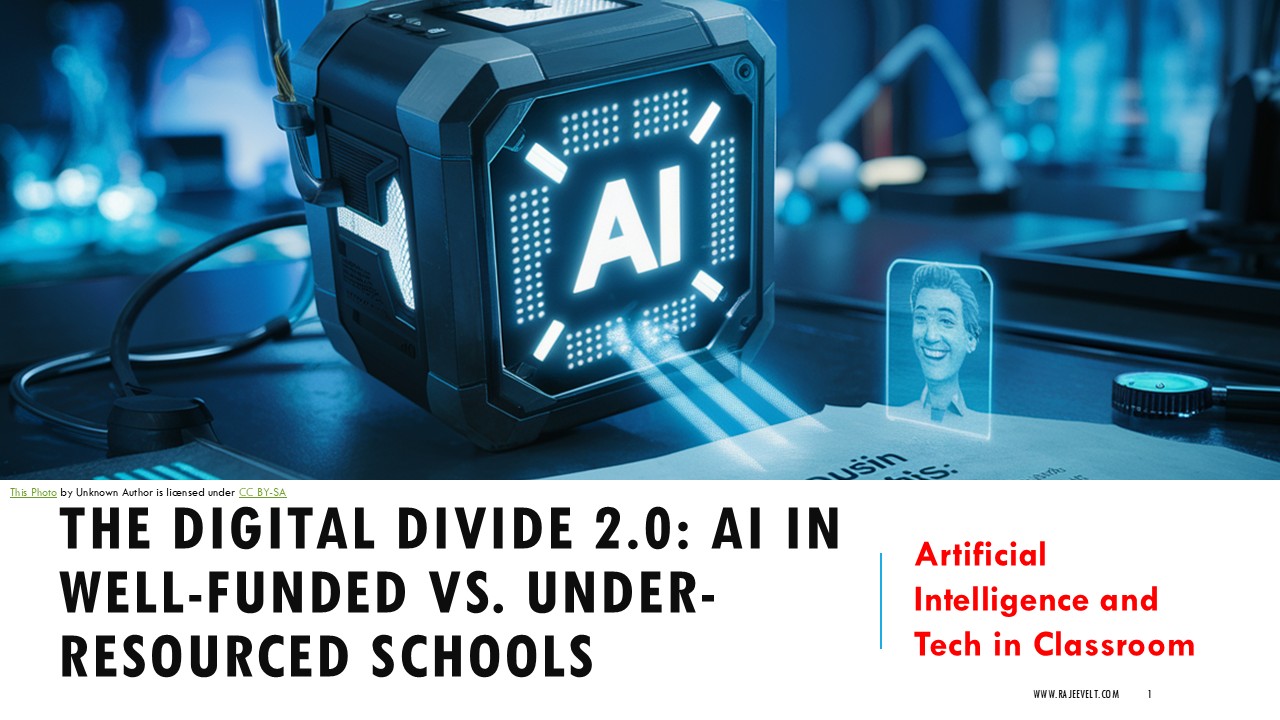
The Digital Divide 2.0: AI in Well-Funded vs. Under-Resourced Schools
How artificial intelligence adoption risks widening — or could help close — the gap between privileged and under-resourced schools worldwide
Introduction: A New Kind of Inequality
For two decades, “the digital divide” meant one thing: who had a computer and internet access, and who didn’t. Schools and policymakers spent years — and billions of dollars — closing that gap, wiring classrooms, distributing laptops, and extending broadband into rural and low-income communities. Just as that first digital divide seemed to be narrowing, a second, more complex one has opened up behind it: the AI divide.
This isn’t simply about who owns a device anymore. It’s about who has access to well-designed AI tools, who has teachers trained to use them effectively, who has the bandwidth to run them reliably, and who has a school system with the policy infrastructure to deploy them responsibly. Well-funded schools are moving quickly to integrate AI into personalized learning, tutoring, and administrative workflows. Under-resourced schools — serving many of the world’s most vulnerable students — risk being left further behind, not closer to catching up. We should understand this new divide, and what’s being done about it, matters for every parent, educator, and policymaker piloting the future of school education.
What Exactly is the “AI Divide”?
The AI divide describes the growing gap between schools and students who can access, understand, and meaningfully benefit from AI tools, and those who cannot. Researchers studying this emerging inequality describe it as an extension of the traditional digital divide: students from under-resourced schools, rural communities, and lower-income backgrounds often arrive with far less AI experience and exposure than their better-resourced peers, creating a compounding disadvantage before students even reach college or the workforce.
Crucially, this divide operates on several layers simultaneously:
- Access divide — whether a school has the devices, internet bandwidth, and licenses needed to use AI tools at all.
- Training divide — whether teachers have been trained to use AI tools effectively and responsibly.
- Use divide — even where devices exist, whether they’re being used to build genuine understanding or merely to complete tasks faster.
- Policy divide — whether a school or district has clear guidelines governing how AI should (and shouldn’t) be used.
The Numbers Behind the Gap
The scale of the underlying digital divide remains staggering. Globally, roughly 2.2 billion people remain offline despite near-universal mobile broadband coverage, and in the United States alone, around 24 million Americans lacked access to fixed broadband as of March 2024, concentrated in rural, Tribal, and historically underserved communities — often the very same communities served by underfunded school districts. Even where infrastructure exists on paper, it frequently falls short of what AI tools require: roughly a quarter of U.S. school districts still haven’t met the FCC’s minimum bandwidth benchmark of 1 Mbps per student, and 53% of middle and high school students cite slow or inconsistent in-school Wi-Fi as their number one obstacle to using technology — a rate that has actually worsened over the past decade rather than improved.
Layered on top of this infrastructure gap is a sharper, AI-specific disparity in adoption and training. Research from RAND found that high-poverty school districts are 53% less likely to have AI-trained teachers than their low-poverty counterparts — with 67% of low-poverty districts reporting trained teachers, compared to just 39% of high-poverty districts. A separate UK-focused analysis found that generative AI tools are used nearly twice as much for schoolwork in private schools compared to state schools, a gap researchers attribute directly to unequal access to digital hardware and unequal investment in formal AI training for both students and teachers. This matters because the same analysis notes AI-assisted learning has been linked to learning outcome improvements of around 6 percent — meaning students without reliable access aren’t just missing a convenience; they’re missing a measurable academic advantage their better-resourced peers are gaining.
India’s own numbers illustrate the pattern sharply. According to Department of School Education data for 2023-24, only 57.2% of schools in India had computers and 53.9% had internet access — figures that mark real progress from just a few years earlier, but that still fall well short of the baseline digital competence that AI education presumes. The gap becomes far starker once it’s broken down by geography: government data presented to the Lok Sabha shows internet access in rural schools trailing urban schools by roughly 29 percentage points, with only around 45% of rural schools having digital infrastructure compared to close to 69% of urban schools. Tele-density figures tell a similar story — as of March 2024, urban tele-density stood at 134% against just 59% in rural areas, a 75-point gap that shapes how reliably any AI tool can actually function in a rural classroom.
The consequences of this gap are not just theoretical. One study of over 2,500 Indian students found that only around 21% of rural students used a computer for academic purposes, compared to nearly 70% of urban students — a gap wide enough to mean AI-assisted learning is, for now, largely an urban and private-school phenomenon in India rather than a nationwide one. This is precisely the tension facing India’s push to make AI and computational thinking mandatory from Class 3 starting 2026-27: the ambition is national, but as one policy analysis put it, low digital literacy in rural areas is a significant roadblock since AI education presumes a baseline of digital competence among both teachers and students that a large share of India’s rural schools do not yet have. Encouragingly, the trend line is improving — UDISE+ data shows school internet connectivity rising from just 8% a decade ago to roughly 63-65% by 2024-25 — but the report behind those numbers also cautions that more than a third of Indian schools still lack computers, and wide disparities persist between states, meaning India’s AI education rollout will likely succeed unevenly across the country unless the rural-urban gap is addressed as deliberately as the curriculum itself.
Globally, the picture is starker still. Gender compounds the divide in many regions: UNESCO estimates that there are 244 million fewer women than men using the internet worldwide, a gap that limits access to digital learning, education, and job opportunities for girls and women disproportionately in low-income countries. The school-level infrastructure gaps remain severe in the world’s most populous developing nations — a key reason the United Nations, UNESCO, UNICEF, and partner governments launched a coordinated initiative aimed at closing digital learning gaps across the E9 countries (Bangladesh, Brazil, China, Egypt, India, Indonesia, Mexico, Nigeria, and Pakistan), which together account for a large share of the world’s school-age population.
Why Well-Funded Schools are Pulling Ahead
Private and well-resourced schools aren’t simply adopting AI faster because they’re more forward-thinking — they have structural advantages that compound over time:
1. Hardware and licensing budgets. AI tools, especially premium tutoring platforms and adaptive learning software, often come with per-student licensing costs. Wealthier schools can absorb these costs district-wide; under-resourced schools often can’t, even when the tools themselves are proven effective.
2. Dedicated IT and training staff. Rolling out AI responsibly requires ongoing technical support and professional development — resources that well-funded schools can dedicate to full-time staff, while under-resourced schools often rely on already-overstretched teachers to self-train.
3. Reliable connectivity. AI tools generally require stable, sufficient bandwidth to function well. Schools without infrastructure investment simply cannot run the same tools reliably, regardless of licensing.
4. Policy and legal capacity. Larger, better-funded districts are more likely to have dedicated staff who can develop AI usage policies, navigate data privacy requirements, and vet tools for safety and effectiveness — capacity that smaller and poorer districts frequently lack entirely.5. Family-level reinforcement. In well-resourced communities, students often have access to AI tools at home too, reinforcing classroom learning. Students in lower-income households are far less likely to have that same continuity between school and home.
The Risk: A Widening, Compounding Gap
What makes the AI divide particularly concerning is that it risks compounding faster than the original digital divide did. A device gap is relatively binary — you either have a laptop or you don’t. An AI capability gap is more insidious: two schools can both technically “have AI,” but one is using it for genuinely personalized, well-scaffolded instruction backed by trained teachers, while the other has a subscription nobody was trained to use effectively, or worse, a tool being used in ways that undermine learning rather than support it.
This creates a scenario where students in well-resourced schools develop stronger AI literacy, better critical-thinking habits around AI-assisted work, and faster academic gains — while students in under-resourced schools fall further behind not just academically, but in the foundational digital and AI fluency increasingly required for future employment. Left unaddressed, this dynamic doesn’t just preserve existing educational inequality — it actively accelerates it, turning a solvable infrastructure problem into a durable, self-reinforcing achievement gap.
There’s also a policy vacuum compounding the risk. Recent analysis found that most U.S. public schools still lack formal AI policies for students, even as adoption races ahead — meaning the schools with the least capacity to develop responsible guardrails are often the same ones least equipped to catch problems (plagiarism, over-reliance, data privacy issues) before they cause harm.
The Opportunity: AI as a Potential Equalizer
The same technology driving this divide also holds genuine potential to close it — if deployed deliberately rather than left to market forces alone. Several forces point toward this more optimistic possibility:
AI tutoring can substitute for expensive private tutoring. A student in a low-income community without access to paid tutors can, in principle, get real-time, personalized help from an AI tool at a fraction of the cost — something that was simply unavailable to previous generations of students in the same circumstances.
Low-bandwidth and offline-first solutions are emerging. Recognizing that many schools cannot rely on constant high-speed connectivity, organizations have developed lower-tech approaches to reach underserved classrooms. In Latin America and the Caribbean, for example, a joint initiative by GIZ, UNESCO, and UNICEF called the Future Teacher Kit uses WhatsApp — already widely available on basic smartphones — to deliver teacher training in Jamaica and Ecuador, helping educators build digital competencies without requiring expensive new infrastructure.
Global connectivity initiatives are targeting the hardest-to-reach schools first. UNICEF’s Giga initiative, launched in partnership with the International Telecommunication Union, aims to connect every school on Earth to the internet by 2030, with a deliberate focus on least-developed countries. The World Bank has committed more than $25 billion toward education technology investment, much of it aimed at closing exactly this kind of infrastructure gap in low- and middle-income countries.
Public-private partnerships are subsidizing access. A coalition including the ITU, Microsoft, Google, GSMA, and other partners came together to expand digital learning access globally during the COVID-19 pandemic — a model increasingly being revived for AI-specific access. Individual governments have taken direct action too: China provided computers, mobile data packages, and telecom subsidies to students from low-income families, while Italy funded an 85-million-euro grant to improve connectivity in isolated communities during remote learning disruptions.
Targeted equity programs are addressing compounding disadvantages. UNESCO’s work with Beijing Normal University in Ghana and Tanzania specifically targets the gender dimension of the AI and digital divide, training ICT teacher educators and directly supporting hundreds of girls to build digital confidence and skills — recognizing that closing the divide requires addressing overlapping barriers of income, geography, and gender simultaneously, not just one factor in isolation.
What Closing the Gap Actually Requires
Experts and international bodies studying this problem consistently point to the same conclusion: there is no single fix. We believe that meaningful progress requires coordinated action across several fronts simultaneously:
Infrastructure investment that reaches the last mile. Broadband funding programs need to prioritize the schools currently furthest behind, not simply the easiest to connect. In the U.S., this means school districts actually claiming available funding — many districts leave E-Rate infrastructure funding unused simply because they lack the administrative capacity to apply for it.
Teacher training as a non-negotiable, funded requirement. The gap in AI-trained teachers between high-poverty and low-poverty districts won’t close on its own. It requires dedicated funding for professional development specifically targeted at under-resourced schools, not just general technology grants that assume schools will self-train.
Low-cost and offline-capable tools by design. AI tools built assuming constant high-speed connectivity will always favour wealthy schools. Tools designed from the outset for low-bandwidth environments — like SMS- or WhatsApp-based training models — extend benefits to schools that would otherwise be excluded entirely.
Clear, funded AI policy at the district and national level. Districts need support — not just guidelines — to develop responsible AI usage policies, given that policy capacity itself is unevenly distributed and tends to track the same funding disparities as everything else.
Sustained, not one-time, funding. Emergency-era digital equity funding (like pandemic-era U.S. federal programs) is expiring, and only a small share of states report being prepared to sustain K-12 digital access without it. Genuine equity requires durable funding commitments, not one-off grants that leave schools stranded once initial investment cycles end.
Case in Point: Two Schools, Two Realities
Consider two hypotheticals but realistic classrooms. In a well-funded suburban school, a math teacher uses an adaptive AI platform that’s been fully integrated into the curriculum, supported by a trained instructional technology coordinator, running on reliable fiber-optic broadband, backed by a clear district AI policy that specifies what’s appropriate use and what isn’t. Struggling students get flagged early; advanced students get extension material automatically.
The same subject is taught in an under-resourced rural school two hours away, by a teacher managing 40 students with no dedicated tech support, spotty Wi-Fi that drops during peak usage hours, and no formal AI training beyond what she’s picked up from YouTube videos in her own time. A donated AI tool sits mostly unused because nobody has time to learn it properly, and there’s no district policy to guide even basic decisions about whether students should be allowed to use AI chatbots for homework help.
Both schools technically “have access to AI.” Only one is actually benefiting from it. This is the heart of the AI divide — and why simply distributing devices or licenses, without the surrounding ecosystem of training, connectivity, and policy support, will not close the gap on its own.
Conclusion: A Choice, Not an Inevitability
The AI divide in education isn’t a natural, unavoidable consequence of new technology — it’s the product of choices about where investment, training, and policy attention go. Left to market forces alone, AI adoption in schools will likely follow the same pattern as every previous educational technology wave: fastest and deepest in wealthy schools, slowest and shallowest in the schools serving the students who could benefit the most.
But the same tools driving this divide also carry real potential to narrow it, if governments, international organizations, and school systems treat equity as a design requirement rather than an afterthought. The evidence from initiatives already underway — from low-bandwidth teacher training in the Caribbean to global connectivity pushes aimed at the world’s least-connected schools — shows that closing this gap is genuinely possible. Whether it happens will depend less on how advanced AI in education becomes, and more on whether the world commits to making sure every student, regardless of their school’s zip code or budget, actually gets to benefit from it.
Frequently Asked Questions
What is the AI digital divide in education?
It’s the growing gap between schools and students who have full access to well-supported, effective AI tools and training, and those who lack the infrastructure, training, or policy support to benefit from AI in the same way.
How is the AI divide different from the traditional digital divide?
The traditional digital divide was primarily about device and internet access. The AI divide adds layers of teacher training, effective tool use, and policy support — meaning two schools can have equal device access but very different real-world AI benefits.
Which students are most affected by the AI divide?
Students in high-poverty, rural, and under-resourced school districts are most affected, along with girls in regions where cultural, economic, and mobility barriers compound existing access gaps.
Can AI help close educational inequality instead of widening it?
Yes, if deployed deliberately — through low-bandwidth tool design, subsidized access, targeted teacher training funding, and sustained (not one-time) infrastructure investment aimed specifically at under-resourced schools.
References:
- Shout Out UK. (2026, July 23). Is the AI ‘Digital Divide’ Exacerbating Education Inequality? https://www.shoutoutuk.org/2026/07/23/is-the-ai-digital-divide-exacerbating-education-inequality/
- The Network Installers. (2026). Digital Divide Statistics: The Numbers Behind the Gap (2026). https://thenetworkinstallers.com/blog/digital-divide-statistics/
- arXiv. (2026). Beyond Tool Adoption: A Practical Five-Stage Developmental Continuum for AI Literacy in Higher Education. https://arxiv.org/pdf/2606.00038
- Programs.com. (2026). The Latest AI in Education Statistics (2026). https://programs.com/resources/ai-education-statistics/
- AI Business Weekly. (2026). AI in Education Statistics 2026: Students, Teachers & Outcomes. https://aibusinessweekly.net/p/ai-education-statistics
- UNESCO. (2025). International Day of Digital Learning 2025: Closing Gaps with Technology. https://www.unesco.org/en/articles/international-day-digital-learning-2025-closing-gaps-technology
- UNESCO. (2026). Closing the Digital Divide for Women and Girls in Africa Through Education. https://www.unesco.org/en/gender-equality/education/digital-divide
- UNESCO. (2026). Closing the Digital Gender Divide Through Education: UNESCO’s Work in Ghana and the United Republic of Tanzania. https://www.unesco.org/en/articles/closing-digital-gender-divide-through-education-unescos-work-ghana-and-united-republic-tanzania
- UNESCO. Scaling Up Digital Learning and Skills in the World’s Most Populous Countries. https://www.unesco.org/en/articles/scaling-digital-learning-and-skills-worlds-most-populous-countries-drive-education-recovery
- GVMUN. (2025). Closing the Gap: Youth Education, the Digital Divide, and Digital Equity White Paper. https://www.gvmun.com/assets/reports/Digital%20Divide%20White%20Paper.pdf
- FHSMUN. UNESCO – Digital Equity in Education and Culture. https://www.fhsmun.org/wp-content/uploads/2025/01/UNESCO-Digital-Equity-in-Education-and-Culture-1.pdf
- Teachers Institute. (2026). Bridging the Knowledge and Digital Divide in Global Education. https://teachers.institute/higher-education/bridging-knowledge-digital-divide-education/
- Balrakshabharat.org. (2026). How Digital Classrooms Bridge Rural-Urban Divide India 2026. https://balrakshabharat.org/blog/digital-classrooms-bridging-rural-urban-education-divide-2026/
- Rau’s IAS. (2026). Growing Digital Divide in Indian Schools. https://compass.rauias.com/current-affairs/growing-digital-divide-indian-schools
- MediaNama. (2024). Rural Schools Lag 29% Behind Urban in Internet Access: Education Ministry Data. https://www.medianama.com/2024/11/223-29-per-cent-disparity-rural-urban-schools-internet-access-education-ministry-data/
- Policy Circle. (2026). AI Education Push: Can India Bridge the Digital Divide? https://www.policycircle.org/opinion/ai-education-in-india/
- Sampath Kumar, B.T., & Shiva Kumara, S.U. (2018). The Digital Divide in India: Use and Non-Use of ICT by Rural and Urban Students. https://www.researchgate.net/publication/323206661
- Tehelka. (2026). The Great Digital Divide: Two Indias Meet at the School Gates. https://tehelka.com/the-great-digital-divide-two-indias-meet-at-the-school-gates/